Per-unit covariance of ordination (latent) scores
Source:R/ordination-uncertainty.R
ordination_uncertainty.RdgetLV(se = TRUE) reports a standard error for every latent-score cell,
one axis at a time. ordination_uncertainty() reports the full covariance
of a unit's score VECTOR across its axes – the object needed to draw an
uncertainty ellipse (rather than an axis-aligned error bar) around a site
in an ordination biplot.
Arguments
- fit
A fitted multivariate model returned by
gllvmTMB(). Must be a native TMB fit withgllvmTMBcontrol(se = TRUE)(the default);engine = "julia"bridge fits,integration = "va"fits, andestimator = "mspl"fits are refused (see Details).- level
"unit"(between-unit,z_B) or"unit_obs"(within-unit,z_W). Deprecated aliases"B"and"W"are still accepted with a warning.
Value
NULL if the fit has no latent() term at the requested level
(matching extract_ordination()). Otherwise a list of class
"gllvmTMB_ordination_uncertainty":
scores– then x Kscore matrix (identical togetLV(fit, level), nativerotate = "none"orientation).se– ann x Kmatrix of per-(unit, axis) standard deviations;sqrt(diag(cov[, , s]))for rows, and numerically identical togetLV(fit, level, se = TRUE)$se.cov– aK x K x narray;cov[, , s]is units's latent-score covariance matrix, dimnamed by axis on the first two margins and by unit on the third.level– the canonical level name ("unit"/"unit_obs").
se and cov are filled with NA (with a warning) when the fit's
Hessian is not positive-definite, matching getLV(se = TRUE).
Estimand (read this before using the output)
Latent scores are random effects, not fixed parameters. What this
function returns is the model's best guess at how far each site's score
could plausibly have landed given (a) the data actually observed at that
site and (b) the package's uncertainty about the fitted parameters
(loadings, dispersion, etc.) – not a sampling-distribution standard
error of a fixed number, the way std.error on a regression coefficient
is. Two model fits refit on two different datasets would not be expected
to recover this quantity "on average" the way a coefficient SE is; it is
closer to a prediction interval than a confidence interval. Practically:
it answers "how sure is the model about THIS site's position on the
ordination plot," not "how much would the whole ordination move if I
recollected the data."
Concretely, it is the covariance of \(\mathbf u_s\) (site \(s\)'s
latent score vector) given the data and the fitted model, read off the
fit's joint (fixed effects + random effects) precision matrix
(TMB::sdreport(getJointPrecision = TRUE)), so it propagates the
package's uncertainty about the loadings and other fixed parameters into
the score covariance, not just the Laplace curvature at the fixed-effect
point estimate.
Rotation / identifiability
Scores are reported in gllvmTMB's native fitting orientation
(rotate = "none") only. That orientation is pinned by a structural
lower-triangular constraint on the loading matrix, which fixes the axes
up to a per-axis SIGN FLIP (a discrete choice), not a continuous
rotation. Per-axis variance (se) is unaffected by that sign choice.
The cross-axis covariance in cov is the one that belongs with the
returned scores from THIS fit, so an ellipse built from them is
correctly oriented for this fit's own biplot – but do not compare the
sign of a cross-axis entry, or of an axis, across independent (re)fits;
that sign is this fit's own arbitrary convention, exactly as in ordinary
PCA or factor analysis. Rotated scores (getLV(..., rotate = "varimax")
/ "promax") are not supported – the covariance's transform under a
post-hoc rotation is not implemented, matching getLV(se = TRUE)'s
existing rotate = "none"-only restriction.
What this is not
A Wald quantity read from asymptotic (delta-method / Laplace) theory, not
a resampled, profiled, or simulation-based interval. Its repeated
-sampling coverage has not been measured for this function; se and
cov are reported as-is, with no lower/upper bound, so that no
unmeasured coverage claim is implied by the return shape (the same
choice getLV(se = TRUE) already makes). A confidence ellipse built from
cov at some nominal level (e.g. via stats::qchisq(level, df = 2)) is
a standard asymptotic-normal construction, not a certified interval.
See also
getLV() for the marginal per-cell standard error this
function generalises to a full per-unit covariance;
ordiplot()'s ellipse argument, which draws the covariance this
function returns.
Examples
set.seed(1)
# Simulate six traits, each measured twice on 100 units (e.g. sites),
# driven by two latent axes plus trait-specific variation.
Lambda <- cbind(c(0.7, 1.0, 0.9, 0.0, 0.0, 0.0),
                c(0.7, 0.0, 0.0, 1.0, 0.9, 0.8))
sim <- simulate_unit_trait(n_units = 100, n_obs_per_unit = 2,
                           n_traits = 6, Lambda_B = Lambda,
                           psi_B = 0.4, sigma2_eps = 0.3)
fit <- gllvmTMB(value ~ 0 + trait +
                  latent(0 + trait | unit, d = 2, unique = TRUE),
                data = sim$data, trait = "trait", unit = "unit")

# Score uncertainty for every unit on both latent axes.
u <- ordination_uncertainty(fit, level = "unit")
u
#> <gllvmTMB ordination score uncertainty: level = "unit", 100 units, 2 axes>
#> Estimand: conditional (posterior) covariance of each unit's latent
#> score given the data and the fitted parameters -- a random-effect
#> prediction uncertainty, NOT a sampling-distribution SE of a fixed
#> quantity. Native (rotate = "none") orientation; per-axis SD is
#> sign-invariant, cross-axis covariance sign is this fit's own
#> convention. Coverage is unmeasured for any interval built from this.
#> $scores, $se: n x K matrices. $cov: K x K x n array.
# Uncertainty (standard deviation) of each unit's score on each axis,
# for the first six units.
head(round(u$se, 3))
#>     LV1   LV2
#> 1 0.425 0.473
#> 2 0.438 0.514
#> 3 0.433 0.510
#> 4 0.445 0.490
#> 5 0.474 0.539
#> 6 0.431 0.496
# Unit 1's 2 x 2 score covariance: the squares of those values on the
# diagonal; the off-diagonal term sets the tilt of its ellipse.
round(u$cov[, , 1], 4)
#>        LV1    LV2
#> LV1 0.1804 0.0109
#> LV2 0.0109 0.2242
# These are the same numbers getLV(se = TRUE) gives, one axis at a time.
all.equal(u$se, getLV(fit, "unit", se = TRUE)$se)
#> [1] TRUE
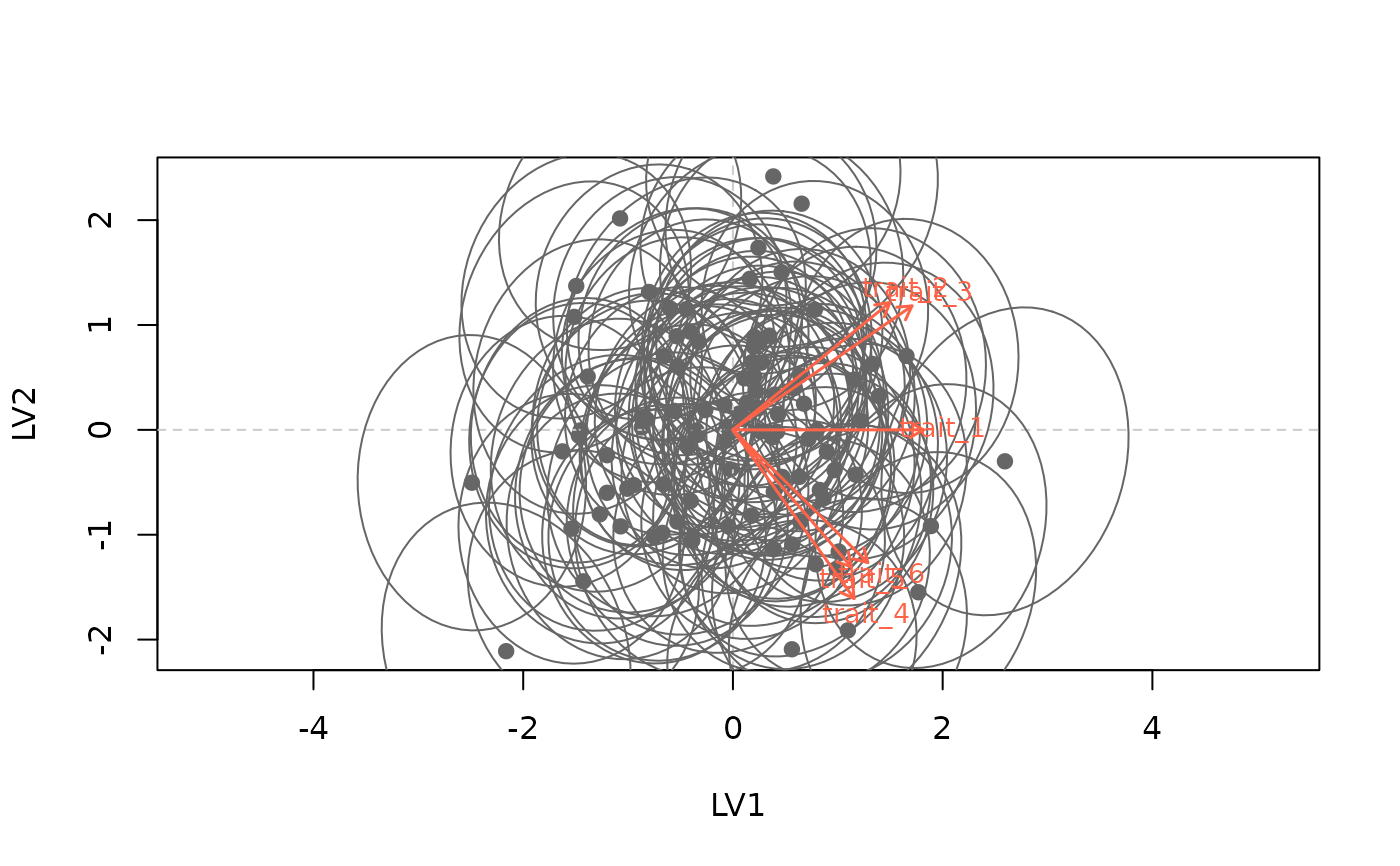
# Ordination plot with an approximate 95% ellipse around every unit.
# Each unit is scored from only six traits, so its position is
# uncertain: the ellipses are wide and overlap.
ordiplot(fit, level = "unit", ellipse = TRUE)
#> ℹ `Lambda_B` is identified only up to rotation (d_B = 2).
#> • Use `rotate = "varimax"` for a quick rotation after fitting, or
#> • see `suggest_lambda_constraint()` for a default `lambda_constraint` matrix to
#>   pass to a refit.
#> • `extract_Sigma_B()` is rotation-invariant and does not need this.