
Joint species distribution models for binary occurrence data
Source:vignettes/articles/joint-sdm.Rmd
joint-sdm.RmdAfter an environmental gradient is in the model, which species still tend to occur together, and which species avoid each other? That is the first joint species distribution model (JSDM) question this page answers.
The data are binary occurrence records: one row per site, one column
or trait per species, and a 0/1 response for absence/presence. The model
uses latent() to estimate a low-rank residual co-occurrence
structure across species after env_1 is accounted for.
This example uses a binomial-logit model with
latent(0 + trait | site, d = K) for residual co-occurrence.
It fits the model, checks its numerical health, and then interprets the
residual species correlations. The equivalent wide
traits(...) formula comes after that first workflow.
Single-species spatial SDMs belong in sdmTMB. Multivariate
spatial fields via spatial_*() are beyond the scope of this
introductory JSDM example and have a separate worked spatial-model guide.
Load and fit
The article uses a shipped teaching data set: 120 sites, eight
species, and an environmental covariate env_1 with
species-specific responses. Every site-by-species cell is an observed
absence or presence. The data were made for teaching, so the fitted
associations are an example of interpretation, not a claim about a real
community.
jsdm_path <- system.file(
  "extdata", "examples", "joint-sdm-example.rds",
  package = "gllvmTMB"
)
if (!nzchar(jsdm_path)) {
  stop("Could not find joint-sdm-example.rds.")
}
jsdm <- readRDS(jsdm_path)

df <- jsdm$data_long
df_wide <- jsdm$data_wide
The same JSDM fits in both long format and the
traits(...) wide format. The long form is shown first; the
wide form is the formula-API equivalent on a pivoted data frame. Both
reach the same engine.
# Long format -- one row per (site, species) observation
fit_jsdm <- gllvmTMB(
  value ~ 0 + trait + (0 + trait):env_1 +
    latent(0 + trait | site, d = 2),
  data   = df,
  trait  = "trait",
  unit   = "site",
  family = binomial()
)
fit_jsdm
#> Stacked-trait gllvmTMB fit
#>   Traits = 8, site = 120
#>   Covstructs: latent_unit, indep_unit
#>   Fixed effects (b_fix): 16
#>   ML log L = -615.301   convergence = 0   engine = Laplace
#>   Note: Lambda_B identified up to rotation (use suggest_lambda_constraint() or rotate_loadings()).
#>   Run gllvmTMB_diagnose(fit) for a full health check, or summary(fit) for parameter estimates.
The printed summary confirms one intercept and one env_1
slope per species, plus a rank-2 latent term. Before interpreting any
association, inspect the fit-health table rather than relying on the
optimizer code alone:
health <- check_gllvmTMB(fit_jsdm)
health[health$component %in% c("optimizer_convergence", "pd_hessian"), ]
#>               component status value threshold
#> 1 optimizer_convergence   PASS     0         0
#> 4            pd_hessian   PASS  TRUE      TRUE
#>                                                   message
#> 1                          optimizer reported convergence
#> 4 positive-definite Hessian for curvature-based inference
#>                                                                             action
#> 1     try multiple starts, stronger starts, rescaling, or an alternative optimizer
#> 4 check gradients, boundary variances, rank, starts, and profile/bootstrap targets
Both rows should pass before you use the correlations below. If either one does not, stop here and follow Fit diagnostics.
# Wide format -- one row per site, one column per species. The
# `traits(...)` LHS names the species columns; the compact RHS
# shorthand uses `1 + env_1`, which expands internally to
# `0 + trait + (0 + trait):env_1`.
fit_jsdm_wide <- gllvmTMB(
  traits(sp_1, sp_2, sp_3, sp_4, sp_5, sp_6, sp_7, sp_8) ~
    1 + env_1 + latent(1 | site, d = 2),
  data   = df_wide,
  unit   = "site",
  family = binomial()
)
all.equal(logLik(fit_jsdm), logLik(fit_jsdm_wide), tolerance = 1e-8)
#> [1] TRUE
Long or wide data shape
JSDM is the package’s natural long-format use case because each row
already carries (site, species) and the response factor
trait indexes species. When the data already live as one
row per site and one binary column per species, the
traits(...) wide form is the same model through the same
gllvmTMB() entry point. In either shape, true absences
should be explicit zeros. Missing response cells are not a safe shortcut
for absences, because missingness can also mean the site or species was
not surveyed.
What latent() estimates
For binary occurrence data with a logit link, the fitted linear predictor is
The site score is the unobserved residual state of site , and the species loading says how species responds to those residual axes. The rotation of is arbitrary, so the stable co-occurrence target is the species covariance implied by the loadings. For this single-trial Bernoulli example, each species-site cell contributes one binary observation. The default between-site diagonal companion is therefore not separately identified from the link scale and the engine maps it off:
For a binary logit JSDM, correlations are easier to interpret on the
latent-liability scale.
extract_correlations(link_residual = "auto") adds the fixed
logistic residual variance
to the diagonal:
The logistic residual term is fixed by the binomial logit link, not
estimated from the data. By default, latent() also
estimates a separate residual variance per species (the diagonal
companion). Here that term is switched off automatically. With a single
0/1 trial per (species, site) cell there is not enough information to
separate a per-species variance from the fixed logistic residual
variance already built into the link. Multi-trial binomial data
(cbind(successes, failures) or
weights = n_trials) can identify that diagonal, and an
explicit indep() term is a separate deliberate choice; both
are different designs and should not be inferred from this occurrence
matrix.
Where loading constraints fit
The loading matrix is usually exploratory in a JSDM: its rotation is arbitrary, while is the interpretable co-occurrence target. If you have an a-priori hypothesis that a species group defines an axis, or that a species should have zero loading on an axis, that is a confirmatory loading question rather than the default species-distribution workflow.
gllvmTMB supports that confirmatory path with
lambda_constraint = list(unit = M), where NA
means “estimate this loading” and a number means “pin this loading
during fitting.” Numeric pins are exact model restrictions: because the
latent scores have unit variance, a loading pinned to 1 is
assumed to equal one; it is not a cosmetic sign convention. The current
route acts on the packed lower-triangular loading matrix, so it is not a
general free-form confirmatory-factor interface.
Specify a biological loading hypothesis before inspecting this fitted loading matrix, verify that the matrix rows follow the response order, and stop if the constrained fit is unhealthy. A matrix suggested from the same data can provide a reproducible descriptive orientation, but it remains exploratory and does not turn selected zeros into biological facts. This guide therefore keeps correlations and as its interpretation targets.
Latent-scale residual species correlations
Pairwise species correlations on the latent-liability scale. The
opt-in method = "fisher-z" gives Fisher-transform heuristic
bounds that are fast (seconds) and bounded inside
by construction. method = "wald" is an accepted alias for
the same Fisher-z path. A heavier alternative is also available:
method = "bootstrap" re-fits the model under a parametric
bootstrap for a full sampling-distribution CI.
One scale caveat is worth stating up front, because it trips people
up on binary fits. The default link_residual = "auto" puts
the correlation on the latent-liability scale — it adds
the fixed logistic residual
to the diagonal of
before forming the correlation, which is the interpretable co-occurrence
quantity for a JSDM. fisher-z, wald, and
bootstrap all honour that argument.
What is and is not certified: the point estimates and Fisher-z bounds are useful diagnostics for this fitted example, but the package-wide calibrated-coverage work is still open. Treat intervals here as model-based uncertainty summaries, not as a claim that every binary or mixed-family covariance interval has reached nominal coverage.
corr_rows <- extract_correlations(
  fit_jsdm,
  tier = "unit",
  method = "fisher-z",
  link_residual = "auto"
)
corr_rows
#>    tier trait_i trait_j  correlation       lower       upper   method
#> 1  unit    sp_1    sp_2  0.153567479 -0.02640055  0.32389344 fisher-z
#> 2  unit    sp_1    sp_3  0.128582423 -0.05185401  0.30088909 fisher-z
#> 3  unit    sp_2    sp_3  0.018409950 -0.16136386  0.19700122 fisher-z
#> 4  unit    sp_1    sp_4 -0.038163215 -0.21592752  0.14204981 fisher-z
#> 5  unit    sp_2    sp_4 -0.093745666 -0.26847578  0.08695682 fisher-z
#> 6  unit    sp_3    sp_4  0.153510534 -0.02645883  0.32384124 fisher-z
#> 7  unit    sp_1    sp_5 -0.028935603 -0.20710281  0.15108935 fisher-z
#> 8  unit    sp_2    sp_5  0.072345015 -0.10830068  0.24836574 fisher-z
#> 9  unit    sp_3    sp_5 -0.288719854 -0.44493554 -0.11545328 fisher-z
#> 10 unit    sp_4    sp_5 -0.197535659 -0.36389281 -0.01896584 fisher-z
#> 11 unit    sp_1    sp_6 -0.115384502 -0.28865595  0.06520539 fisher-z
#> 12 unit    sp_2    sp_6 -0.044903816 -0.22235550  0.13542753 fisher-z
#> 13 unit    sp_3    sp_6 -0.209621591 -0.37478133 -0.03156629 fisher-z
#> 14 unit    sp_4    sp_6 -0.077270717 -0.25300787  0.10340276 fisher-z
#> 15 unit    sp_5    sp_6  0.168024394 -0.01156525  0.33711293 fisher-z
#> 16 unit    sp_1    sp_7 -0.140539423 -0.31192327  0.03970203 fisher-z
#> 17 unit    sp_2    sp_7 -0.164260640 -0.33367774  0.01543515 fisher-z
#> 18 unit    sp_3    sp_7  0.054161547 -0.12630597  0.23115880 fisher-z
#> 19 unit    sp_4    sp_7  0.139363873 -0.04089912  0.31084049 fisher-z
#> 20 unit    sp_5    sp_7 -0.146861900 -0.31773916  0.03325483 fisher-z
#> 21 unit    sp_6    sp_7  0.001373018 -0.17791211  0.18056992 fisher-z
#> 22 unit    sp_1    sp_8 -0.202899443 -0.36873079 -0.02455097 fisher-z
#> 23 unit    sp_2    sp_8 -0.201160207 -0.36716303 -0.02273874 fisher-z
#> 24 unit    sp_3    sp_8 -0.023451586 -0.20184447  0.15644738 fisher-z
#> 25 unit    sp_4    sp_8  0.124518626 -0.05597194  0.29712839 fisher-z
#> 26 unit    sp_5    sp_8 -0.096575960 -0.27112403  0.08412156 fisher-z
#> 27 unit    sp_6    sp_8  0.058840718 -0.12168398  0.23559729 fisher-z
#> 28 unit    sp_7    sp_8  0.217571467  0.03988558  0.38191881 fisher-z
#>          interval_status
#> 1  heuristic_unvalidated
#> 2  heuristic_unvalidated
#> 3  heuristic_unvalidated
#> 4  heuristic_unvalidated
#> 5  heuristic_unvalidated
#> 6  heuristic_unvalidated
#> 7  heuristic_unvalidated
#> 8  heuristic_unvalidated
#> 9  heuristic_unvalidated
#> 10 heuristic_unvalidated
#> 11 heuristic_unvalidated
#> 12 heuristic_unvalidated
#> 13 heuristic_unvalidated
#> 14 heuristic_unvalidated
#> 15 heuristic_unvalidated
#> 16 heuristic_unvalidated
#> 17 heuristic_unvalidated
#> 18 heuristic_unvalidated
#> 19 heuristic_unvalidated
#> 20 heuristic_unvalidated
#> 21 heuristic_unvalidated
#> 22 heuristic_unvalidated
#> 23 heuristic_unvalidated
#> 24 heuristic_unvalidated
#> 25 heuristic_unvalidated
#> 26 heuristic_unvalidated
#> 27 heuristic_unvalidated
#> 28 heuristic_unvalidated
The matrix view below shows the same point estimates as a
species-by-species map. For a binary JSDM, the useful first picture is
the latent-liability correlation pattern after adding
the fixed logistic link residual to the denominator; raw
entries can be dominated by loading scale and are harder to interpret.
The Fisher-z interval bounds stay in corr_rows rather than
being printed inside every matrix cell.
plot_correlations(
  corr_rows,
  style = "heatmap",
  matrix_layout = "by_level",
  label_type = "estimate",
  label_digits = 2,
  include_diagonal = TRUE,
  title = "Residual species correlations",
  subtitle = "Latent-liability correlations after accounting for env_1."
)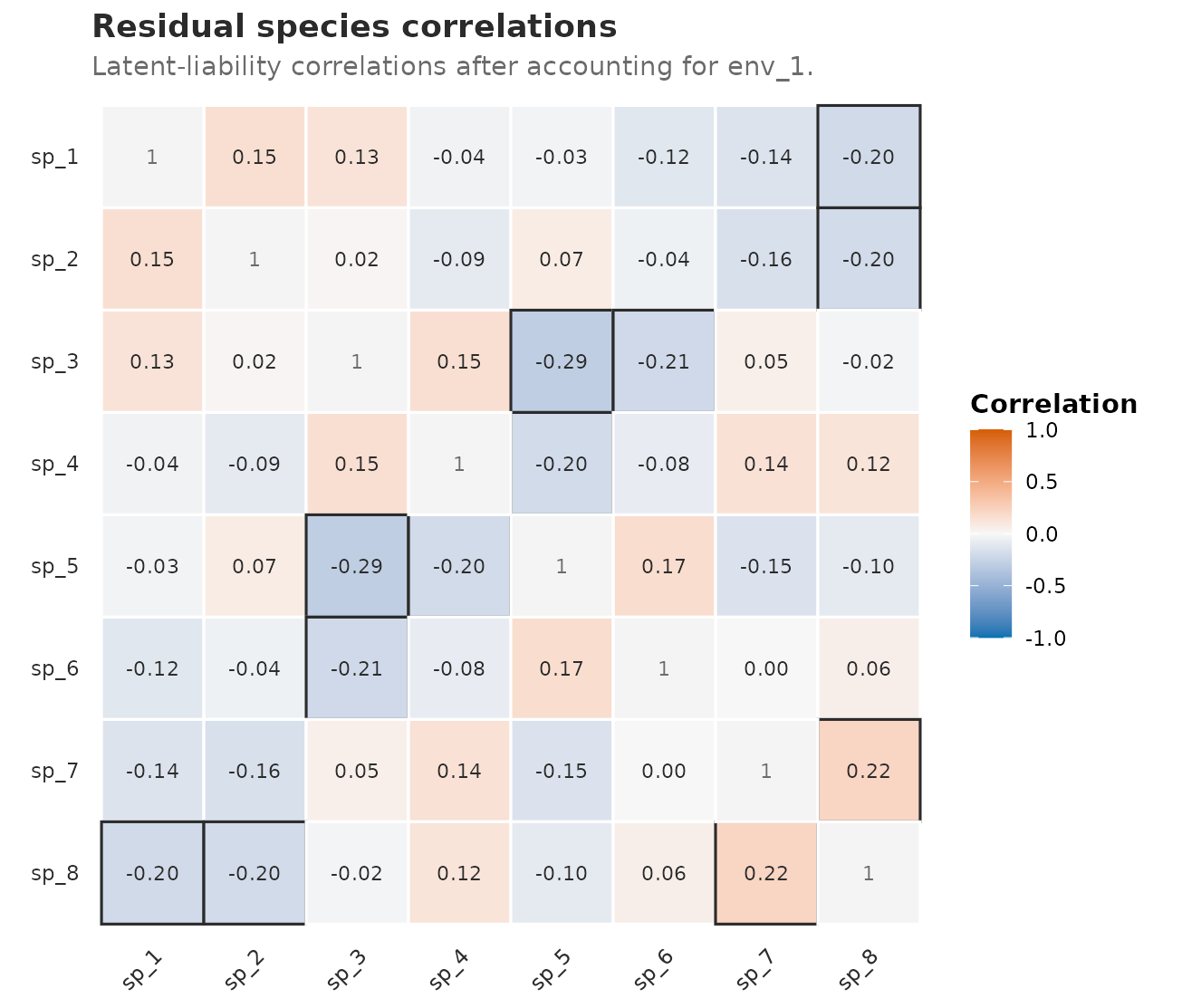
Residual species correlations from the fitted binary JSDM. Cells show Fisher-z point estimates on the latent-liability scale after accounting for env_1 and the fixed logistic link residual; interval bounds are available in the preceding table.
Black cell outlines mark pairs whose supplied interval excludes zero — a significance cue inherited from the Fisher-z bounds, and it carries the same coverage caveat as the intervals themselves. Use these correlations, rather than the signs of individual loadings, for the rotation-invariant co-occurrence story.
Confidence intervals on the binary latent scale
This section works through the available CI methods on two estimands — a pairwise species correlation and a per-species ICC — to show what each method returns and where it currently stops short. These chunks are optional because the bootstrap path re-fits the model; run them when the interval method itself is the question, not for a first pass through the article.
Two CI methods for one correlation
Take a single species pair (sp_1, sp_2) and
ask for the same correlation three ways. Keeping
link_residual = "auto" for the Fisher-z and bootstrap calls
holds them on the latent-liability scale, so their point estimates agree
and only the interval differs:
pair_ij <- c("sp_1", "sp_2")

cor_fisher <- extract_correlations(
  fit_jsdm, tier = "unit", pair = pair_ij,
  method = "fisher-z", link_residual = "auto"
)
cor_boot <- extract_correlations(
  fit_jsdm, tier = "unit", pair = pair_ij,
  method = "bootstrap", nsim = 20, seed = 1, link_residual = "auto"
)
rbind(cor_fisher, cor_boot)[, c("trait_i", "trait_j",
                                "correlation", "lower", "upper", "method")]
The Fisher-z and bootstrap point estimates match because both add the logistic residual to the diagonal; the bootstrap interval is the empirical 2.5/97.5 percentile across the refits.
Nonlinear profile intervals for correlations are not currently
available: the penalty-based constrained-refit prototype has been
withdrawn pending an exact constraint solver and calibration evidence.
Requesting method = "profile" raises an error.
For the interpretable JSDM co-occurrence story, prefer the
latent-liability scale (auto), and use Fisher-z for speed
or the bootstrap when you want an empirical sampling-distribution
interval.
ICC (communality) on the latent scale
For a single-trial binary JSDM, the natural communality quantity is the share of each species’ latent-liability variance represented by the shared factors rather than the fixed logistic residual:
The unit-level latent() term estimates the shared
loading covariance, and link_residual = "auto" adds the
fixed logistic residual variance
,
so
extract_communality(level = "unit", link_residual = "auto")
returns exactly this ratio — the proportion of the latent-liability
variance that the shared factors explain.
This is a different quantity from the package’s
extract_repeatability() and extract_ICC_site()
functions, which split variance into between-site and within-site
components. A single-trial occurrence matrix has only one observation
per site per species — there is no repeat visit to split — so those
functions do not apply to this fit.
icc_point <- extract_communality(
  fit_jsdm, level = "unit", link_residual = "auto"
)
round(icc_point, 3)
#>  sp_1  sp_2  sp_3  sp_4  sp_5  sp_6  sp_7  sp_8
#> 0.193 0.152 0.323 0.143 0.310 0.143 0.195 0.266
A parametric bootstrap puts an interval on each species’ ICC:
icc_boot <- extract_communality(
  fit_jsdm, level = "unit", link_residual = "auto",
  ci = TRUE, method = "bootstrap", nsim = 20, seed = 1
)
icc_boot[, c("trait", "c2", "lower", "upper", "method")]
The intervals are wide — eight species and 120 sites is modest information for a per-species variance share, and the upper bounds for the more strongly-loading species run close to 1.
One limitation applies to the ICC interval in this example:
-
Profile bounds are not available. The penalty-based
constrained-refit prototype has been withdrawn pending an exact
constraint solver and calibration evidence, so
method = "profile"raises an error rather than returning a bound. The defaultmethod = "wald"andmethod = "bootstrap"both return intervals; report which one you used, and read the caveat below.
The point estimates are available, but interval coverage on binary and mixed-family scales has not been established. Report the point estimate and the interval method used; do not present these intervals as coverage-certified.
Ordination biplot
Site scores on the two latent variables (LV1, LV2), with species
loadings shown as arrows. This is model-based ordination: LV1
and LV2 are the latent variables of a fitted GLLVM, estimated jointly
with the env_1 regression — not a variance-maximising PCA,
a distance-based NMDS embedding, or a covariate-constrained CCA/RDA of
the raw occurrence matrix. The plotted site scores are predicted
(empirical-Bayes) conditional modes of the residual site states
:
shrunk toward zero, and carrying prediction uncertainty the point
display does not show. The rotation-invariant interpretation target is
the model-implied residual co-occurrence
(defined above), not the axis coordinates themselves — species loading
in the same direction tend to co-occur after env_1 is
accounted for.
plot(
  fit_jsdm,
  type = "ordination",
  level = "unit",
  rotation = "varimax",
  sign_anchor = "auto",
  standardize_loadings = TRUE
) +
  ggplot2::labs(
    title = "Residual species ordination",
    subtitle = "Varimax-rotated site scores and species loading directions."
  )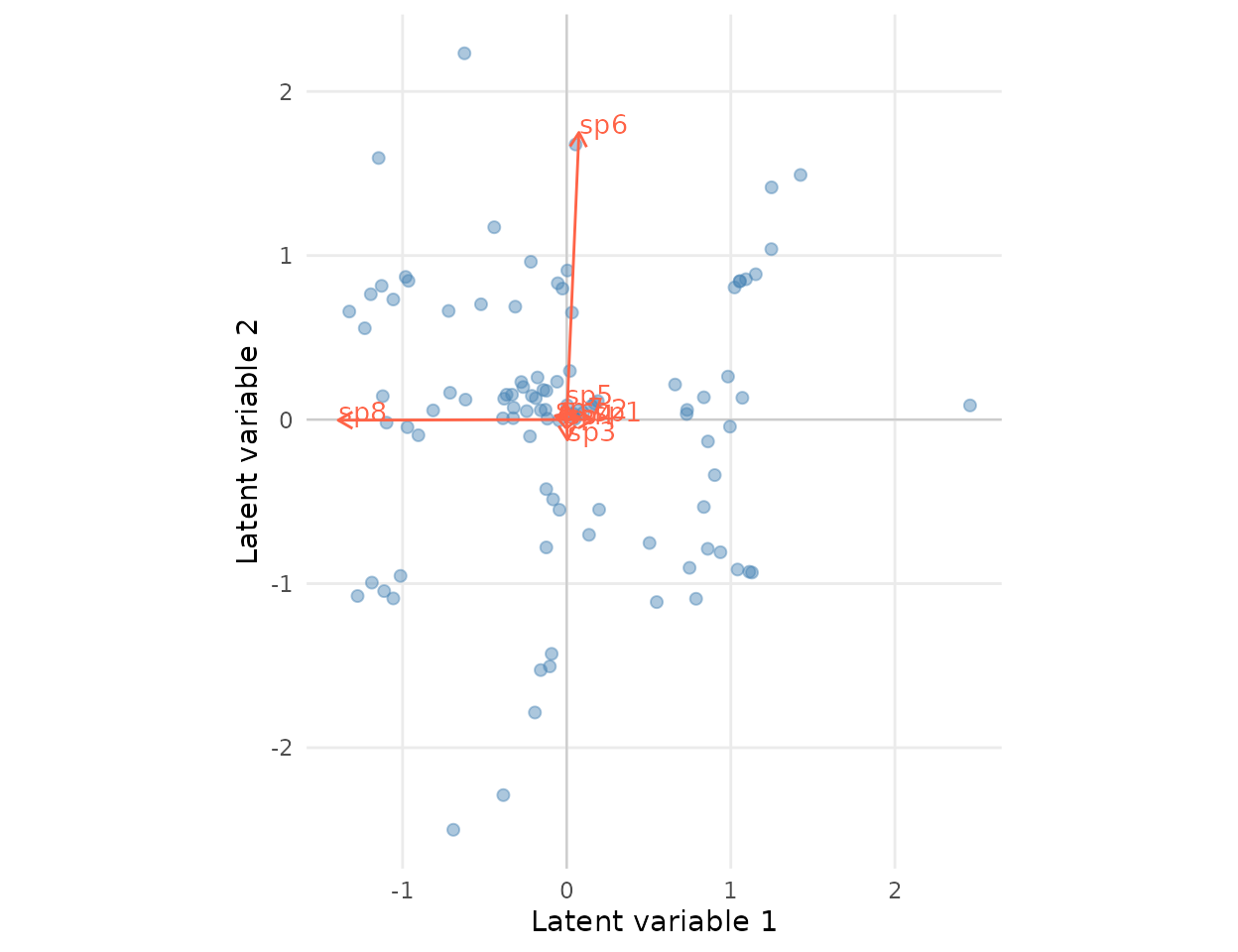
Ordination biplot from the fitted binary JSDM, using varimax-rotated and sign-anchored site scores and species loadings. Arrow lengths are display-scaled for visibility and are not on the site-score axis scale. Loading orientation and sign are not identifiable; the model-implied Sigma and correlations remain the rotation-invariant interpretation target.
In this simulated example, the eight species belong to four
association groups: sp_1 / sp_2,
sp_3 / sp_4, sp_5 /
sp_6, and sp_7 / sp_8. The fitted
arrows should be read for broad grouping, not axis labels. The exact
orientation is arbitrary — only
is identifiable. Species arrows pointing in the same direction co-occur
after env_1 is accounted for; arrows pointing in opposite
directions tend to mutually exclude.
See also
- Joint ecological intensity from opportunistic records — the relative-intensity, point-process framing of the same joint machinery, and the opener of the Species Distribution Models series.
-
Morphometrics — Gaussian
stacked-trait analogue with ordinary
latent(). -
Choosing latent rank
— how to compare candidate values of
d. -
Explore loading
constraints — a reproducible lower-triangular
suggest_lambda_constraint()workflow. It is an exploratory orientation, not confirmatory evidence. -
?confirmatory_lambdadocuments the separate advanced API for a prespecified loading hypothesis. -
vignette("response-families")— full table of supported families and the per-family .
References
- Niku, J., Warton, D.I., Hui, F.K.C., & Taskinen, S. (2017). Generalized linear latent variable models for multivariate count and biomass data in ecology. Journal of Agricultural, Biological, and Environmental Statistics 22, 498–522. https://link.springer.com/article/10.1007/s13253-017-0304-7
- Niku, J., Hui, F.K.C., Taskinen, S., & Warton, D.I. (2019). gllvm: Fast analysis of multivariate abundance data with generalized linear latent variable models in r. Methods in Ecology and Evolution 10, 2173–2182. https://doi.org/10.1111/2041-210X.13303
- Nakagawa, S., & Schielzeth, H. (2010). Repeatability for Gaussian and non-Gaussian data: a practical guide for biologists. Biological Reviews 85, 935–956. https://doi.org/10.1111/j.1469-185X.2010.00141.x
- Nakagawa, S., Johnson, P.C.D., & Schielzeth, H. (2017). The coefficient of determination R² and intra-class correlation coefficient from generalized linear mixed-effects models revisited and expanded. Journal of the Royal Society Interface 14,
- Warton, D.I., Blanchet, F.G., O’Hara, R.B., Ovaskainen, O., Taskinen, S., Walker, S.C., & Hui, F.K.C. (2015). So many variables: joint modeling in community ecology. Trends in Ecology & Evolution 30, 766–779. https://doi.org/10.1016/j.tree.2015.09.007