
Returns the implied cross-trait correlations from a fit returned by
gllvmTMB() at one or more covariance levels. Use the canonical input
names "unit", "unit_obs", "phy", and
"spatial"; legacy aliases "B", "W", and
"spde" still work. The helper returns point estimates only by
default, with no confidence level. Fisher-z and bootstrap intervals can be
requested explicitly with the method argument; the former profile
token is retained only to return a clear withdrawal error:
Arguments
- fit
A fit returned by
gllvmTMB. Julia bridge (engine = "julia") fits expose the ordinary unit tier only and carry no correlation-interval payload. Their off-diagonal rows havelowerandupperset toNA,method = "none", andinterval_status = "none". Withentries = "all", self-pairs instead havemethod = "fixed". Useengine = "tmb"when you need correlation confidence intervals.- tier
Character vector. Use
"all"(the default) to request every level present in the fit. Canonical inputs are"unit","unit_obs","phy", and"spatial"; legacy aliases"B","W", and"spde"are accepted.- pair
Optional length-2 character or integer vector specifying one trait pair (
c("trait_1", "trait_2")orc(1, 2)). When supplied, only that pair is returned for each requested tier. Numeric indices must be finite, distinct whole numbers within the trait range; fractional indices are rejected. DefaultNULL(all pairs).- level
Confidence level in (0, 1). Default 0.95.
- method
One of
"none"(default),"fisher-z","wald"(alias of"fisher-z"), or"bootstrap". The accepted"profile"token is withdrawn and stops with an explanation. See Details.- n_eff
Optional positive integer (>= 4): override the effective sample size used in Fisher's \(\widehat{\mathrm{SE}}(\hat z) = 1/\sqrt{n_{\text{eff}} - 3}\) formula. This is a user-supplied sensitivity parameter, not an estimated effective sample size. It is consulted for
method %in% c("fisher-z", "wald")and for explicit Wald fallback rows when a requested bootstrap tier is not yet routed. The default heuristic usesfit$n_sitesfor tier"B"("unit"),fit$n_site_speciesfor"W"("unit_obs"),fit$n_speciesfor"phy", andfit$n_siteselsewhere. These counts are only transparent heuristics: grouped, phylogenetic, spatial, latent, and non-Gaussian structure can make the iid Fisher variance inappropriate. If the automatic tier count is missing or below 4, Fisher-z rows return point correlations with unavailable interval bounds rather than substituting an arbitrary sample size. Setn_effonly when the analysis supplies a defensible target-specific rationale, and report that rationale.- nsim
Number of bootstrap replicates when
method = "bootstrap". Default 500.- seed
Optional RNG seed for the bootstrap.
- link_residual
How to treat the family-specific link-residual variance on the diagonal of the implied \(\boldsymbol\Sigma\) before computing correlations:
"auto"(default)For non-Gaussian fits, add the link-specific implicit residual (e.g. \(\pi^2/3\) for binomial-logit; \(1\) for probit;
trigamma()terms for Gamma / NB2 / Beta / etc.) to the diagonal before computing correlations. Returned correlations are on the latent-liability scale; this is the convention most readers expect. Gaussian fits are unaffected (link residual is \(0\))."none"Use the fitted model-implied \(\Sigma\) directly with no link-residual addition. For ordinary
latent()fits this includes the default diagonal Psi companion; correlations come out on the model-implied scale without the family adjustment.
Behaviour change in this release: the previous version hardcoded
link_residual = "none". Non-Gaussian callers who relied on that behaviour will see different correlation values under the new default. A one-shot warning fires the first time per session that a non-Gaussian fit is processed without an explicitlink_residualargument. Passlink_residual = "auto"to suppress the warning and lock the new behaviour, orlink_residual = "none"to restore the previous behaviour.- entries
Table layout.
"unique"(default) returns each unordered pair once, without the diagonal."offdiag"includes both directions, without the diagonal."all"includes both directions and the diagonal. A single tier with p traits has p(p-1)/2, p(p-1), or p squared rows, respectively. Non-unique layouts cannot be combined withpair.
Value
A data frame (tibble-like) with columns:
tierCharacter level label. The current output stores internal labels
"B","W","phy", and"spde"; use"unit"and"unit_obs"as input names in new calls.trait_i,trait_jTrait names. The default unique layout has i < j in fitted trait order.
correlationPoint estimate.
lower,upperConfidence-interval bounds.
methodMethod used to compute the CI.
interval_statusClaim-boundary marker:
"none"for point-only output,"heuristic_unvalidated"for Fisher-z/Wald bounds, and"target_specific_uncalibrated"for bootstrap bounds. The bootstrap route computes intervals, but this function does not certify their frequentist coverage for the fitted target.
Details
"none"(default): point correlations only. No universal interval calibration has been established across covariance tiers, families, and targets."fisher-z": Fisher's z-transform heuristic interval. Computes \(\hat z = \mathrm{atanh}(\hat\rho)\), \(\widehat{\mathrm{SE}}(\hat z) = 1/\sqrt{n_{\text{eff}} - 3}\), constructs the CI on z, then back-transforms via \(\tanh(\cdot)\) (so bounds are guaranteed inside \([-1, 1]\)). Fast (seconds for any T), but the classical iid-correlation variance is not a calibrated mixed-model standard error. Treat these bounds as a sensitivity display and seen_eff."profile": withdrawn. The nonlinear penalty-profile prototype did not yet provide a sufficiently strict constraint and constrained-optimizer diagnostic contract. This token stops with an explanation rather than returning bounds."wald": backward-compat alias of"fisher-z"with the same numerics. Emits a one-shot inform pointing at the canonical name. Kept for scripts that filter onmethod == "wald"."bootstrap": parametric bootstrap viabootstrap_Sigma. Slowest (full sampling distribution); use when a fitted model gives useful point estimates but Hessian- or profile-based intervals are not the right uncertainty summary. Structured tiers not yet resampled bybootstrap_Sigma, currently the SPDE spatial tier, return an explicit Wald/Fisher-z fallback with a message rather than fake bootstrap support.
For T traits at one tier, there are T(T-1)/2 unique correlations. A fit with T = 6 and four covariance levels present has up to 60 cross-trait correlations to report.
Pair table versus correlation matrix
By default, each unordered pair appears once, in fitted trait order. With \(p\)
traits, a single tier returns \(p(p-1)/2\) rows; reversed pairs and
diagonal entries are omitted. The first trait therefore appears only in
trait_i, and the last only in trait_j. No trait is missing
from the combined pair table when at least two traits are present.
This also applies to ordinal responses.
Plotting these rows directly with geom_tile() leaves the reversed
cells blank; alphabetical axis ordering can scatter those blanks.
Use extract_correlations(fit, tier = "unit", entries = "all")
for a complete table, or entries = "offdiag" to omit self-pairs.
Mirrored rows retain the same estimates and interval columns; they are
duplicate representations of one correlation, rather than independent
estimates. Diagonal rows are fixed at 1, with method = "fixed",
interval_status = "none", and NA interval bounds.
Use entries = "unique" for interval/eye plots and pairwise analyses
that should count each correlation once.
Use plot_correlations(cors, style = "heatmap") for a symmetric
display, extract_Sigma(fit, level = "unit")$R for a square matrix,
or extract_Sigma_table(fit, level = "unit", measure = "correlation",
entries = "all") for a full table including the diagonal. Use the same
link_residual convention when comparing these outputs.
For off-diagonal rows from an engine = "julia" bridge fit,
lower/upper are NA, method = "none",
and interval_status = "none".
Caveats
The former nonlinear penalty-profile route is withheld pending an exact constraint solver and explicit constrained-fit diagnostics.
Bootstrap uses
bootstrap_Sigmarefits and is the practical fallback when point estimates are useful but Hessian- or profile-based intervals are unavailable. Inspect bootstrap warnings, failed replicates, and interval width before treating the intervals as final.
Examples
## Simulate 80 units (for example, individual animals), each measured
## three times on four traits. Between units, the traits share one latent
## factor plus trait-specific variation, so they are correlated.
## Lambda holds each trait's loading on the shared factor; psi holds each
## trait's own between-unit variance.
set.seed(1)
Lambda <- matrix(c(0.9, 0.4, -0.3, 0.5), ncol = 1)
psi <- c(0.4, 0.3, 0.5, 0.2)
sim <- simulate_unit_trait(
n_units = 80, n_obs_per_unit = 3, n_traits = 4,
Lambda_B = Lambda, psi_B = psi
)
## One latent factor across units plus a per-trait variance (Psi).
fit <- gllvmTMB(
value ~ 0 + trait + latent(0 + trait | unit, d = 1, unique = TRUE),
data = sim$data, trait = "trait", unit = "unit"
)
## Default: point estimates of the between-unit correlations, one row per
## pair of traits ("B" in the tier column means the unit level).
cors <- extract_correlations(fit, tier = "unit")
cors
#> tier trait_i trait_j correlation lower upper method interval_status
#> 1 unit trait_1 trait_2 0.4300549 NA NA none none
#> 2 unit trait_1 trait_3 -0.1917988 NA NA none none
#> 3 unit trait_2 trait_3 -0.1320519 NA NA none none
#> 4 unit trait_1 trait_4 0.5097888 NA NA none none
#> 5 unit trait_2 trait_4 0.3509855 NA NA none none
#> 6 unit trait_3 trait_4 -0.1565349 NA NA none none
## The correlations used to simulate the data; the estimates above differ
## from them by sampling error.
round(cov2cor(tcrossprod(Lambda) + diag(psi)), 2)
#> [,1] [,2] [,3] [,4]
#> [1,] 1.00 0.48 -0.32 0.61
#> [2,] 0.48 1.00 -0.23 0.44
#> [3,] -0.32 -0.23 1.00 -0.29
#> [4,] 0.61 0.44 -0.29 1.00
## A symmetric heatmap drawn from the pair table (needs ggplot2).
if (requireNamespace("ggplot2", quietly = TRUE)) {
plot_correlations(cors, style = "heatmap")
}
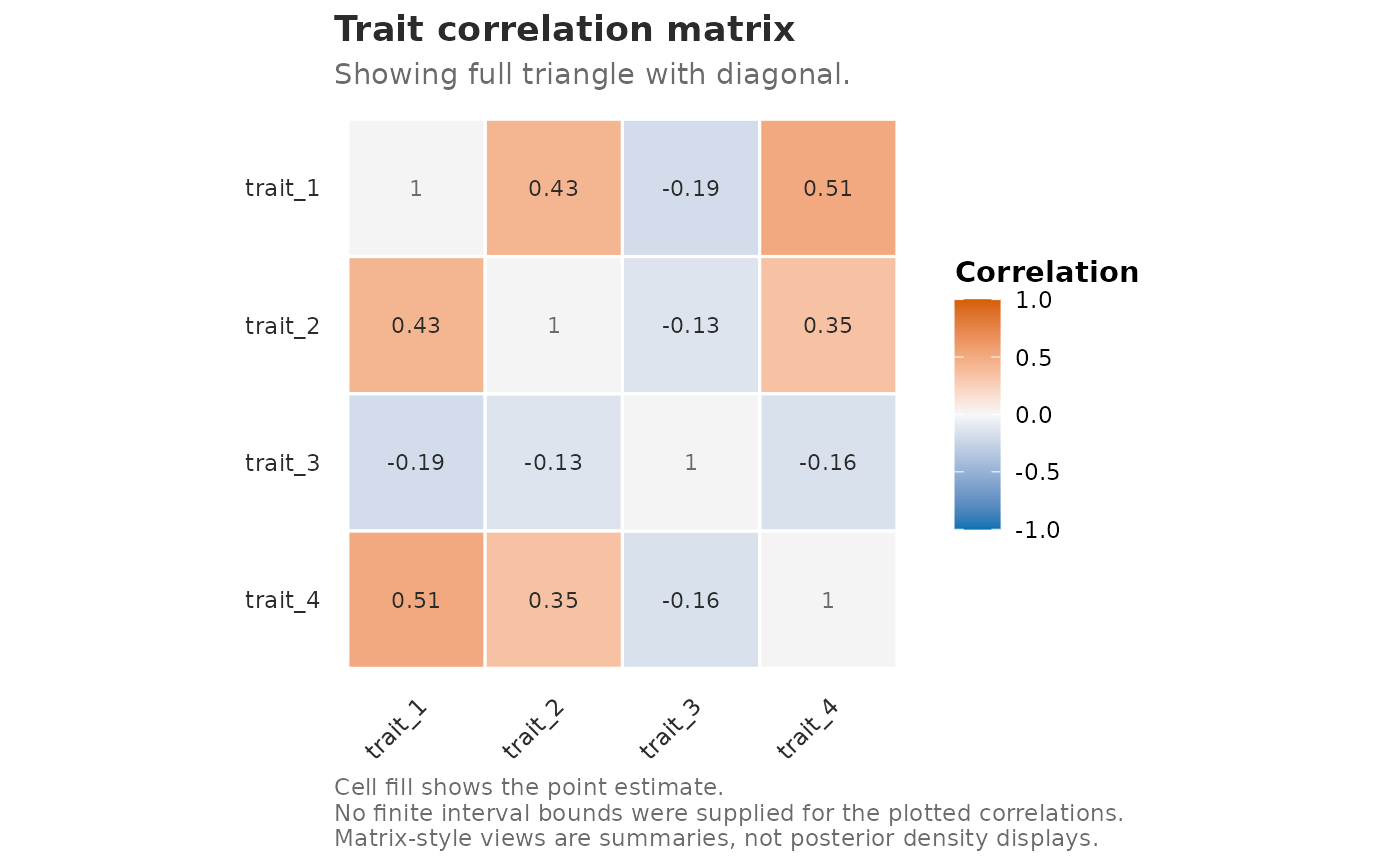 ## The same estimates as a full table (both directions plus the
## diagonal: 4 x 4 = 16 rows), as a square matrix, or as a table of
## matrix entries.
full <- extract_correlations(fit, tier = "unit", entries = "all")
nrow(full)
#> [1] 16
R <- extract_Sigma(fit, level = "unit")$R
round(R, 2)
#> trait_1 trait_2 trait_3 trait_4
#> trait_1 1.00 0.43 -0.19 0.51
#> trait_2 0.43 1.00 -0.13 0.35
#> trait_3 -0.19 -0.13 1.00 -0.16
#> trait_4 0.51 0.35 -0.16 1.00
full_sigma <- extract_Sigma_table(fit, level = "unit",
measure = "correlation", entries = "all")
## Fisher-z bounds are opt-in and depend on an effective sample size, n_eff.
## By default it is the number of units (80 here). We pass a more
## cautious 60 as an illustration, because each unit is seen only through
## three noisy measurements; in your own analysis, choose n_eff from your
## design and report why. These are rough bounds, not intervals
## calibrated to give 95% coverage in a mixed model.
cors_z <- extract_correlations(fit, tier = "unit", method = "fisher-z",
n_eff = 60L)
cors_z
#> tier trait_i trait_j correlation lower upper method
#> 1 unit trait_1 trait_2 0.4300549 0.1977218 0.6166414 fisher-z
#> 2 unit trait_1 trait_3 -0.1917988 -0.4250238 0.0653065 fisher-z
#> 3 unit trait_2 trait_3 -0.1320519 -0.3734542 0.1261011 fisher-z
#> 4 unit trait_1 trait_4 0.5097888 0.2939102 0.6761830 fisher-z
#> 5 unit trait_2 trait_4 0.3509855 0.1065576 0.5554099 fisher-z
#> 6 unit trait_3 trait_4 -0.1565349 -0.3947683 0.1014211 fisher-z
#> interval_status
#> 1 heuristic_unvalidated
#> 2 heuristic_unvalidated
#> 3 heuristic_unvalidated
#> 4 heuristic_unvalidated
#> 5 heuristic_unvalidated
#> 6 heuristic_unvalidated
## A parametric bootstrap simulates new data from the fitted model and
## refits it each time. nsim = 40 keeps this example short, so expect a
## warning (it calls nsim `n_boot`) that so few resamples give noisy
## bounds; it stays quiet only from 999 resamples, and real analyses need
## at least several hundred. Bootstrap bounds are not certified to reach
## 95% coverage either.
# \donttest{
cors_b <- extract_correlations(fit, tier = "unit", method = "bootstrap",
nsim = 40, seed = 42)
#> Warning: `n_boot` = 40 gives noisy percentile bounds.
#> ℹ Percentile CIs are first-order accurate, so more draws buy precision, not
#> correctness -- but below ~999 the Monte Carlo error in the endpoints is
#> itself material.
#> ℹ `n_cores` >= 2 parallelises the refits; the cost here is wall-clock, not
#> accuracy.
#> ℹ For Sigma diagonals, `profile_ci_total_variance()` needs no resampling at
#> all.
cors_b
#> tier trait_i trait_j correlation lower upper method
#> 1 unit trait_1 trait_2 0.4300549 0.09281779 0.61561624 bootstrap
#> 2 unit trait_1 trait_3 -0.1917988 -0.38813278 -0.02809850 bootstrap
#> 3 unit trait_2 trait_3 -0.1320519 -0.50974747 -0.01567524 bootstrap
#> 4 unit trait_1 trait_4 0.5097888 0.10748158 0.70646699 bootstrap
#> 5 unit trait_2 trait_4 0.3509855 0.10887754 0.60104241 bootstrap
#> 6 unit trait_3 trait_4 -0.1565349 -0.42099639 -0.02646512 bootstrap
#> interval_status
#> 1 target_specific_uncalibrated
#> 2 target_specific_uncalibrated
#> 3 target_specific_uncalibrated
#> 4 target_specific_uncalibrated
#> 5 target_specific_uncalibrated
#> 6 target_specific_uncalibrated
# }
## The same estimates as a full table (both directions plus the
## diagonal: 4 x 4 = 16 rows), as a square matrix, or as a table of
## matrix entries.
full <- extract_correlations(fit, tier = "unit", entries = "all")
nrow(full)
#> [1] 16
R <- extract_Sigma(fit, level = "unit")$R
round(R, 2)
#> trait_1 trait_2 trait_3 trait_4
#> trait_1 1.00 0.43 -0.19 0.51
#> trait_2 0.43 1.00 -0.13 0.35
#> trait_3 -0.19 -0.13 1.00 -0.16
#> trait_4 0.51 0.35 -0.16 1.00
full_sigma <- extract_Sigma_table(fit, level = "unit",
measure = "correlation", entries = "all")
## Fisher-z bounds are opt-in and depend on an effective sample size, n_eff.
## By default it is the number of units (80 here). We pass a more
## cautious 60 as an illustration, because each unit is seen only through
## three noisy measurements; in your own analysis, choose n_eff from your
## design and report why. These are rough bounds, not intervals
## calibrated to give 95% coverage in a mixed model.
cors_z <- extract_correlations(fit, tier = "unit", method = "fisher-z",
n_eff = 60L)
cors_z
#> tier trait_i trait_j correlation lower upper method
#> 1 unit trait_1 trait_2 0.4300549 0.1977218 0.6166414 fisher-z
#> 2 unit trait_1 trait_3 -0.1917988 -0.4250238 0.0653065 fisher-z
#> 3 unit trait_2 trait_3 -0.1320519 -0.3734542 0.1261011 fisher-z
#> 4 unit trait_1 trait_4 0.5097888 0.2939102 0.6761830 fisher-z
#> 5 unit trait_2 trait_4 0.3509855 0.1065576 0.5554099 fisher-z
#> 6 unit trait_3 trait_4 -0.1565349 -0.3947683 0.1014211 fisher-z
#> interval_status
#> 1 heuristic_unvalidated
#> 2 heuristic_unvalidated
#> 3 heuristic_unvalidated
#> 4 heuristic_unvalidated
#> 5 heuristic_unvalidated
#> 6 heuristic_unvalidated
## A parametric bootstrap simulates new data from the fitted model and
## refits it each time. nsim = 40 keeps this example short, so expect a
## warning (it calls nsim `n_boot`) that so few resamples give noisy
## bounds; it stays quiet only from 999 resamples, and real analyses need
## at least several hundred. Bootstrap bounds are not certified to reach
## 95% coverage either.
# \donttest{
cors_b <- extract_correlations(fit, tier = "unit", method = "bootstrap",
nsim = 40, seed = 42)
#> Warning: `n_boot` = 40 gives noisy percentile bounds.
#> ℹ Percentile CIs are first-order accurate, so more draws buy precision, not
#> correctness -- but below ~999 the Monte Carlo error in the endpoints is
#> itself material.
#> ℹ `n_cores` >= 2 parallelises the refits; the cost here is wall-clock, not
#> accuracy.
#> ℹ For Sigma diagonals, `profile_ci_total_variance()` needs no resampling at
#> all.
cors_b
#> tier trait_i trait_j correlation lower upper method
#> 1 unit trait_1 trait_2 0.4300549 0.09281779 0.61561624 bootstrap
#> 2 unit trait_1 trait_3 -0.1917988 -0.38813278 -0.02809850 bootstrap
#> 3 unit trait_2 trait_3 -0.1320519 -0.50974747 -0.01567524 bootstrap
#> 4 unit trait_1 trait_4 0.5097888 0.10748158 0.70646699 bootstrap
#> 5 unit trait_2 trait_4 0.3509855 0.10887754 0.60104241 bootstrap
#> 6 unit trait_3 trait_4 -0.1565349 -0.42099639 -0.02646512 bootstrap
#> interval_status
#> 1 target_specific_uncalibrated
#> 2 target_specific_uncalibrated
#> 3 target_specific_uncalibrated
#> 4 target_specific_uncalibrated
#> 5 target_specific_uncalibrated
#> 6 target_specific_uncalibrated
# }