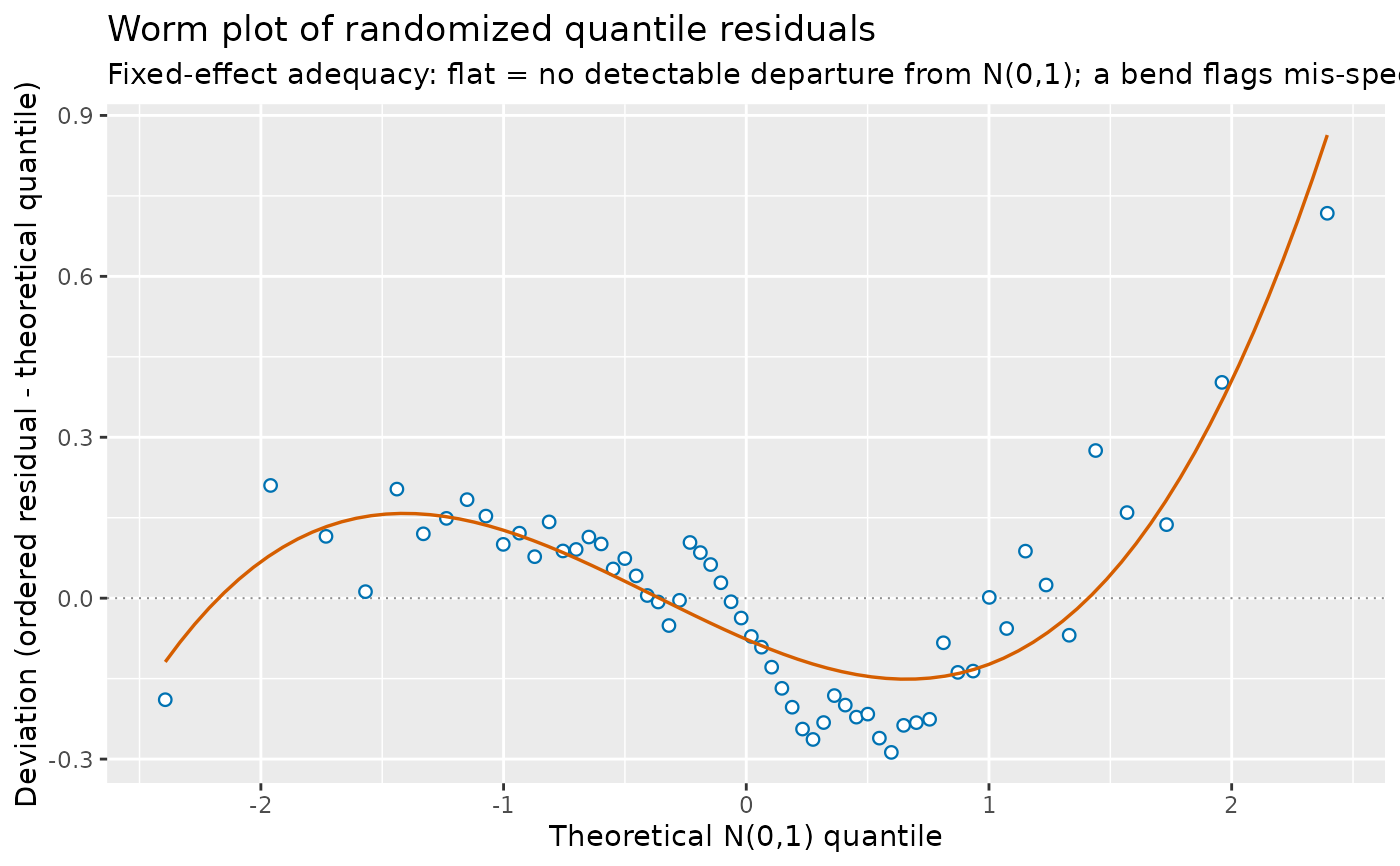
worm_plot() draws a detrended QQ plot (van Buuren & Fredriks-style worm
plot) of drm_quantile_residuals() against their N(0,1) order-statistic
theoretical quantiles: deviation = sorted residual - theoretical quantile. A flat scatter around the dotted zero reference line is no
detectable departure from N(0,1); a systematic bend flags a
mis-specification of the fitted distributional form (see the
GAMLSS-Primer Fig-4c contrast: a location-only fit to heteroscedastic data
bends, the matching location-scale fit is flat).
Arguments
- object
A
drmTMBfit.- seed
Optional single integer seed, passed to
drm_quantile_residuals().- nsim
Number of Dunn-Smyth realizations to overplot as an envelope; passed to
drm_quantile_residuals().- response
For a bivariate
biv_gaussianfit,1or2, selecting which response's marginal residuals to plot; seefitted_distribution(). Must beNULL(the default) for univariate model types.- ...
Reserved for future options.
Details
When nsim > 1, a pale grey envelope (with a darker outline) overplots the
per-rank range across the nsim Dunn-Smyth realizations, so a single
randomized draw is not over-read; the first realization's points and
fitted trend are drawn on top.
This is fixed-effect adequacy only – see drm_quantile_residuals(). A
flat worm plot is "no detectable departure" evidence about the fixed-effect
distributional form, never a general validity or calibration claim.
What this detects – and does not. A worm plot bends when the
underlying quantile residuals depart from N(0,1); see
residuals.drmTMB()'s Details for the numerical evidence and its incomplete
Tweedie boundary. It flags shape/atom mis-specification a family cannot reabsorb
through its own free parameters (heavy tails, ignored overdispersion or
zero-inflation in a no-free-dispersion family, ignored truncation, a
missing zero/one atom – power >= 0.8 in the evaluated scenarios), but it stays flat – a
genuine structural blind spot, not evidence of adequacy – when a free
nuisance/dispersion/inflation parameter absorbs the mis-specification
(e.g. heteroscedasticity absorbed by Student-t nu, missing
zero-inflation absorbed by nbinom2 sigma, or a constant-vs-covariate
zero-inflation/hurdle mechanism mis-set for hurdle_nbinom2/
zero_one_beta). For zi_poisson/zi_nbinom2, the same
constant-vs-covariate mechanism mis-spec is NOT flat – power rises with
n – but stays far below 0.8 even at n = 3000, so it is
sample-size-limited in principle but impractical to detect at realistic
sample sizes. A mean-structure diagnostic, not this one, is what catches
an absorbed mis-specification.
Examples
set.seed(20260712)
n <- 60
x <- stats::rnorm(n)
dat <- data.frame(y = 0.5 + 0.8 * x + stats::rnorm(n), x = x)
fit <- drmTMB(bf(y ~ x, sigma ~ 1), family = gaussian(), data = dat)
if (requireNamespace("ggplot2", quietly = TRUE)) {
  worm_plot(fit)
}