
Two-tree phylogenetic interactions
Source:vignettes/bipartite-phylogenetic-interactions.Rmd
bipartite-phylogenetic-interactions.RmdA tale of two phylogenies starts with a row in a paired data set. One partner comes from one tree, the other partner comes from another tree, and the response belongs to the pair. In bipartite ecological network data this could be a plant and a pollinator, a host and a parasite, or any two partner clades where related partners may have similar pair-level deviations.
This tutorial assumes the single-tree case in Phylogenetic mixed models and
extends phylo() to two coupled trees at once. Use
phylo_interaction() when the pair itself should carry a
phylogenetic random effect. The fitted first slice is:
eta_i = X_i beta + z[a_i, b_i]
vec(z) ~ Normal(0, sd_pair^2 (A_partner2 kron A_partner1))
Here a_i is the first partner level, b_i is
the second partner level, A_partner1 and
A_partner2 are the two phylogenetic covariance matrices,
and sd_pair is the standard deviation of the pair-level
structured field. For Poisson and NB2 models, eta_i is the
log mean. For Gaussian models, eta_i is the location
mean.
What is fitted today
| Question | Syntax | Status |
|---|---|---|
| Do pairs from two partner clades share phylogenetically structured deviations? | phylo_interaction(1 | plant:pollinator, tree1 = plant_tree, tree2 = pollinator_tree) |
Fitted first q=1 mu slice for univariate Gaussian,
ordinary Poisson, and ordinary NB2 models. |
| Do pair deviations need to be independent rather than phylogenetic? | precompute pair_id <- interaction(plant, pollinator)
and use (1 | pair_id)
|
Fitted through ordinary grouped random effects. The direct grammar
(1 | plant:pollinator) remains future parser sugar. |
| Do you already have a labelled Kronecker precision matrix? | relmat(1 | plant_pollinator, Q = Q_pair) |
Low-level escape hatch for power users who can build and align the pair precision themselves. |
| Do you need partner main phylogenies plus the pair interaction in one model? | phylo(1 | plant, ...) + phylo(1 | pollinator, ...) + phylo_interaction(...) |
Planned. Simultaneous structured layers need the next identifiability and reporting checks. |
| Is the response binary incidence? | Bernoulli/binomial pair model | Planned. Current fitted pair route covers Gaussian, Poisson, and NB2
mu, not binary incidence. |
A small count example
The example below uses two small trees and a count response. The same marker can also enter a Gaussian location model or an ordinary NB2 mean model.
balanced_partner_tree <- function(n_tip = 4L, prefix = "sp") {
  stopifnot(n_tip >= 2L, log2(n_tip) == floor(log2(n_tip)))
  edges <- matrix(integer(), ncol = 2L)
  edge_lengths <- numeric()
  next_node <- n_tip + 1L

  build <- function(tips) {
    if (length(tips) == 1L) {
      return(tips)
    }
    node <- next_node
    next_node <<- next_node + 1L
    mid <- length(tips) / 2L
    left <- build(tips[seq_len(mid)])
    right <- build(tips[seq.int(mid + 1L, length(tips))])
    edges <<- rbind(edges, c(node, left), c(node, right))
    edge_lengths <<- c(edge_lengths, 1, 1)
    node
  }

  build(seq_len(n_tip))
  structure(
    list(
      edge = edges,
      edge.length = edge_lengths,
      tip.label = paste0(prefix, "_", seq_len(n_tip)),
      Nnode = n_tip - 1L
    ),
    class = "phylo"
  )
}

set.seed(20260531)
plant_tree <- balanced_partner_tree(4, "plant")
pollinator_tree <- balanced_partner_tree(4, "poll")

pair_grid <- expand.grid(
  plant = plant_tree$tip.label,
  pollinator = pollinator_tree$tip.label,
  KEEP.OUT.ATTRS = FALSE
)

plant_clade <- ifelse(pair_grid$plant %in% plant_tree$tip.label[1:2], -1, 1)
pollinator_clade <- ifelse(
  pair_grid$pollinator %in% pollinator_tree$tip.label[1:2],
  -1,
  1
)
pair_signal <- 0.45 * plant_clade * pollinator_clade
names(pair_signal) <- paste(pair_grid$plant, pair_grid$pollinator, sep = ":")

network_dat <- pair_grid[rep(seq_len(nrow(pair_grid)), each = 5), ]
network_dat$floral_density <- rnorm(nrow(network_dat))
eta <- 0.6 +
  0.25 * network_dat$floral_density +
  pair_signal[paste(network_dat$plant, network_dat$pollinator, sep = ":")]
network_dat$visits <- rpois(nrow(network_dat), lambda = exp(eta))
head(network_dat)
#>       plant pollinator floral_density visits
#> 1   plant_1     poll_1     -0.4671070      3
#> 1.1 plant_1     poll_1      0.2959469      0
#> 1.2 plant_1     poll_1      0.3627907      8
#> 1.3 plant_1     poll_1     -1.0481202      2
#> 1.4 plant_1     poll_1     -1.7112862      4
#> 2   plant_2     poll_1     -0.4815308      2
Fit the pair-level phylogenetic interaction with one marker:
fit_pair <- drmTMB(
bf(
visits ~ floral_density +
phylo_interaction(
1 | plant:pollinator,
tree1 = plant_tree,
tree2 = pollinator_tree
)
),
family = poisson(link = "log"),
data = network_dat
)
check_drm(fit_pair)
#> <drm_check: 18 checks>
#> ok: 17; notes: 1; warnings: 0; errors: 0
#> check status
#> optimizer_convergence ok
#> convergence_status ok
#> optimizer_budget ok
#> finite_objective ok
#> logsigma_clamp_active ok
#> fixed_gradient ok
#> sdreport_status ok
#> hessian_positive_definite ok
#> hessian_conditioning ok
#> standard_errors_finite ok
#> standard_errors_inflated ok
#> mle_existence ok
#> observations_per_parameter ok
#> dropped_rows ok
#> positive_scale ok
#> random_effect_sd_boundary ok
#> interval_reliability_scope note
#> fixed_effect_design_size ok
#> value
#> 0
#> converged
#> iterations=13; function=19; gradient=14
#> 141.3
#> <NA>
#> max=0.00000000001327; component=log_sd_phylo
#> ok
#> TRUE
#> min_eig=13.88; cond=8.649
#> range=[0.09184,0.1935]
#> n_inflated=0; max_se=0.1935; reference_median=0.1427
#> finite
#> n_obs=80; n_par=3; ratio=26.67
#> nobs=80; dropped=0
#> min=1.000
#> min=0.4569; boundary=0.0001000; term=mu.phylo_interaction(1 | plant:pollinator)
#> sd_targets=1; assessed_here=0
#> total_mb=0.006866; max_cols=2; largest=mu; largest_class=matrix; largest_density=1.000
#> message
#> nlminb convergence code is 0.
#> Optimizer convergence and uncertainty diagnostics are consistent with a proper interior optimum.
#> Optimizer evaluation counts recorded; no eval.max or iter.max control was supplied.
#> Objective and log-likelihood are finite.
#> The log(sigma) clamp does not apply to this family.
#> Maximum absolute fixed gradient is <= 0.001; largest component is log_sd_phylo.
#> TMB::sdreport() completed successfully.
#> sdreport reports a positive-definite Hessian.
#> Minimum eigenvalue and condition number of TMB's sdreport() fixed-effect covariance (sdr$cov.fixed), inverted. These are a genuinely different read of the fit's conditioning than TMB's internal pdHess flag -- comparable across fits, not claimed to be numerically identical to any raw TMB gradient or Hessian quantity. This fit's Hessian conditioning is within the requested threshold.
#> All fixed-effect standard errors are finite.
#> No fixed-effect standard error is inflated relative to the others.
#> The screened fixed-effect geometry is consistent with a finite maximum-likelihood estimate.
#> Observations per estimated parameter are at or above the small-samplenote threshold (10).
#> No rows were dropped by model-frame or known-covariance filtering.
#> All fitted scale values are finite and positive.
#> All fitted random-effect standard deviations are finite, positive, and above the requested lower-boundary warning threshold.
#> This fit has 1 random-effect standard-deviation target. `check_drm()` assesses the fit, not interval reliability: a target can pass every check above and still return an interval that `confint()` warns about at a variance boundary. Before reporting an interval, call `confint()` and read `conf.status` and any boundary warning.
#> Dense fixed-effect design matrices are modest for this fit.The fitted standard deviation is the scale of the latent pair
deviations on the linear predictor scale. For this Poisson model, that
is the log-count scale. Use ranef() for conditional pair
deviations and profile_targets() for the pair-SD estimate
and its uncertainty status. These are different outputs: the deviations
describe this fitted network, whereas the SD says how much pair
deviation the model estimates across comparable pairs.
pair_term <- "phylo_interaction(1 | plant:pollinator)"
pair_targets <- profile_targets(fit_pair)
pair_targets[
  pair_targets$parm == paste0("sd:mu:", pair_term),
  c("parm", "estimate", "scale", "profile_ready", "profile_note")
]
#>                                            parm  estimate    scale
#> 3 sd:mu:phylo_interaction(1 | plant:pollinator) 0.4568795 response
#>   profile_ready profile_note
#> 3          TRUE        ready

pair_dev <- ranef(fit_pair, "phylo_interaction_mu")$terms[[pair_term]]
pair_table <- data.frame(
  pair = names(pair_dev),
  conditional_log_rate_deviation = unname(pair_dev),
  row.names = NULL
)
pair_table[order(pair_table$conditional_log_rate_deviation), ]
#>              pair conditional_log_rate_deviation
#> 4  plant_4:poll_1                    -0.69119675
#> 10 plant_4:poll_2                    -0.55880181
#> 28  plant_4:node6                    -0.41666619
#> 20 plant_2:poll_4                    -0.39267712
#> 3  plant_3:poll_1                    -0.38753519
#> 6    node7:poll_1                    -0.35957731
#> 19 plant_1:poll_4                    -0.33044863
#> 9  plant_3:poll_2                    -0.32970571
#> 14 plant_2:poll_3                    -0.30187373
#> 12   node7:poll_2                    -0.29616917
#> 23   node6:poll_4                    -0.24104191
#> 27  plant_3:node6                    -0.23908030
#> 32  plant_2:node7                    -0.23151695
#> 30    node7:node6                    -0.21858216
#> 31  plant_1:node7                    -0.12363587
#> 35    node6:node7                    -0.11838427
#> 17   node6:poll_3                    -0.11411091
#> 13 plant_1:poll_3                    -0.04045899
#> 7  plant_1:poll_2                     0.01649399
#> 11   node6:poll_2                     0.06055521
#> 29    node6:node6                     0.12041280
#> 8  plant_2:poll_2                     0.16517164
#> 25  plant_1:node6                     0.17739042
#> 26  plant_2:node6                     0.18384796
#> 36    node7:node7                     0.26039492
#> 5    node6:poll_1                     0.30068317
#> 33  plant_3:node7                     0.31279815
#> 18   node7:poll_3                     0.32576432
#> 15 plant_3:poll_3                     0.33317491
#> 2  plant_2:poll_1                     0.38637225
#> 24   node7:poll_4                     0.45542044
#> 34  plant_4:node7                     0.46838661
#> 1  plant_1:poll_1                     0.51567728
#> 21 plant_3:poll_4                     0.60521954
#> 16 plant_4:poll_3                     0.64411805
#> 22 plant_4:poll_4                     0.76104179
The table is a reportable point-estimate summary of
which observed pairs depart above or below the fixed-effect log rate. It
is not an interval for an individual pair. Before reporting the pair SD
as an uncertainty interval, inspect profile_ready and
profile_note above, then check the exact capability
evidence for this family and target; a computable profile is not by
itself a calibration claim.
pair_table <- pair_table[order(pair_table$conditional_log_rate_deviation), ]
graphics::dotchart(
  pair_table$conditional_log_rate_deviation,
  labels = pair_table$pair,
  xlab = "Conditional log-rate deviation",
  main = "Fitted pair deviations"
)
graphics::abline(v = 0, lty = 2, col = "grey40")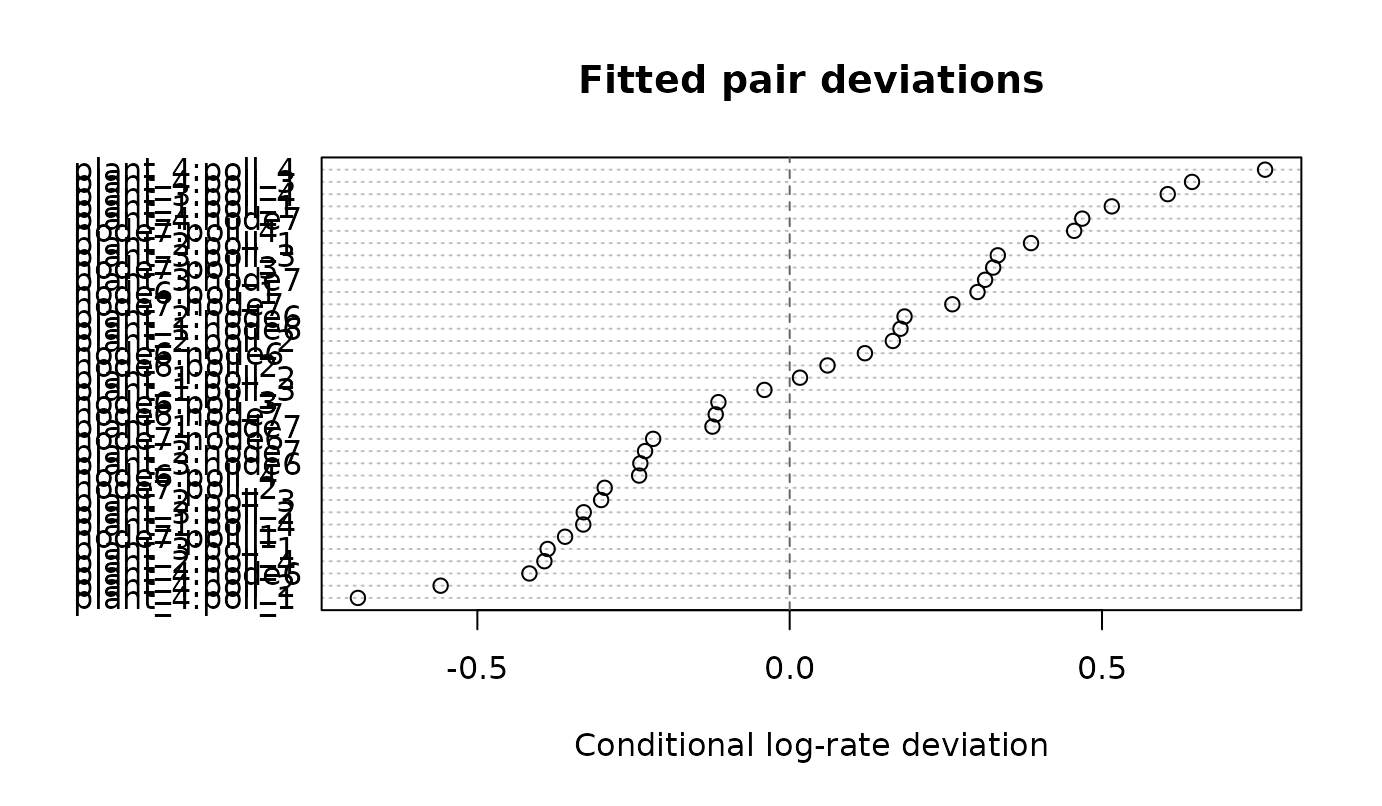
Conditional pair deviations for the fitted two-tree Poisson model. Positive values indicate pairs with a higher fitted log visit rate than the fixed effects predict; negative values indicate lower fitted rates. The display is point-only and is not an interval plot.
Independent pairs are a different question
If the biological question is “do repeated observations of the same pair share an unexplained deviation?” and no phylogenetic structure is needed, use an ordinary grouped random effect. Precompute the pair identifier first:
network_dat$pair_id <- interaction(
  network_dat$plant,
  network_dat$pollinator,
  drop = TRUE
)

fit_independent_pair <- drmTMB(
  visits ~ floral_density + (1 | pair_id),
  family = poisson(link = "log"),
  data = network_dat
)
Do not write (1 | plant:pollinator) yet. The ordinary
random-effect parser currently expects a simple grouping column, so
pair_id is the supported route.
When to reach for relmat()
relmat() is the low-level route when you already have
the pair precision matrix and have checked that its row names match the
pair-level factor in the data. If the factor is
plant_pollinator, then the row names and column names of
Q_pair must match the levels of
plant_pollinator exactly.
fit_pair_relmat <- drmTMB(
  visits ~ floral_density +
    relmat(1 | plant_pollinator, Q = Q_pair),
  family = poisson(link = "log"),
  data = network_dat
)
For most two-tree pair models, phylo_interaction() is
safer because it builds the sparse Kronecker precision from
tree1 and tree2, preserves the two partner
names, and keeps the biological meaning visible in the formula.
What this does not claim
This first slice is a pair-level structured random intercept. It is not yet the full additive model with a main plant phylogeny, a main pollinator phylogeny, and a pair interaction:
visits ~ floral_density +
  phylo(1 | plant, tree = plant_tree) +
  phylo(1 | pollinator, tree = pollinator_tree) +
  phylo_interaction(
    1 | plant:pollinator,
    tree1 = plant_tree,
    tree2 = pollinator_tree
  )
It also does not fit reciprocal evolutionary dynamics, community-only matching without pair observations, binary incidence, structured pair slopes, or simultaneous spatial or animal-model interactions. Those are different statistical questions and need separate model designs.