
Many ecological responses are counts: fledglings per nest, parasites per host, insects in a trap, or soil invertebrates in a quadrat. This page helps you model counts when predictors may affect more than their average. Ask three separate questions: do predictors change expected abundance, do counts vary more than a Poisson model expects, or is there a biological reason for an additional source of zeros? Start with the worked NB2 example below. Read When variance carries signal, Part 1 for more background on modelling average and variability separately.
Start with an NB2 model when counts vary more than a Poisson model
predicts. Use mu for expected abundance, sigma
for extra-Poisson variation, and add zi only when a
separate zero-producing process makes biological sense. The worked
example fits these three parts with measured predictors. For repeated
sampling within sites, or dependence among species or locations, see Adding grouped or
structured effects after working through the example.
The source motivation comes from Nakagawa et al. (2026), who use
location-scale models to discuss heteroscedasticity in continuous,
count, and proportion data. Their count section highlights
negative-binomial models for fledglings, insect colony size, parasites,
and soil invertebrates, and it separates overdispersion from
structural-zero processes. drmTMB uses the same scientific
split, but reports the NB2 scale as public sigma rather
than the native size or precision parameter often written as
theta.
Model Equation And Syntax
For an overdispersed count model, nbinom2() uses
The matching drmTMB syntax is:
drmTMB(
  bf(
    springtails ~ habitat + moisture + offset(log(trap_nights)),
    sigma ~ habitat
  ),
  family = nbinom2(),
  data = soil_counts
)
Read each parameter before interpreting the fitted model:
| Symbol or syntax | Meaning | In the soil-invertebrate example |
|---|---|---|
,
springtails
|
observed non-negative integer count | springtails found in trap |
,
trap_nights
|
sampling effort exposure | number of nights the trap was active |
offset(log(trap_nights)) |
forces expected count to scale with effort | estimates abundance rate per trap night |
,
mu
|
expected count after accounting for effort | expected springtail abundance in a trap |
| location coefficients on the log mean scale | habitat and moisture effects on expected abundance | |
,
sigma
|
NB2 extra-Poisson scale | variation beyond the Poisson expectation |
scale coefficients on the log sigma scale |
habitat effects on extra-Poisson variation | |
,
theta in some papers |
native NB2 size or precision |
size_i = 1 / sigma_i^2, so larger sigma
means smaller size
|
The sigma slope is a variability slope. If
gamma_1 is the restored-habitat coefficient, then
If a paper reports the native NB2 parameter , the direction reverses:
That reversal is why the tutorial keeps saying sigma: in
drmTMB, larger sigma always means more
modelled variation for this family.
A Soil-Invertebrate Example
Suppose springtails are counted from soil traps in degraded and restored grassland plots. Restoration may increase average abundance, but restored plots may also be more patchy while litter and vegetation structure re-establish. A few bare-soil microsites may be true absences where springtails are not available to be trapped.
This transparent simulation gives us known structure before fitting:
set.seed(106)
n <- 360
soil_counts <- data.frame(
  habitat = factor(
    rep(c("degraded", "restored"), each = n / 2),
    levels = c("degraded", "restored")
  ),
  surface = factor(
    sample(c("litter", "bare"), n, replace = TRUE, prob = c(0.72, 0.28)),
    levels = c("litter", "bare")
  ),
  moisture = as.numeric(scale(runif(n, 0.15, 0.95))),
  trap_nights = sample(2:5, n, replace = TRUE)
)

restored <- as.numeric(soil_counts$habitat == "restored")
bare <- as.numeric(soil_counts$surface == "bare")

rate <- exp(log(2.4) + 0.35 * restored + 0.30 * soil_counts$moisture)
mu <- soil_counts$trap_nights * rate
sigma_nb2 <- exp(-0.75 + 0.40 * restored)
zi <- plogis(-3.2 + 1.6 * bare - 0.25 * restored)

structural_zero <- runif(n) < zi
soil_counts$springtails <- ifelse(
  structural_zero,
  0L,
  rnbinom(n, size = 1 / sigma_nb2^2, mu = mu)
)

head(soil_counts)
#>    habitat surface   moisture trap_nights springtails
#> 1 degraded  litter -1.1665372           3           1
#> 2 degraded    bare  1.5939065           4           4
#> 3 degraded  litter  0.4203317           5          14
#> 4 degraded  litter  0.6364855           5           7
#> 5 degraded  litter  1.0379937           4           5
#> 6 degraded  litter -1.4584601           2           3
Start with the NB2 location-scale model before adding a structural-zero submodel:
fit_nb2 <- drmTMB(
  bf(
    springtails ~ habitat + moisture + offset(log(trap_nights)),
    sigma ~ habitat
  ),
  family = nbinom2(),
  data = soil_counts
)
Run diagnostics before interpreting coefficients:
check_drm(fit_nb2)
#> <drm_check: 17 checks>
#> ok: 17; notes: 0; warnings: 0; errors: 0
#> check status
#> optimizer_convergence ok
#> convergence_status ok
#> optimizer_budget ok
#> finite_objective ok
#> logsigma_clamp_active ok
#> fixed_gradient ok
#> sdreport_status ok
#> hessian_positive_definite ok
#> hessian_conditioning ok
#> standard_errors_finite ok
#> standard_errors_inflated ok
#> mle_existence ok
#> observations_per_parameter ok
#> fixed_effect_collinearity ok
#> dropped_rows ok
#> positive_scale ok
#> fixed_effect_design_size ok
#> value
#> 0
#> converged
#> iterations=17; function=29; gradient=17
#> 1130.
#> <NA>
#> max=0.000000002700; component=beta_mu[3]
#> ok
#> TRUE
#> min_eig=68.33; cond=9.408
#> range=[0.04334,0.1013]
#> n_inflated=0; max_se=0.1013; reference_median=0.07791
#> finite
#> n_obs=360; n_par=5; ratio=72.00
#> max_abs_r=0.01298
#> nobs=360; dropped=0
#> min=0.6499
#> total_mb=0.06026; max_cols=3; largest=mu; largest_class=matrix; largest_density=0.8333
#> message
#> nlminb convergence code is 0.
#> Optimizer convergence and uncertainty diagnostics are consistent with a proper interior optimum.
#> Optimizer evaluation counts recorded; no eval.max or iter.max control was supplied.
#> Objective and log-likelihood are finite.
#> The log(sigma) clamp is not active at the optimum.
#> Maximum absolute fixed gradient is <= 0.001; largest component is beta_mu[3].
#> TMB::sdreport() completed successfully.
#> sdreport reports a positive-definite Hessian.
#> Minimum eigenvalue and condition number of TMB's sdreport() fixed-effect covariance (sdr$cov.fixed), inverted. These are a genuinely different read of the fit's conditioning than TMB's internal pdHess flag -- comparable across fits, not claimed to be numerically identical to any raw TMB gradient or Hessian quantity. This fit's Hessian conditioning is within the requested threshold.
#> All fixed-effect standard errors are finite.
#> No fixed-effect standard error is inflated relative to the others.
#> The screened fixed-effect geometry is consistent with a finite maximum-likelihood estimate.
#> Observations per estimated parameter are at or above the small-samplenote threshold (10).
#> No fixed-effect design column pair exceeds the collinearity note threshold.
#> No rows were dropped by model-frame or known-covariance filtering.
#> All fitted scale values are finite and positive.
#> Dense fixed-effect design matrices are modest for this fit.The NB2 fit answers two questions. The mu coefficients
describe abundance rates, because the offset has already accounted for
trap effort. The sigma coefficients describe extra-Poisson
variation in the count component:
coef(fit_nb2, "mu")
#>     (Intercept) habitatrestored        moisture
#>       0.7603132       0.3511158       0.2422673
coef(fit_nb2, "sigma")
#>     (Intercept) habitatrestored
#>      -0.4309457       0.2758270

sigma_ratio <- exp(coef(fit_nb2, "sigma")["habitatrestored"])
c(
  sigma_ratio_restored_vs_degraded = sigma_ratio,
  variance_multiplier_at_same_mu = sigma_ratio^2
)
#> sigma_ratio_restored_vs_degraded.habitatrestored
#>                                         1.317620
#>   variance_multiplier_at_same_mu.habitatrestored
#>                                         1.736122
The second value is the multiplier on the quadratic extra-Poisson part when two traps have the same expected count. It is not the full variance ratio whenever also changes, because NB2 variance contains both and .
When Zeros Are A Separate Process
The paper example of soil invertebrates in patchy habitats maps
naturally to a zero-inflated count model. Bare-soil microsites can be
true absences, while litter microsites can still produce ordinary
sampling zeros from the NB2 count component. Add a zi
formula when the biological question needs that split:
In this equation, is the structural-zero probability. It is not a scale parameter and should not be interpreted as overdispersion.
fit_zinb2 <- drmTMB(
bf(
springtails ~ habitat + moisture + offset(log(trap_nights)),
sigma ~ habitat,
zi ~ surface
),
family = nbinom2(),
data = soil_counts
)
check_drm(fit_zinb2)
#> <drm_check: 17 checks>
#> ok: 17; notes: 0; warnings: 0; errors: 0
#> check status
#> optimizer_convergence ok
#> convergence_status ok
#> optimizer_budget ok
#> finite_objective ok
#> logsigma_clamp_active ok
#> fixed_gradient ok
#> sdreport_status ok
#> hessian_positive_definite ok
#> hessian_conditioning ok
#> standard_errors_finite ok
#> standard_errors_inflated ok
#> mle_existence ok
#> observations_per_parameter ok
#> fixed_effect_collinearity ok
#> dropped_rows ok
#> positive_scale ok
#> fixed_effect_design_size ok
#> value
#> 0
#> converged
#> iterations=31; function=41; gradient=32
#> 1105.
#> <NA>
#> max=0.00000000001310; component=beta_mu[1]
#> ok
#> TRUE
#> min_eig=4.310; cond=220.2
#> range=[0.03636,0.4202]
#> n_inflated=0; max_se=0.4202; reference_median=0.09309
#> finite
#> n_obs=360; n_par=7; ratio=51.43
#> max_abs_r=0.01298
#> nobs=360; dropped=0
#> min=0.4904
#> total_mb=0.08898; max_cols=3; largest=mu; largest_class=matrix; largest_density=0.8333
#> message
#> nlminb convergence code is 0.
#> Optimizer convergence and uncertainty diagnostics are consistent with a proper interior optimum.
#> Optimizer evaluation counts recorded; no eval.max or iter.max control was supplied.
#> Objective and log-likelihood are finite.
#> The log(sigma) clamp is not active at the optimum.
#> Maximum absolute fixed gradient is <= 0.001; largest component is beta_mu[1].
#> TMB::sdreport() completed successfully.
#> sdreport reports a positive-definite Hessian.
#> Minimum eigenvalue and condition number of TMB's sdreport() fixed-effect covariance (sdr$cov.fixed), inverted. These are a genuinely different read of the fit's conditioning than TMB's internal pdHess flag -- comparable across fits, not claimed to be numerically identical to any raw TMB gradient or Hessian quantity. This fit's Hessian conditioning is within the requested threshold.
#> All fixed-effect standard errors are finite.
#> No fixed-effect standard error is inflated relative to the others.
#> The screened fixed-effect geometry is consistent with a finite maximum-likelihood estimate.
#> Observations per estimated parameter are at or above the small-samplenote threshold (10).
#> No fixed-effect design column pair exceeds the collinearity note threshold.
#> No rows were dropped by model-frame or known-covariance filtering.
#> All fitted scale values are finite and positive.
#> Dense fixed-effect design matrices are modest for this fit.The zi coefficients are on the log-odds scale.
Prediction gives the structural-zero probability on the response
scale:
coef(fit_zinb2, "zi")
#> (Intercept) surfacebare
#>   -2.786077    1.215586

zero_grid <- data.frame(
  habitat = factor(c("degraded", "degraded"), levels = levels(soil_counts$habitat)),
  surface = factor(c("litter", "bare"), levels = levels(soil_counts$surface)),
  moisture = 0,
  trap_nights = 3
)

data.frame(
  surface = zero_grid$surface,
  structural_zero_probability = predict(fit_zinb2, newdata = zero_grid, dpar = "zi")
)
#>   surface structural_zero_probability
#> 1  litter                  0.05808118
#> 2    bare                  0.17214631
For the fitted zero-inflated model,
predict(fit_zinb2, dpar = "mu") returns the conditional NB2
count mean, sigma(fit_zinb2) returns the conditional NB2
overdispersion scale, and fitted(fit_zinb2) returns the
unconditional response mean
:
new_traps <- data.frame(
  habitat = factor(c("degraded", "restored"), levels = levels(soil_counts$habitat)),
  surface = factor(c("litter", "litter"), levels = levels(soil_counts$surface)),
  moisture = c(0, 0),
  trap_nights = c(3, 3)
)

mu_hat <- predict(fit_zinb2, newdata = new_traps, dpar = "mu")
sigma_hat <- predict(fit_zinb2, newdata = new_traps, dpar = "sigma")
zi_hat <- predict(fit_zinb2, newdata = new_traps, dpar = "zi")

data.frame(
  habitat = new_traps$habitat,
  conditional_mean = mu_hat,
  sigma = sigma_hat,
  structural_zero_probability = zi_hat,
  unconditional_mean = (1 - zi_hat) * mu_hat,
  unconditional_variance =
    (1 - zi_hat) * (mu_hat + sigma_hat^2 * mu_hat^2) +
      zi_hat * (1 - zi_hat) * mu_hat^2
)
#>    habitat conditional_mean     sigma structural_zero_probability
#> 1 degraded         6.924234 0.4903941                  0.05808118
#> 2 restored        10.124437 0.6257924                  0.05808118
#>   unconditional_mean unconditional_variance
#> 1           6.522067               20.00547
#> 2           9.536398               52.95497
library(ggplot2)

count_plot_grid <- expand.grid(
  habitat = factor(levels(soil_counts$habitat), levels = levels(soil_counts$habitat)),
  surface = factor(levels(soil_counts$surface), levels = levels(soil_counts$surface))
)
count_plot_grid$moisture <- 0
count_plot_grid$trap_nights <- 3
count_plot_grid$conditional_mean <- predict(
  fit_zinb2,
  newdata = count_plot_grid,
  dpar = "mu"
)
count_plot_grid$sigma <- predict(fit_zinb2, newdata = count_plot_grid, dpar = "sigma")
count_plot_grid$structural_zero_probability <- predict(
  fit_zinb2,
  newdata = count_plot_grid,
  dpar = "zi"
)
count_plot_grid$unconditional_mean <-
  (1 - count_plot_grid$structural_zero_probability) *
  count_plot_grid$conditional_mean
count_plot_grid$row_label <- paste(count_plot_grid$habitat, count_plot_grid$surface)
count_plot_long <- rbind(
  data.frame(
    count_plot_grid[c("habitat", "row_label")],
    component = "Conditional mean",
    value = count_plot_grid$conditional_mean
  ),
  data.frame(
    count_plot_grid[c("habitat", "row_label")],
    component = "Unconditional mean",
    value = count_plot_grid$unconditional_mean
  ),
  data.frame(
    count_plot_grid[c("habitat", "row_label")],
    component = "NB2 sigma",
    value = count_plot_grid$sigma
  ),
  data.frame(
    count_plot_grid[c("habitat", "row_label")],
    component = "Structural-zero probability",
    value = count_plot_grid$structural_zero_probability
  )
)
count_plot_long$component <- factor(
  count_plot_long$component,
  levels = c(
    "Conditional mean",
    "Unconditional mean",
    "NB2 sigma",
    "Structural-zero probability"
  )
)
count_plot_long$row_label <- factor(
  count_plot_long$row_label,
  levels = rev(unique(count_plot_grid$row_label))
)

ggplot(count_plot_long, aes(value, row_label, colour = habitat)) +
  geom_point(size = 2.7) +
  facet_wrap(~component, scales = "free_x", ncol = 2) +
  scale_colour_manual(values = c("degraded" = "#D55E00", "restored" = "#009E73")) +
  labs(
    title = "Zero-inflated counts have several fitted pieces",
    subtitle = "Facets keep count means, NB2 sigma, and structural-zero probabilities separate",
    x = "Response-scale fitted value",
    y = NULL,
    colour = "Habitat"
  ) +
  theme_minimal(base_size = 11) +
  theme(
    panel.grid.minor = element_blank(),
    panel.grid.major.y = element_blank(),
    legend.position = "bottom",
    plot.title = element_text(face = "bold"),
    plot.subtitle = element_text(colour = "grey30"),
    strip.text = element_text(face = "bold")
  )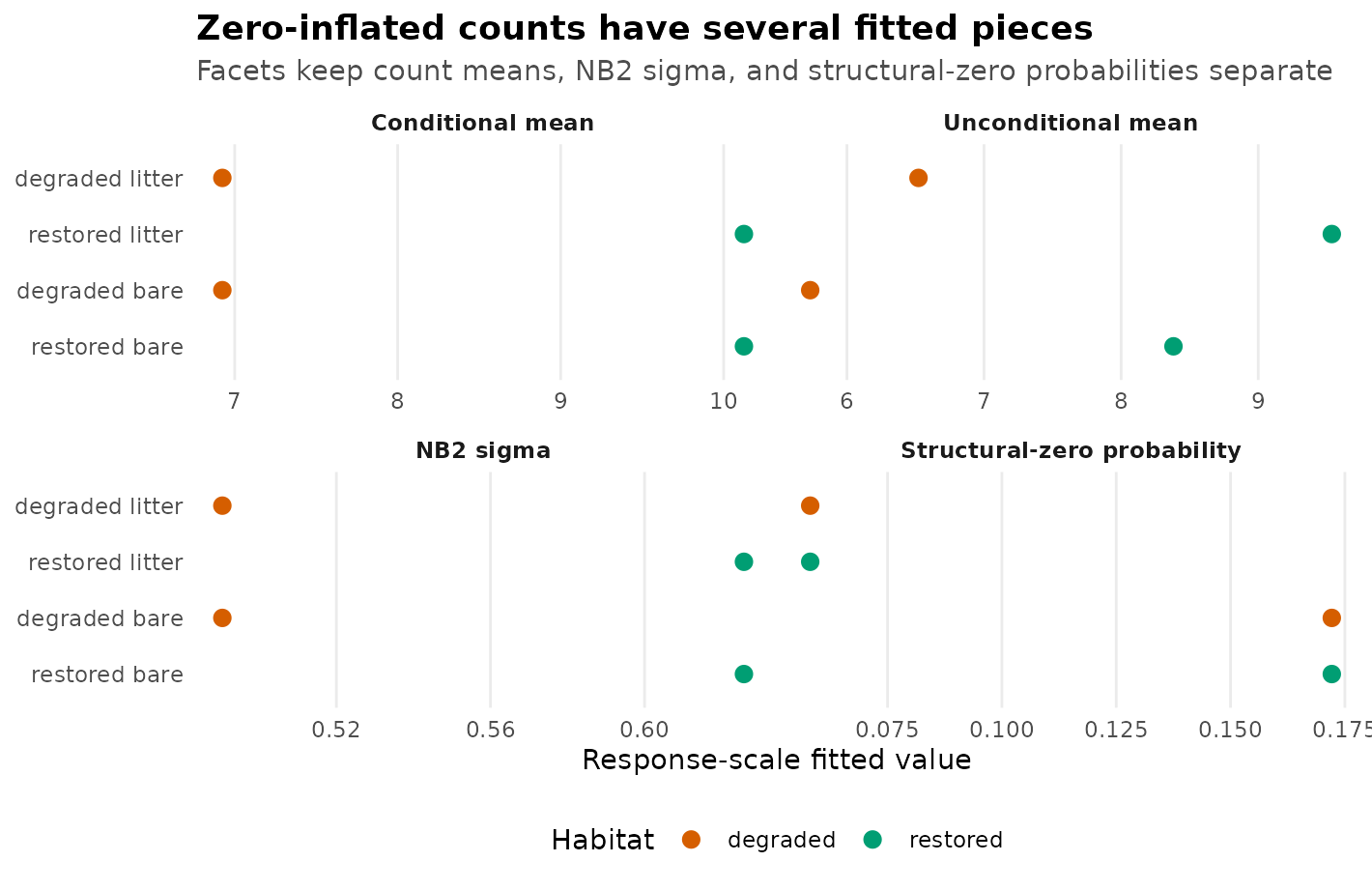
Response-scale model parts for the zero-inflated NB2 example. Points show fitted conditional counts, unconditional counts, NB2 extra-Poisson scale, and structural-zero probabilities on separate facets with their own x scales. No interval bars are drawn because this figure compares fitted components, not confidence intervals.
Use AIC only as one check, not as a substitute for the design story. A zero-inflated model needs a plausible structural-zero process such as bare soil, unsuitable host tissue, unsurveyable habitat, or true absence.
AIC(fit_nb2, fit_zinb2)
#>   df      AIC
#> 1  5 2270.559
#> 2  7 2223.058
Adding grouped or structured effects
If you repeatedly sample the same site, add an ordinary random
intercept (1 | site) to the count mean. An independent
numeric slope such as (0 + effort | site) lets the effect
of effort vary among sites. These mean effects are available for Poisson
and NB2 models without zero inflation. For NB2,
sigma ~ z + (1 | id) also lets extra-Poisson variation
differ among groups. Keep sigma free of random effects in
zero-inflated, hurdle, and zero-truncated models.
If your question concerns structural zeros, start with the fixed-effect model used above:
drmTMB(
  bf(count ~ habitat + offset(log(effort)), sigma ~ habitat, zi ~ surface),
  family = nbinom2(),
  data = dat
)
For dependence described by a tree, coordinates, pedigree, or
relatedness matrix, use phylo(), spatial(),
animal(), or relmat(), respectively. Poisson
and NB2 models without zero inflation allow one such term with an
intercept and one numeric slope in mu. NB2 allows the same
terms in sigma, fitted separately from the structured
mu term. For example, choose the first formula to model
species differences in mean abundance and its response to
x, or the second to model species differences in
overdispersion:
bf(count ~ habitat + phylo(1 + x | species, tree = tree), sigma ~ z)
bf(count ~ habitat, sigma ~ z + phylo(1 + x | species, tree = tree))
These structured count models can be used for point estimates in the
combinations shown above, but their confidence intervals have not yet
been shown to be reliable. Run check_drm(fit) after fitting
and consult Can I fit and report
this model? before reporting uncertainty. Slope-only structured
terms, more than one structured slope, and labelled covariance blocks
are not available.
For a hurdle NB2 model, you can explore whether related groups have
similar zero probabilities with one relatedness intercept in
hu. Supply either a covariance matrix K or its
precision matrix Q:
Zero-inflated Poisson also allows one spatial intercept in the zero
probability, zi ~ spatial(1 | id, coords = coords).
Alternatively, keep zero inflation constant and put the spatial
intercept in the mean:
# Poisson
bf(count ~ habitat + spatial(1 | site, coords = coords), zi ~ 1)
# NB2
bf(count ~ habitat + spatial(1 | site, coords = coords), sigma ~ 1, zi ~ 1)
The hurdle-relatedness and zero-inflated spatial models above have been checked for fitting and extracting results only. Their point-estimate accuracy and confidence intervals have not been validated. Use them for exploratory work; the fixed-effect example earlier in this tutorial is the starting point for learning how the zero and count components differ.
One NB2 model without zero inflation can combine a spatial mean
intercept with a relatedness mean intercept:
mu ~ spatial(1 | site, coords = coords) + relmat(1 | id, Q = Q).
Its point estimates have simulation checks, but its intervals do not.
This does not extend to other combinations of structured effects.
For your next fit, keep ordinary count slopes independent, use at
most the structured terms described above, and leave ordinary NB2
sigma slopes and sd(group) formulas out.
Zero-truncated NB2 allows ordinary mean intercepts and independent
slopes when there is no hu formula; an active hurdle
formula does not allow those mean random effects. Known sampling
covariance via meta_V(V = V), bivariate or mixed-response
count models, and COM-Poisson underdispersion models are unavailable. If
your design needs one of these, choose a model that supports it before
interpreting results. For underdispersed counts (variance below the
mean), glmmTMB offers the Conway-Maxwell-Poisson
compois() and generalized Poisson genpois()
families.
Working in Julia? The DRModels.jl
companion page mirrors this article with Julia syntax and states
which parts DRModels.jl supports today. DRModels.jl is a separate
package with its own fitting and inference routes; Julia is optional for
drmTMB users.