
This tutorial introduces bivariate location-scale regression with predictor-dependent residual correlation. It assumes the univariate location-scale reading pattern from When variance carries signal and extends it to two responses. The scientific idea is that two responses can change in mean, change in residual variance, and change in residual coupling.
Current fixed-effect syntax uses one formula per distributional parameter:
drmTMB(
  drm_formula(
    mu1 = y1 ~ x1 + x2,
    mu2 = y2 ~ x1,
    sigma1 = ~ x1 + x2,
    sigma2 = ~ x1,
    rho12 = ~ x1 + x2
  ),
  family = c(gaussian(), gaussian()),
  data = dat
)
The central modelling question is whether predictors change residual coupling between two responses, not only their means or variances.
The key parameter is rho12. A location-scale model asks
whether predictors change residual SDs. A location-coscale model asks
whether predictors also change the residual covariance structure between
two responses; in the current bivariate Gaussian model, that structure
is the residual correlation rho12. In ecology and
evolution, this can ask whether the residual association between traits
such as body mass and litter size differs among terrestrial, aquatic,
and aerial lifestyles after modelling response-specific means and
dispersion.
The bivariate Gaussian model
For observation i, the implemented fixed-effect
bivariate Gaussian model is:
\[ \begin{bmatrix} y_{1i} \\ y_{2i} \end{bmatrix} \mid \mu_{1i}, \mu_{2i}, \sigma_{1i}, \sigma_{2i}, \rho_{12i} \sim \operatorname{MVN} \left( \begin{bmatrix} \mu_{1i} \\ \mu_{2i} \end{bmatrix}, \Omega_i \right). \]
The five distributional predictors are:
\[ \begin{aligned} \mu_{1i} &= X_{\mu 1,i}\beta_{\mu 1}, \\ \mu_{2i} &= X_{\mu 2,i}\beta_{\mu 2}, \\ \log(\sigma_{1i}) &= X_{\sigma 1,i}\beta_{\sigma 1}, \\ \log(\sigma_{2i}) &= X_{\sigma 2,i}\beta_{\sigma 2}, \\ \eta_{\rho12,i} &= X_{\rho12,i}\beta_{\rho12}, \\ \rho_{12i} &= \tanh(\eta_{\rho12,i}). \end{aligned} \]
The residual covariance matrix is:
\[ \Omega_i = \begin{bmatrix} \sigma_{1i}^2 & \rho_{12i}\sigma_{1i}\sigma_{2i} \\ \rho_{12i}\sigma_{1i}\sigma_{2i} & \sigma_{2i}^2 \end{bmatrix}. \]
Component meanings:
| Component | Meaning |
|---|---|
mu1, mu2
|
expected values for responses 1 and 2 |
sigma1, sigma2
|
residual SDs for responses 1 and 2 |
eta_rho12 |
unconstrained linear predictor for residual correlation |
rho12 |
residual response-response correlation within observation
i
|
Omega_i |
residual covariance matrix after means and residual SDs are modelled |
For implementation cross-checking, the same model can also be written in a compact code-like form:
mu1_i = X_mu1[i, ] beta_mu1
mu2_i = X_mu2[i, ] beta_mu2
log(sigma1_i) = X_sigma1[i, ] beta_sigma1
log(sigma2_i) = X_sigma2[i, ] beta_sigma2
eta_rho12_i = X_rho12[i, ] beta_rho12
rho12_i = tanh(eta_rho12_i)
Omega_i[1, 1] = sigma1_i^2
Omega_i[2, 2] = sigma2_i^2
Omega_i[1, 2] = Omega_i[2, 1] = rho12_i * sigma1_i * sigma2_i
To keep covariance matrices strictly positive definite near their
boundaries, the fitted correlation is evaluated as
0.999999 * tanh(eta_rho12_i). This tiny safeguard is not a
biological scaling factor and does not change how you interpret the
model.
The matching drmTMB syntax is:
drmTMB(
  bf(
    mu1 = y1 ~ x1 + x2,
    mu2 = y2 ~ x1,
    sigma1 = ~ x1 + x2,
    sigma2 = ~ x1,
    rho12 = ~ x1 + x2
  ),
  family = c(gaussian(), gaussian()),
  data = dat
)
The mapping is:
| Symbol | Meaning | R syntax source |
|---|---|---|
y1_i, y2_i
|
observed responses | left-hand sides of mu1 and mu2
formulas |
X_mu1, X_mu2
|
response-specific mean design matrices | right-hand sides of mu1 and mu2
|
mu1_i, mu2_i
|
fitted response-specific means | columns of fitted(fit)
|
X_sigma1, X_sigma2
|
response-specific residual scale design matrices | right-hand sides of sigma1 and sigma2
|
X_rho12 |
residual correlation design matrix | right-hand side of rho12
|
sigma1_i, sigma2_i
|
residual SDs for responses 1 and 2 |
predict(fit, dpar = "sigma1"),
predict(fit, dpar = "sigma2")
|
rho12_i |
residual response-response correlation | rho12(fit) |
The fixed effects may be the same, overlapping, or different across
parameters. For example, x1 can appear in all five
formulae, while x2 might appear only in mu1,
sigma1, and rho12. Each parameter still gets
its own coefficient vector.
Read those coefficient vectors as separate biological statements:
| Formula | Example coefficient | Interpretation |
|---|---|---|
mu1 = y1 ~ x |
mu1:x |
predictor effect on the expected value of response 1 |
mu2 = y2 ~ x |
mu2:x |
predictor effect on the expected value of response 2 |
sigma1 = ~ x |
sigma1:x |
multiplicative change in residual SD for response 1 |
sigma2 = ~ x |
sigma2:x |
multiplicative change in residual SD for response 2 |
rho12 = ~ x |
rho12:x |
change in residual response-response coupling after both means and residual SDs are modelled |
The rho12 slope is not a slope for either response mean.
It is a slope on the correlation-link scale. Use
rho12(fit, newdata = grid) or a rho12 curve
when the reader needs the fitted residual correlation on the response
scale.
If both responses have the same location predictors,
mvbind() is a shorthand for the two location formulas:
drmTMB(
  bf(
    mvbind(y1, y2) ~ x1 + x2,
    sigma1 = ~ x1 + x2,
    sigma2 = ~ x1,
    rho12 = ~ x1 + x2
  ),
  family = c(gaussian(), gaussian()),
  data = dat
)
mvbind() is shorthand for
mu1 = y1 ~ x1 + x2 and mu2 = y2 ~ x1 + x2. Use
explicit mu1 and mu2 formulas whenever the
responses need different location predictors.
Worked example: behaviour coupling and disturbance
Suppose an ecologist measures two behaviours, activity and boldness, and wants to know whether an environmental gradient changes their residual coupling after accounting for response-specific means and residual SDs. The code below uses simulated data, but the model structure matches that scientific question.
For this example, the fitted biological model is:
\[ \begin{aligned} \begin{bmatrix} \text{activity}_i\\ \text{boldness}_i \end{bmatrix} &\sim \operatorname{MVN} \left( \begin{bmatrix} \mu_{\text{activity},i}\\ \mu_{\text{boldness},i} \end{bmatrix}, \Omega_i \right),\\ \mu_{\text{activity},i} &= \beta_{a0} + \beta_{a1}\text{food}_i + \beta_{a2}\text{temperature}_i,\\ \mu_{\text{boldness},i} &= \beta_{b0} + \beta_{b1}\text{food}_i,\\ \log(\sigma_{\text{activity},i}) &= \gamma_{a0} + \gamma_{a1}\text{food}_i + \gamma_{a2}\text{temperature}_i,\\ \log(\sigma_{\text{boldness},i}) &= \gamma_{b0} + \gamma_{b1}\text{food}_i,\\ \eta_{\rho12,i} &= \delta_0 + \delta_1\text{disturbance}_i,\\ \rho_{12,i} &= \tanh(\eta_{\rho12,i}). \end{aligned} \]
Here rho12 is not the ordinary correlation between raw
activity and raw boldness. It is the residual correlation after the
model has already adjusted for the mean and residual SD predictors in
each response.
set.seed(1)
n <- 180
dat <- data.frame(
  food = rnorm(n),
  temperature = rnorm(n),
  disturbance = rnorm(n)
)
mu1 <- 0.2 + 0.5 * dat$food + 0.2 * dat$temperature
mu2 <- -0.1 + 0.4 * dat$food
sigma1 <- exp(-0.2 + 0.2 * dat$food - 0.1 * dat$temperature)
sigma2 <- exp(0.1 - 0.2 * dat$food)
eta_rho12 <- -0.1 + 0.4 * dat$disturbance
rho12 <- tanh(eta_rho12)
e1 <- rnorm(n)
e2 <- rho12 * e1 + sqrt(1 - rho12^2) * rnorm(n)
dat$activity <- mu1 + sigma1 * e1
dat$boldness <- mu2 + sigma2 * e2
The model lets food and temperature explain
mean activity, lets food explain mean boldness, lets
food and temperature explain residual SD in
activity, lets food explain residual SD in boldness, and
lets disturbance explain residual correlation:
fit_biv <- drmTMB(
  drm_formula(
    mu1 = activity ~ food + temperature,
    mu2 = boldness ~ food,
    sigma1 = ~ food + temperature,
    sigma2 = ~ food,
    rho12 = ~ disturbance
  ),
  family = c(gaussian(), gaussian()),
  data = dat
)
Check the fit and inspect the coefficient table:
check_drm(fit_biv)
#> <drm_check: 18 checks>
#> ok: 18; notes: 0; warnings: 0; errors: 0
#> check status
#> optimizer_convergence ok
#> convergence_status ok
#> optimizer_budget ok
#> finite_objective ok
#> logsigma_clamp_active ok
#> fixed_gradient ok
#> sdreport_status ok
#> hessian_positive_definite ok
#> hessian_conditioning ok
#> standard_errors_finite ok
#> standard_errors_inflated ok
#> mle_existence ok
#> observations_per_parameter ok
#> fixed_effect_collinearity ok
#> dropped_rows ok
#> positive_scale ok
#> rho12_boundary ok
#> fixed_effect_design_size ok
#> value
#> 0
#> converged
#> iterations=19; function=30; gradient=19
#> 495.7
#> <NA>
#> max=0.000000004455; component=beta_sigma2[1]
#> ok
#> TRUE
#> min_eig=108.8; cond=5.003
#> range=[0.05053,0.08091]
#> n_inflated=0; max_se=0.08091; reference_median=0.05655
#> finite
#> n_obs=180; n_par=12; ratio=15.00
#> max_abs_r=0.02255
#> nobs=180; dropped=0
#> min=0.5408
#> 0.9633
#> total_mb=0.07536; max_cols=3; largest=mu1; largest_class=matrix; largest_density=1.000
#> message
#> nlminb convergence code is 0.
#> Optimizer convergence and uncertainty diagnostics are consistent with a proper interior optimum.
#> Optimizer evaluation counts recorded; no eval.max or iter.max control was supplied.
#> Objective and log-likelihood are finite.
#> The log(sigma) clamp is not active at the optimum.
#> Maximum absolute fixed gradient is <= 0.001; largest component is beta_sigma2[1].
#> TMB::sdreport() completed successfully.
#> sdreport reports a positive-definite Hessian.
#> Minimum eigenvalue and condition number of TMB's sdreport() fixed-effect covariance (sdr$cov.fixed), inverted. These are a genuinely different read of the fit's conditioning than TMB's internal pdHess flag -- comparable across fits, not claimed to be numerically identical to any raw TMB gradient or Hessian quantity. This fit's Hessian conditioning is within the requested threshold.
#> All fixed-effect standard errors are finite.
#> No fixed-effect standard error is inflated relative to the others.
#> The screened fixed-effect geometry is consistent with a finite maximum-likelihood estimate.
#> Observations per estimated parameter are at or above the small-samplenote threshold (10).
#> No fixed-effect design column pair exceeds the collinearity note threshold.
#> No rows were dropped by model-frame or known-covariance filtering.
#> All fitted scale values are finite and positive.
#> All fitted residual correlations have absolute value <= 0.98.
#> Dense fixed-effect design matrices are modest for this fit.
summary(fit_biv)
#> <summary.drmTMB>
#> estimator: ML
#> estimate std_error
#> mu1:(Intercept) 0.130704445 0.05416605
#> mu1:food 0.565333493 0.06286360
#> mu1:temperature 0.217923142 0.05437145
#> mu2:(Intercept) -0.081405809 0.07948981
#> mu2:food 0.330438769 0.08090952
#> sigma1:(Intercept) -0.155133250 0.05052620
#> sigma1:food 0.208913874 0.05454896
#> sigma1:temperature 0.003850302 0.05566017
#> sigma2:(Intercept) 0.209287826 0.05234182
#> sigma2:food -0.192523154 0.05744743
#> rho12:(Intercept) -0.004442688 0.07014721
#> rho12:disturbance 0.523482019 0.06355308
#> Distributional, random-effect, scale, and correlation parameters:
#> component dpar term estimate minimum
#> fitted:sigma1 distributional-scale sigma1 fitted range 0.88343684 0.5408477
#> fitted:sigma2 distributional-scale sigma2 fitted range 1.23862958 0.7764064
#> fitted:rho12 residual-correlation rho12 fitted range -0.02545523 -0.9184606
#> maximum scale
#> fitted:sigma1 1.4181049 response
#> fitted:sigma2 1.8882847 response
#> fitted:rho12 0.9633254 response
#> logLik: -495.7
#> convergence_status: converged
#> convergence: 0How to read this output:
- Rows beginning with
mu1:describe expected activity, and rows beginning withmu2:describe expected boldness. - Rows beginning with
sigma1:andsigma2:describe log residual SDs for activity and boldness. - Rows beginning with
rho12:describe the residual activity-boldness correlation on the linear-predictor scale. Userho12(fit_biv)orrho12(fit_biv, newdata = ...)to read that effect as a correlation.
The rho12 coefficients are on the linear-predictor
scale:
coef(fit_biv, "rho12")
#>  (Intercept)  disturbance
#> -0.004442688  0.523482019
head(rho12(fit_biv))
#> [1] -0.87673492  0.59373366 -0.32491962 -0.22558103 -0.09280983  0.30592387
corpairs() gives the same residual correlation in the
long correlation-pair format. The same table shape now also holds fitted
ordinary group-level and structured rows where their covariance routes
are fitted, including phylogenetic, coordinate-spatial, animal-model,
and relmat() q=2 or constant q=4 rows. Predictor-dependent
spatial, animal, relmat(), study-level, q=4,
residual-scale, and slope-specific corpair() regressions
remain planned:
corpairs(fit_biv)[
  c("level", "from_response", "to_response", "class", "parameter",
    "estimate", "min", "max", "modelled")
]
#>      level from_response to_response    class parameter    estimate        min
#> 1 residual      activity    boldness residual     rho12 -0.02545523 -0.9184606
#>         max modelled
#> 1 0.9633254     TRUE
The rho12 coefficients are fitted on the
linear-predictor scale eta_rho12; the response transform is
rho12 = tanh(eta_rho12) with the boundary safeguard
described above. Use rho12(fit) to read them as residual
correlations, and use corpairs(fit) to place residual
rho12 in a table that is ready to hold other correlation
levels later. In this example, a positive coefficient for
disturbance means that observations with larger disturbance
have stronger positive residual coupling between activity and boldness,
after the model has already accounted for the predictors in
mu1, mu2, sigma1, and
sigma2.
Keep the three correlation words separate:
| Word | Use it for | Do not use it for |
|---|---|---|
rho12 |
the residual bivariate Gaussian coscale formula and extractor | group-level, phylogenetic, spatial, animal-model, or known-matrix covariance |
corpair() |
a formula for an implemented predictor-dependent latent random-effect pair, currently selected q=2 ordinary and phylogenetic location-location routes | residual correlation or q=4, spatial, animal, relmat(),
residual-scale, and slope-specific correlation regressions |
corpairs() |
extracting fitted residual and latent correlation rows from the model object | asking the model to fit a new covariance structure |
A location-scale model changes sigma; a location-coscale
model changes residual rho12. A double-hierarchical or
structured covariance model may also report latent correlations through
corpairs(), but those rows answer questions about group,
phylogenetic, spatial, animal-model, or known-matrix deviations rather
than residual coupling within an observation.
newdat <- data.frame(
  food = 0,
  temperature = 0,
  disturbance = c(-1, 0, 1)
)
rho_table <- data.frame(
  disturbance = newdat$disturbance,
  sigma_activity = predict(fit_biv, newdata = newdat, dpar = "sigma1"),
  sigma_boldness = predict(fit_biv, newdata = newdat, dpar = "sigma2"),
  rho12 = rho12(fit_biv, newdata = newdat)
)
rho_table$residual_covariance <- with(
  rho_table,
  rho12 * sigma_activity * sigma_boldness
)
rho_table$residual_variance_activity <- rho_table$sigma_activity^2
rho_table$residual_variance_boldness <- rho_table$sigma_boldness^2
round(rho_table, 3)
#>   disturbance sigma_activity sigma_boldness  rho12 residual_covariance
#> 1          -1          0.856          1.233 -0.484              -0.511
#> 2           0          0.856          1.233 -0.004              -0.005
#> 3           1          0.856          1.233  0.477               0.503
#>   residual_variance_activity residual_variance_boldness
#> 1                      0.733                       1.52
#> 2                      0.733                       1.52
#> 3                      0.733                       1.52
This table gives three quantities a reader can report directly.
sigma_activity and sigma_boldness are the
fitted residual SDs for each response at the chosen covariate values.
rho12 is the fitted residual correlation between the two
responses. residual_covariance is the off-diagonal element
of \Omega_i, computed as
rho12 * sigma_activity * sigma_boldness. The two residual
variance columns are the diagonal elements of \Omega_i.
What should I report?
For a location-coscale model, a useful result sentence usually needs all three distributional pieces: means, residual SDs, and residual coupling. A minimal table for the coscale part is:
report_grid <- data.frame(
  food = 0,
  temperature = 0,
  disturbance = c(-1.5, 0, 1.5)
)
report_table <- data.frame(
  disturbance = report_grid$disturbance,
  eta_rho12 = predict(
    fit_biv,
    newdata = report_grid,
    dpar = "rho12",
    type = "link"
  ),
  rho12 = rho12(fit_biv, newdata = report_grid),
  sigma_activity = predict(fit_biv, newdata = report_grid, dpar = "sigma1"),
  sigma_boldness = predict(fit_biv, newdata = report_grid, dpar = "sigma2")
)
report_table$residual_covariance <- with(
  report_table,
  rho12 * sigma_activity * sigma_boldness
)
report_table$residual_variance_activity <- report_table$sigma_activity^2
report_table$residual_variance_boldness <- report_table$sigma_boldness^2
round(report_table, 3)
#>   disturbance eta_rho12  rho12 sigma_activity sigma_boldness
#> 1        -1.5    -0.790 -0.658          0.856          1.233
#> 2         0.0    -0.004 -0.004          0.856          1.233
#> 3         1.5     0.781  0.653          0.856          1.233
#>   residual_covariance residual_variance_activity residual_variance_boldness
#> 1              -0.695                      0.733                       1.52
#> 2              -0.005                      0.733                       1.52
#> 3               0.690                      0.733                       1.52
The raw correlation between activity and boldness is not the same
estimand as rho12. The raw correlation mixes mean
structure, residual SDs, and residual coupling. The fitted
rho12 is the residual correlation after the model has
accounted for the formulae in mu1, mu2,
sigma1, and sigma2:
round(data.frame(
  raw_activity_boldness_correlation = stats::cor(dat$activity, dat$boldness),
  mean_fitted_residual_rho12 = mean(rho12(fit_biv))
), 3)
#>   raw_activity_boldness_correlation mean_fitted_residual_rho12
#> 1                             0.021                     -0.025
When reporting this model, avoid saying only “activity and boldness were correlated”. A better sentence is: “After modelling response-specific means and residual SDs, the fitted residual activity-boldness correlation increased with disturbance.” That sentence tells the reader which correlation has been modelled.
The same response-scale result can be visualised as a
rho12 curve. Here the ribbon is a 95% Wald interval from
predict_parameters(). A predictor-dependent
rho12 has no single scalar target, so you must supply
newdata and the interval is computed for each supplied row;
confint(..., parm = "rho12", newdata = ..., method = "profile")
gives the profile counterpart. Treat both as computed but not
coverage-certified: no simulation study yet establishes their nominal
coverage for a regression rho12. Fit rho12 ~ 1
when you want the constant residual-correlation profile interval. That
interval is finite and can be reported, but its coverage is not
established: there is no bivariate fixed-effect confidence-interval
coverage study for this constant rho12 model.
rho_grid <- data.frame(
  food = 0,
  temperature = 0,
  disturbance = seq(-2, 2, length.out = 80)
)
rho_pred <- predict_parameters(
  fit_biv,
  newdata = rho_grid,
  dpar = "rho12",
  conf.int = TRUE
)
rho_grid$rho12 <- rho_pred$estimate
rho_grid$conf.low <- rho_pred$conf.low
rho_grid$conf.high <- rho_pred$conf.high

if (requireNamespace("ggplot2", quietly = TRUE)) {
  ggplot2::ggplot(rho_grid, ggplot2::aes(disturbance, rho12)) +
    ggplot2::geom_hline(yintercept = 0, linetype = "dotted", colour = "grey60") +
    ggplot2::geom_ribbon(
      ggplot2::aes(ymin = conf.low, ymax = conf.high),
      fill = "#006D77",
      alpha = 0.18,
      colour = NA
    ) +
    ggplot2::geom_line(linewidth = 0.9, colour = "#006D77") +
    ggplot2::coord_cartesian(ylim = c(-1, 1)) +
    ggplot2::labs(
      x = "Disturbance",
      y = "Fitted residual correlation (rho12)",
      title = "Residual coupling changes with disturbance",
      subtitle = "Ribbon is a 95% Wald interval; dotted line marks rho12 = 0"
    ) +
    ggplot2::theme_minimal(base_size = 11) +
    ggplot2::theme(
      panel.grid.minor = ggplot2::element_blank(),
      plot.title = ggplot2::element_text(face = "bold"),
      plot.subtitle = ggplot2::element_text(colour = "grey30"),
      plot.background = ggplot2::element_rect(fill = "white", colour = NA),
      panel.background = ggplot2::element_rect(fill = "white", colour = NA)
    )
} else {
  old_par <- graphics::par(bg = "white")
  on.exit(graphics::par(old_par), add = TRUE)
  plot(
    rho12 ~ disturbance,
    data = rho_grid,
    type = "l",
    lwd = 2,
    ylim = c(-1, 1),
    xlab = "Disturbance",
    ylab = "Fitted residual correlation (rho12)"
  )
  abline(h = 0, lty = 3, col = "grey60")
}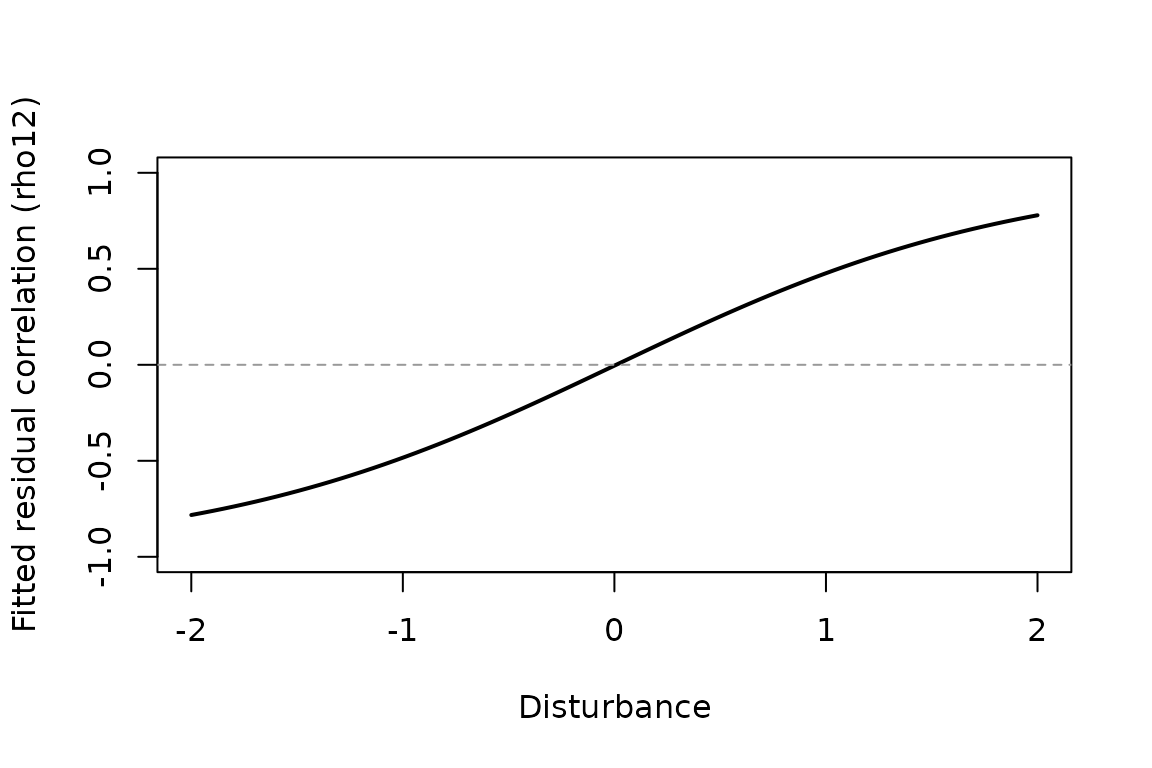
Fitted residual rho12 over disturbance after modelling
response-specific means and residual SDs; the ribbon is a 95% Wald
confidence interval computed for each supplied row (coverage not
certified) and the dotted line marks zero residual correlation.
In this example, a positive disturbance coefficient for
rho12 means that activity and boldness become more tightly
positively coupled at higher disturbance, after their means and residual
SDs have been modelled. It does not say that disturbance changes
among-individual personality or plasticity correlations; those require
group-level covariance blocks and should appear as separate rows in
corpairs(fit).
A concise reporting sentence would be: after accounting for food, temperature, and response-specific residual SDs, the fitted residual correlation between activity and boldness increased along the disturbance gradient. In biological terms, individuals that were more active than expected were also more bold than expected under higher disturbance.
Where residual rho12 stops
The fitted model above has no repeated-individual structure. It estimates residual coupling: whether two measurements from the same observation are closer together or farther apart than expected after modelling their means and residual SDs. That is useful, but it is not the same question as whether some individuals have consistently high activity and consistently high boldness.
For ecological and evolutionary examples, residual rho12
can represent changing residual coupling between traits such as activity
and boldness, body size and fecundity, or leaf area and seed number. A
group-level covariance block asks a different question: do groups,
individuals, species, or sites share latent deviations across fitted
components?
Worked example: individual differences
Suppose the same ecologist repeatedly measures each individual and now asks an individual-difference question. After accounting for food and disturbance, do individuals with higher average activity also tend to have higher average boldness?
The first fitted group-level version adds matching labelled random
intercepts in the mean structure. The shared p label
creates one covariance block for the mu1 and
mu2 random intercepts:
drmTMB(
  formula = bf(
    mu1 = activity ~ food + disturbance + (1 | p | ID),
    mu2 = boldness ~ food              + (1 | p | ID),
    sigma1 = ~1,
    sigma2 = ~1,
    rho12 = ~1,
    corpair(ID, level = "group", block = "p", from = "mu1", to = "mu2") ~ 1
  ),
  family = biv_gaussian(),
  data = dat_group
)
Here sigma1 and sigma2 are residual scale
parameters. Read the fitted group-level random-intercept SDs from
summary(fit)$parameters or their named rows in
profile_targets(fit); they are not residual
sigma.
Symbolically, the implemented random-intercept mean part is:
\[ \begin{aligned} \mu_{1ij} &= X_{\mu 1}[ij, ]\beta_{\mu 1} + b_{0,1j},\\ \mu_{2ij} &= X_{\mu 2}[ij, ]\beta_{\mu 2} + b_{0,2j},\\ \begin{bmatrix} b_{0,1j}\\ b_{0,2j} \end{bmatrix} &\sim \operatorname{MVN}(\mathbf{0}, \Sigma_{\mu,ID}). \end{aligned} \]
The covariance matrix Sigma_mu_ID contains two
group-level standard deviations and one group-level correlation. That
correlation answers whether individuals with higher average activity
also tend to have higher average boldness. It is not
rho12_i. The parameter rho12_i remains the
observation-level residual correlation in Omega_i.
The small simulation below creates repeated observations from that model:
set.seed(98)
n_ID <- 55
n_each <- 7
ID <- factor(rep(seq_len(n_ID), each = n_each))
id_index <- as.integer(ID)
n <- length(ID)

food <- rnorm(n)
disturbance <- rnorm(n)

sigma_activity <- 0.35
sigma_boldness <- 0.45
sd_activity_ID <- 0.65
sd_boldness_ID <- 0.65
rho_ID <- 0.55
rho_residual <- 0.15

u_activity <- rnorm(n_ID)
u_boldness <- rho_ID * u_activity + sqrt(1 - rho_ID^2) * rnorm(n_ID)

e_activity <- rnorm(n)
e_boldness <- rho_residual * e_activity +
  sqrt(1 - rho_residual^2) * rnorm(n)

dat_group <- data.frame(ID = ID, food = food, disturbance = disturbance)
dat_group$activity <- 0.25 + 0.45 * food + 0.15 * disturbance +
  sd_activity_ID * u_activity[id_index] + sigma_activity * e_activity
dat_group$boldness <- -0.15 + 0.35 * food +
  sd_boldness_ID * u_boldness[id_index] + sigma_boldness * e_boldness
Fit the grouped model with matching (1 | p | ID) terms
in the two location formulas:
fit_group <- drmTMB(
  bf(
    mu1 = activity ~ food + disturbance + (1 | p | ID),
    mu2 = boldness ~ food + (1 | p | ID),
    sigma1 = ~1,
    sigma2 = ~1,
    rho12 = ~1,
    corpair(ID, level = "group", block = "p", from = "mu1", to = "mu2") ~ 1
  ),
  family = biv_gaussian(),
  data = dat_group,
  control = list(eval.max = 500, iter.max = 500)
)
In a real analysis, inspect every row of
check_drm(fit_group). The filtered rows below show the
convergence and covariance checks most directly tied to this
individual-difference question:
group_checks <- check_drm(fit_group)
group_checks[
  group_checks$check %in% c(
    "optimizer_convergence",
    "random_effect_sd_boundary",
    "rho12_boundary",
    "biv_mu_random_effect_covariance"
  ),
  c("check", "status", "value", "message")
]
#> <drm_check: 4 of 21 checks shown>
#> ok: 3; notes: 1; warnings: 0; errors: 0
#>                            check status
#>            optimizer_convergence     ok
#>        random_effect_sd_boundary     ok
#>                   rho12_boundary     ok
#>  biv_mu_random_effect_covariance   note
#>                                                                                                                value
#>                                                                                                                    0
#>                                                             min=0.6263; boundary=0.0001000; term=mu.mu1:(1 | p | ID)
#>                                                                                                               0.1743
#>  class=mean-mean; rho_abs=   NA; boundary=0.9800; n_groups=55; min_group_n=7; singleton_groups=0; min_sd_ratio=1.414
#>                                                                                                                                                                                                     message
#>                                                                                                                                                                               nlminb convergence code is 0.
#>                                                                                All fitted random-effect standard deviations are finite, positive, and above the requested lower-boundary warning threshold.
#>                                                                                                                                               All fitted residual correlations have absolute value <= 0.98.
#>  The group-level correlation could not be extracted (it may be fixed via map, unmatched, or produced by a skipped sdreport). Inspect the sdreport and parameter mapping before interpreting the covariance.
Reading group-level covariance
corpairs() keeps residual and group-level correlations
in the same long table without giving them the same meaning. The
ordinary intercept-only q2 group row is interval-feasible but not
coverage-backed, so this article keeps both rows point-only rather than
presenting an unvalidated reporting interval:
pair_table <- corpairs(
  fit_group
)
pair_table[
  ,
  c(
    "level", "group", "block", "from_dpar", "to_dpar", "class",
    "parameter", "estimate", "conf.status", "interval_source", "modelled"
  )
]
#>      level group block from_dpar  to_dpar     class
#> 1 residual  <NA>  <NA>  residual residual  residual
#> 2    group    ID     p       mu1      mu2 mean-mean
#>                                       parameter  estimate   conf.status
#> 1                                         rho12 0.1743294 not_requested
#> 2 cor(mu1:(Intercept),mu2:(Intercept) | p | ID) 0.4752278 not_requested
#>   interval_source modelled
#> 1   not_available    FALSE
#> 2   not_available     TRUE
The optional plotting helper consumes that explicit table. Faceting
by level keeps the residual rho12 row visually
separate from the group-level random-intercept correlation:
if (requireNamespace("ggplot2", quietly = TRUE)) {
  pair_plot_table <- pair_table
  pair_plot_table$display_label <- ifelse(
    pair_plot_table$level == "residual",
    "Residual\nrho12",
    "Individual\nmean-mean"
  )
  plot_corpairs(pair_plot_table, label = "display_label", facet = NULL) +
    ggplot2::labs(
      title = "Residual and individual-level correlations are separate",
      subtitle = "Point estimates only; dotted line marks zero correlation",
      colour = NULL
    ) +
    ggplot2::theme_minimal(base_size = 11) +
    ggplot2::theme(
      panel.grid.minor = ggplot2::element_blank(),
      plot.title = ggplot2::element_text(face = "bold"),
      plot.subtitle = ggplot2::element_text(colour = "grey30"),
      legend.position = "none"
    )
}
Point display separating residual rho12 from the
individual-level mean-mean random-intercept correlation; the dotted line
marks zero correlation. The group row is not shown with an interval
because coverage-backed validation remains planned.
The residual row is rho12: within-observation
activity-boldness coupling. The group row is the
mu1/mu2 random-intercept correlation:
among-individual covariation in average activity and average
boldness.
summary(fit_group)$covariance gives the same group-level
row with the component SDs and covariance on the interpretation
scale:
group_covariance <- summary(fit_group)$covariance
report_group_covariance <- group_covariance[
  ,
  c(
    "level", "group", "block", "from_response", "to_response", "class",
    "correlation", "from_sd", "to_sd", "covariance", "from_scale",
    "to_scale", "covariance_conf.status"
  )
]
numeric_columns <- vapply(report_group_covariance, is.numeric, logical(1))
report_group_covariance[numeric_columns] <- lapply(
  report_group_covariance[numeric_columns],
  round,
  3
)
report_group_covariance
#>   level group block from_response to_response     class correlation from_sd
#> 1 group    ID     p      activity    boldness mean-mean       0.475   0.626
#>   to_sd covariance from_scale to_scale covariance_conf.status
#> 1 0.643      0.191   identity identity          not_requested
For this mean-mean block, from_sd is the
among-individual SD in average activity and to_sd is the
among-individual SD in average boldness. The correlation
column is the individual-level activity-boldness correlation, and
covariance is correlation * from_sd * to_sd.
The identity scale columns tell you these quantities are on
the response-location scale, not on a log residual-SD scale.
For this fitted block, check_drm() reports whether group
levels are replicated and whether either group-level SD is tiny relative
to the matching residual scale. A note there is not a proof that the
model is wrong; it tells you to inspect whether the group-level SDs and
correlation are supported by the data before treating them as biological
conclusions.
Use profile_targets(fit_group) before requesting profile
intervals for this block. The SDs are direct random-effect targets,
while the modelled corpair() row is a fixed-effect target
on the correlation-link scale:
group_targets <- profile_targets(fit_group)
group_cor_dpar <- 'corpair(ID, level = "group", block = "p", from = "mu1", to = "mu2")'
group_target_names <- c(
  "sd:mu:mu1:(1 | p | ID)",
  "sd:mu:mu2:(1 | p | ID)",
  paste0("fixef:", group_cor_dpar, ":(Intercept)")
)
group_targets[
  match(group_target_names, group_targets$parm),
  c("parm", "profile_ready", "profile_note")
]
#>                                                                                     parm
#> 13                                                                sd:mu:mu1:(1 | p | ID)
#> 14                                                                sd:mu:mu2:(1 | p | ID)
#> 9  fixef:corpair(ID, level = "group", block = "p", from = "mu1", to = "mu2"):(Intercept)
#>    profile_ready profile_note
#> 13          TRUE        ready
#> 14          TRUE        ready
#> 9           TRUE        ready
The group-level SD targets are named like
sd:mu:mu1:(1 | p | id) and
sd:mu:mu2:(1 | p | id). The modelled group-level
correlation target begins with fixef:corpair(...). A
confint(..., newdata = ...) call can diagnose its
response-scale profile geometry, but that callable target is not
coverage-backed interval evidence and was not used in the point-only
plot. These targets are separate from residual rho12.
Returned diagnostic profile rows include profile.boundary
and profile.message; a non-"ok" message is a
prompt to inspect check_drm(fit) and the profile path.
Slope-slope covariance
The first ordinary bivariate random-slope route asks a narrower
plasticity-syndrome question: do individuals with steeper response-1
slopes also tend to have steeper response-2 slopes for the same
predictor? It is a group-level covariance question, not residual
rho12.
For a shared predictor x, the fitted mean layer is:
\[ \begin{aligned} \mu_{1ij} &= X_{\mu 1}[ij, ]\beta_{\mu 1} + x_{ij}b_{1j},\\ \mu_{2ij} &= X_{\mu 2}[ij, ]\beta_{\mu 2} + x_{ij}b_{2j},\\ \begin{bmatrix} b_{1j}\\ b_{2j} \end{bmatrix} &\sim \operatorname{MVN}(\mathbf{0}, \Sigma_{\mu,x,ID}). \end{aligned} \]
The matching first-slice syntax uses slope-only labelled blocks in both location formulas:
drmTMB(
  bf(
    mu1 = y1 ~ x + (0 + x | p | id),
    mu2 = y2 ~ x + (0 + x | p | id),
    sigma1 = ~1,
    sigma2 = ~1,
    rho12 = ~1
  ),
  family = biv_gaussian(),
  data = dat
)
Read this model through the named SD rows in
summary(fit)$parameters for the two response-specific slope
SDs, corpairs(fit, class = "slope-slope") for the
group-level slope-slope correlation,
summary(fit)$covariance for the covariance table, and
profile_targets(fit) for the direct SD and correlation
target names. Run check_drm(fit) before interpreting the
row; the relevant diagnostic is the bivariate mu
random-effect covariance check, plus the ordinary convergence, Hessian,
and boundary checks.
This slope-only route deliberately excludes random intercepts from
the same labelled bivariate block. If the scientific question needs
baseline individual differences and slope differences in the same
two-response block, matching location blocks can use syntax such as
(1 + x | p | id) or (1 + x + z | p | id) in
both location formulas. Those combinations are not developed as full
teaching examples or broad simulation results. Matching
sigma1/sigma2 scale-slope blocks and
same-response mu/sigma slope covariance are
separate model combinations. Broader location-scale slope variants, and
any coverage or power claims for them, are not yet available.
Boundaries for this covariance layer
The middle p in (1 | p | ID) follows
grouped covariance-block syntax for correlated group-level effects. This
syntax is distinct from residual rho12. Use
rho12(fit) for within-observation residual coupling and
corpairs(fit, level = "group") for fitted ordinary
group-level covariance rows.
This example teaches only the mu1/mu2
random-intercept covariance row. Other implemented ordinary bivariate
random-intercept rows include sigma1/sigma2,
one same-response mu/sigma pair, and the
all-four
mu1/mu2/sigma1/sigma2
block. Read the all-four block as six rows: one
mu1-mu2 row, four mean-scale rows
(mu1-sigma1,
mu1-sigma2,
mu2-sigma1, and
mu2-sigma2), and one
sigma1-sigma2 row.
For a bivariate slope-slope model, use the matching
(0 + x | p | id) block in both mu1 and
mu2. Random effects in rho12, bivariate
meta_V() with random effects, mixed-response families, and
ordinary spatial group-level covariance are not available in this
tutorial. For phylogenetic covariance, continue to the
structural-dependence tutorial and keep those rows separate from both
ordinary group-level covariance and residual rho12.
Working in Julia? The DRModels.jl
companion page mirrors this article with Julia syntax and states
which parts DRModels.jl supports today. DRModels.jl is a separate
package with its own fitting and inference routes; Julia is optional for
drmTMB users.