
Continuous biological and environmental measurements, such as seedling height growth in centimetres, often contain a few large residuals. They may be real rare events, short-term stress responses, field measurement problems, or individuals that experienced unmeasured conditions. A Gaussian location-scale model can still be useful, but a Student-t model asks a slightly different question: are the location and scale patterns stable when the likelihood allows heavier tails?
This article introduces the first implemented robust continuous
family in drmTMB: fixed-effect Student-t
location-scale-shape regression. It builds on the location-scale reading
pattern from When variance carries
signal and adds a third parameter. Here location means the expected
response parameter mu, scale means the positive Student-t
core scale sigma, and shape means the tail parameter
nu. This one-response model has no coscale term; in
drmTMB, coscale means modelling residual correlation, such
as bivariate rho12.
Model equation and R syntax
The Student-t model has three distributional parameters:
The matching drmTMB syntax is:
Here mu is the expected response, sigma is
the Student-t scale parameter, and nu is the tail-shape
parameter. When nu > 2, the residual standard deviation
is sigma * sqrt(nu / (nu - 2)), so sigma
should not be read as the exact residual SD unless nu is
large. Smaller nu means heavier tails. Large
nu means the Student-t likelihood is close to Gaussian. In
drmTMB,
so fitted nu values stay above 2. This keeps the fitted
Student-t distribution in the finite-variance region.
A seedling growth example
Suppose seedlings are grown under ambient and dry conditions, and growth is measured as height increase in centimetres. We expect drought to reduce average growth, and we also allow drought to change scale among seedlings.
library(drmTMB)

set.seed(101)
n <- 180
seedlings <- data.frame(
  drought = factor(rep(c("ambient", "dry"), each = n / 2))
)
dry <- as.numeric(seedlings$drought == "dry")
mu <- 1.2 - 0.45 * dry
sigma <- exp(-1 + 0.35 * dry)
seedlings$growth <- mu + sigma * rt(n, df = 5)
In the equation above, dry_i is the model-matrix
indicator for the dry treatment level. It corresponds to the
droughtdry coefficient printed by R.
A Gaussian location-scale model is a useful baseline:
fit_gaussian <- drmTMB(
  bf(growth ~ drought, sigma ~ drought),
  family = gaussian(),
  data = seedlings
)
The robust version keeps the same location and scale formulas, then
adds a formula for nu:
fit_student <- drmTMB(
  bf(growth ~ drought, sigma ~ drought, nu ~ 1),
  family = student(),
  data = seedlings
)
The extra line nu ~ 1 says that the tail-shape parameter
is estimated as a constant across observations. Predictor-varying
fixed-effect nu formulas are also supported. For example,
nu ~ drought asks whether the residual tails are heavier in
the dry treatment than in the ambient treatment after mu
and sigma have been modelled. This first tutorial keeps
nu constant so the comparison focuses on location, scale,
and residual-tail assumptions.
Check the fitted robust model
Run check_drm() before interpreting the Student-t
coefficients:
student_checks <- check_drm(fit_student)
student_checks
#> <drm_check: 17 checks>
#> ok: 17; notes: 0; warnings: 0; errors: 0
#> check status
#> optimizer_convergence ok
#> convergence_status ok
#> optimizer_budget ok
#> finite_objective ok
#> logsigma_clamp_active ok
#> fixed_gradient ok
#> sdreport_status ok
#> hessian_positive_definite ok
#> hessian_conditioning ok
#> standard_errors_finite ok
#> standard_errors_inflated ok
#> mle_existence ok
#> observations_per_parameter ok
#> dropped_rows ok
#> positive_scale ok
#> student_nu ok
#> fixed_effect_design_size ok
#> value
#> 0
#> converged
#> iterations=23; function=36; gradient=24
#> 144.6
#> <NA>
#> max=0.000000000003259; component=beta_mu[1]
#> ok
#> TRUE
#> min_eig=1.037; cond=748.6
#> range=[0.04836,0.9790]
#> n_inflated=0; max_se=0.9790; reference_median=0.1110
#> finite
#> n_obs=180; n_par=5; ratio=36.00
#> nobs=180; dropped=0
#> min=0.4116
#> range=[9.615,9.615]
#> total_mb=0.04302; max_cols=2; largest=mu; largest_class=matrix; largest_density=0.7500
#> message
#> nlminb convergence code is 0.
#> Optimizer convergence and uncertainty diagnostics are consistent with a proper interior optimum.
#> Optimizer evaluation counts recorded; no eval.max or iter.max control was supplied.
#> Objective and log-likelihood are finite.
#> The log(sigma) clamp is not active at the optimum.
#> Maximum absolute fixed gradient is <= 0.001; largest component is beta_mu[1].
#> TMB::sdreport() completed successfully.
#> sdreport reports a positive-definite Hessian.
#> Minimum eigenvalue and condition number of TMB's sdreport() fixed-effect covariance (sdr$cov.fixed), inverted. These are a genuinely different read of the fit's conditioning than TMB's internal pdHess flag -- comparable across fits, not claimed to be numerically identical to any raw TMB gradient or Hessian quantity. This fit's Hessian conditioning is within the requested threshold.
#> All fixed-effect standard errors are finite.
#> No fixed-effect standard error is inflated relative to the others.
#> The screened fixed-effect geometry is consistent with a finite maximum-likelihood estimate.
#> Observations per estimated parameter are at or above the small-samplenote threshold (10).
#> No rows were dropped by model-frame or known-covariance filtering.
#> All fitted scale values are finite and positive.
#> All fitted Student-t nu values are finite and above the boundary at 2.
#> Dense fixed-effect design matrices are modest for this fit.
student_checks[
student_checks$check == "student_nu",
c("status", "value", "message")
]
#> <drm_check: 1 of 17 checks shown>
#> ok: 1; notes: 0; warnings: 0; errors: 0
#> status value
#> ok range=[9.615,9.615]
#> message
#> All fitted Student-t nu values are finite and above the boundary at 2.The student_nu row inspects fitted response-scale
nu values. A near-boundary warning means the tail-shape
parameter is close to 2, where the finite-variance constraint matters. A
large-nu note means the Student-t fit may be close to a
Gaussian fit. If nu is large, report that the Student-t fit
is close to Gaussian and check whether the Gaussian and Student-t
mu and sigma conclusions differ. If
nu is near the boundary, inspect influential observations,
compare Gaussian and Student-t conclusions, and report that the fitted
tail-shape parameter is near the lower bound.
Keep the student_nu status beside AIC, coefficient, and
simulation-summary tables. An ok row supports reading the
fitted nu as an ordinary finite-variance Student-t shape
estimate. A note or warning should travel with
the result, because it changes how a reader should interpret the tail
assumption even when the optimizer converged.
Interpret coefficients by parameter
Location and scale coefficients use the same formula grammar as Gaussian location-scale models:
coef(fit_student, "mu")
#> (Intercept)  droughtdry
#>   1.2084533  -0.4493227
coef(fit_student, "sigma")
#> (Intercept)  droughtdry
#>  -0.8877248   0.3309563
coef(fit_student, "nu")
#> (Intercept)
#>    2.030157
The mu coefficient for droughtdry estimates
the drought difference in expected growth. The sigma
coefficient for droughtdry is on the log Student-t
scale-parameter scale: a positive value means the fitted scale is larger
under drought. The nu coefficient is on the link scale for
nu = 2 + exp(eta_nu). Use prediction to read
nu on the response scale:
Compare with the Gaussian model
For this simulated example, the two models share mu and
sigma formulas: does drought reduce growth, and does it
change scale? They differ in the residual-tail assumption.
AIC(fit_gaussian, fit_student)
#>   df      AIC
#> 1  4 299.2362
#> 2  5 299.1516
AIC is only one summary. The more important habit is to inspect
whether the scientific conclusions about mu and
sigma are sensitive to the residual tail assumption.
coef(fit_gaussian, "mu")
#> (Intercept)  droughtdry
#>    1.224279   -0.489904
coef(fit_student, "mu")
#> (Intercept)  droughtdry
#>   1.2084533  -0.4493227

coef(fit_gaussian, "sigma")
#> (Intercept)  droughtdry
#>  -0.7835869   0.3472756
coef(fit_student, "sigma")
#> (Intercept)  droughtdry
#>  -0.8877248   0.3309563
library(ggplot2)

student_plot_grid <- data.frame(
  drought = factor(c("ambient", "dry"), levels = levels(seedlings$drought))
)
student_plot_means <- rbind(
  data.frame(
    student_plot_grid,
    model = "Gaussian",
    fitted_mu = predict(fit_gaussian, newdata = student_plot_grid, dpar = "mu")
  ),
  data.frame(
    student_plot_grid,
    model = "Student-t",
    fitted_mu = predict(fit_student, newdata = student_plot_grid, dpar = "mu")
  )
)

ggplot(seedlings, aes(drought, growth, colour = drought)) +
  geom_jitter(width = 0.12, height = 0, alpha = 0.22, size = 1.1) +
  geom_point(
    data = student_plot_means,
    aes(y = fitted_mu, shape = model),
    position = position_dodge(width = 0.35),
    size = 3.2,
    stroke = 1.1
  ) +
  scale_colour_manual(values = c("ambient" = "#0072B2", "dry" = "#D55E00")) +
  scale_shape_manual(values = c("Gaussian" = 16, "Student-t" = 1)) +
  labs(
    title = "Robust fits should be checked against the raw tails",
    subtitle = "Points are observed growth values; symbols are fitted expected growth",
    x = "Drought treatment",
    y = "Growth",
    colour = "Treatment",
    shape = "Model"
  ) +
  guides(colour = "none") +
  theme_minimal(base_size = 11) +
  theme(
    panel.grid.minor = element_blank(),
    legend.position = "bottom",
    plot.title = element_text(face = "bold"),
    plot.subtitle = element_text(colour = "grey30")
  )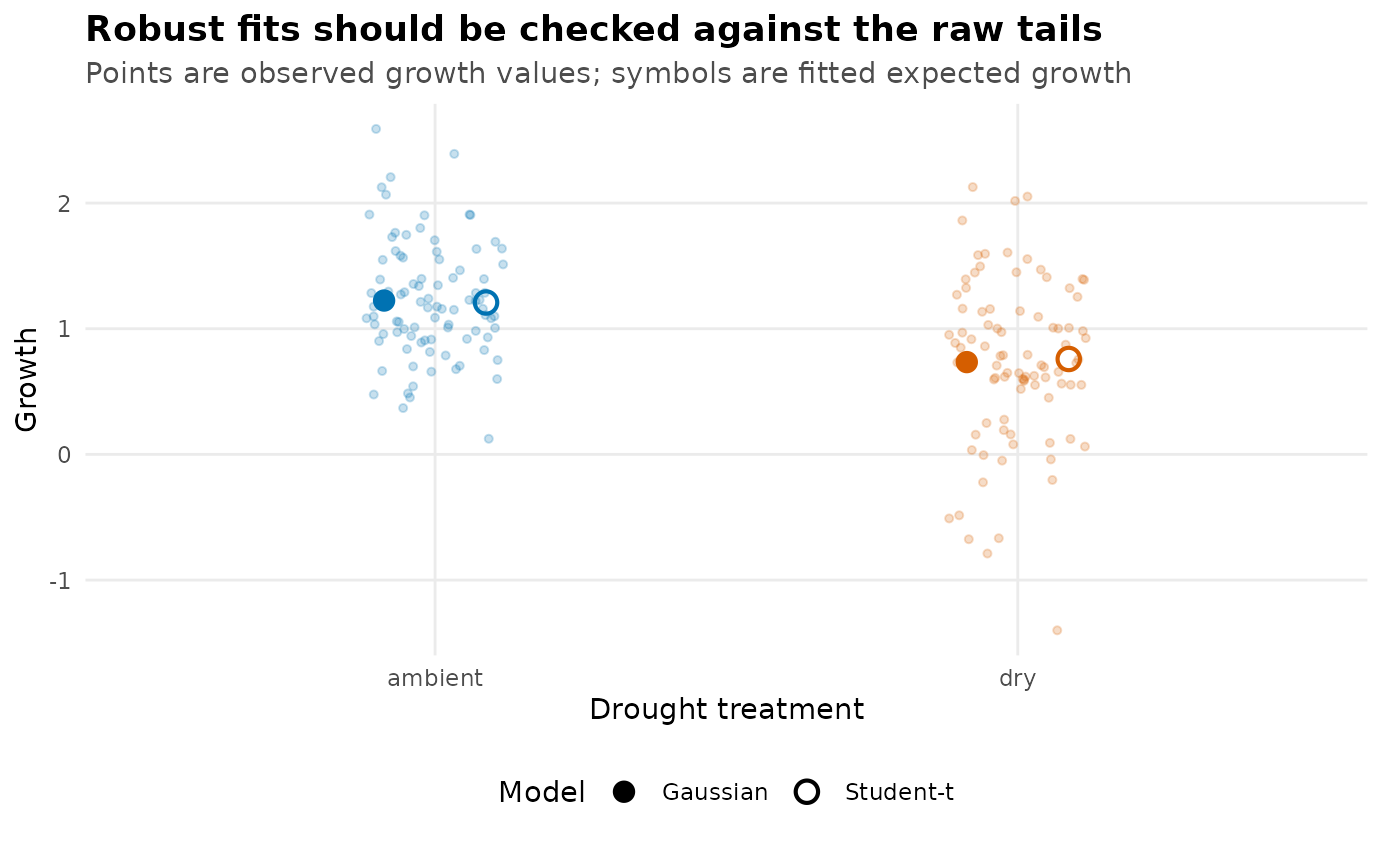
Robust-model check for the seedling example. Faint points show observed growth values; overlaid points compare fitted Gaussian and Student-t expected growth by drought treatment. No interval bars are drawn because this fixture is a raw-data and fitted-point comparison, not an interval summary.
If the mu and sigma conclusions change
strongly, the large residuals are not a side detail. They are part of
the distributional story and should be reported.
Current boundary
The implemented Student-t path is intentionally narrow:
Student mu random intercepts and independent slopes, a
spatial mu term
(spatial(1 | id, coords = coords)), and a phylogenetic
nu term are implemented, but only as point-estimate-only or
diagnostic-only routes: they fit as point estimates and are not
coverage-validated, so trust the point estimate, not the interval, and
treat them as exploratory. Correlated slopes, labelled covariance
blocks, scale (sigma) and shape (nu) random
effects, known sampling covariance (meta_V), other
structured terms, and bivariate Student-t models remain planned
extensions. Start with this fixed-effect path when you need a robust
continuous comparison to a Gaussian location-scale model.
Skew-normal residual asymmetry is a separate fitted fixed-effect family:
drmTMB(
  bf(y ~ x1, sigma ~ x2, nu ~ x3),
  family = skew_normal(),
  data = dat
)
Use this model when the question is residual asymmetry rather than
heavy tails. The fitted first slice has density, Gaussian-limit,
positive- and negative-skew recovery, false-positive, and
interval-visibility checks. Random effects, known covariance, structured
effects, bivariate skew-normal models, residual rho12,
aliases such as skew ~ x, and ID-level skewness such as
future skew(id) ~ x remain later routes. Gaussian,
Student-t, and skew-normal fits answer different residual-distribution
questions, so compare them as sensitivity models rather than
aliases.
Working in Julia? The DRModels.jl
companion page mirrors this article with Julia syntax and states
which parts DRModels.jl supports today. DRModels.jl is a separate
package with its own fitting and inference routes; Julia is optional for
drmTMB users.