
Proportions and success rates
Source:vignettes/proportion-beta-binomial.Rmd
proportion-beta-binomial.RmdProportion data are common in ecology and evolution, but the measurement process matters. Some proportions are counts of successes out of known trials: germinated seeds out of seeds planted, infected hosts out of hosts checked, or occupied quadrats out of quadrats surveyed. Other proportions are continuous rates already measured on the unit interval, such as leaf damage, vegetation cover, or the fraction of time an animal spends foraging. This tutorial assumes the location-scale reading pattern from When variance carries signal and extends it to a bounded response.
This article stays inside the currently implemented
drmTMB bounded-response surface:
- use
stats::binomial(link = "logit")for ordinary 0/1 events or counted successes out of known trials with binomial sampling variation only; - use
beta_binomial()for counted successes out of known trials when extra-binomial variation is part of the scientific question; - use
beta_family()for continuous proportions strictly inside(0, 1); - use
zero_one_beta()for continuous proportions on[0, 1]when exact 0 or 1 values are structural outcomes rather than trial-count outcomes.
The source motivation comes from Nakagawa et al. (2026), who treat overdispersed proportions as part of the same location-scale framework as continuous and count responses. They distinguish discrete proportions from continuous proportions, recommend beta-binomial models for successes out of trials when extra-binomial variation is present, and warn that exact 0 or 1 values in continuous beta responses need explicit zero-one processes rather than being hidden by the model.
Choose The Proportion Route
Start from how the response was measured:
| Response | Example | First drmTMB family |
Boundary status |
|---|---|---|---|
| 0/1 event indicator | early NDVI onset, host infected or not, quadrat occupied or not | stats::binomial(link = "logit") |
rows are ordinary Bernoulli trials; no modelled
sigma
|
| Counted successes out of trials with ordinary binomial variation | germinated seeds out of planted seeds | stats::binomial(link = "logit") |
successes can be 0 or all trials through the binomial count process |
| Counted successes out of trials with extra-binomial variation | germinated seeds out of planted seeds, with tray-to-tray probability scatter | beta_binomial() |
adds modelled sigma for variation beyond binomial
sampling |
Continuous proportion strictly inside (0, 1)
|
leaf-area damage, vegetation cover, foraging time fraction | beta_family() |
exact 0 or 1 is not supported by the strict beta likelihood |
| Continuous proportion with structural 0 or 1 values | 0% disease, 100% cover, complete absence or saturation | zero_one_beta() |
zoi models exact boundary mass; coi models
exact ones among boundary observations |
The distinction is not cosmetic. A denominator-aware model knows that
3 successes out of 6 trials and 30 successes out of 60 trials carry
different sampling information. A strict beta model assumes the
observation is already a continuous rate and that the boundaries are not
part of the observed support. For denominator-aware responses, write
cbind(successes, failures). Do not write
weights = trials, successes / trials, or
cbind(successes, trials): top-level weights are likelihood
weights, and the second column of a two-column binomial response is
failures, not trial totals.
Plain Binomial Equation And Syntax
Use stats::binomial(link = "logit") when the response is
an event probability and ordinary binomial sampling variation is
enough:
For a 0/1 response, :
drmTMB(
  bf(early_onset ~ canopy + ndvi),
  family = stats::binomial(link = "logit"),
  data = onset_data
)
For success counts, keep both the successes and failures:
drmTMB(
  bf(cbind(germinated, failed) ~ treatment + moisture),
  family = stats::binomial(link = "logit"),
  data = seed_trials
)
The fitted mu is the event probability.
fitted(fit) and predict(fit, dpar = "mu")
return probabilities; multiply by successes_i + failures_i
only when the target summary is the expected number of successes.
Here is a small 0/1 event example. Suppose each site is scored for whether a vegetation index crosses an early-season threshold. The model asks how canopy condition and spring NDVI change that event probability:
set.seed(196)
n_onset <- 240
onset_data <- data.frame(
  canopy = factor(
    rep(c("open", "closed"), each = n_onset / 2),
    levels = c("open", "closed")
  ),
  ndvi = as.numeric(scale(runif(n_onset, 0.15, 0.85)))
)

closed <- as.numeric(onset_data$canopy == "closed")
mu_onset <- plogis(-0.85 - 0.35 * closed + 1.10 * onset_data$ndvi)
onset_data$early_onset <- rbinom(n_onset, size = 1, prob = mu_onset)

fit_onset <- drmTMB(
  bf(early_onset ~ canopy + ndvi),
  family = stats::binomial(link = "logit"),
  data = onset_data
)

coef(fit_onset, "mu")
#>  (Intercept) canopyclosed         ndvi
#>  -0.77939914   0.04603729   0.82133405
Predicted probabilities are already on the response scale:
new_onset <- data.frame(
  canopy = factor(c("open", "closed"), levels = levels(onset_data$canopy)),
  ndvi = c(0, 0)
)

data.frame(
  canopy = new_onset$canopy,
  ndvi = new_onset$ndvi,
  early_onset_probability = predict(fit_onset, newdata = new_onset, dpar = "mu")
)
#>   canopy ndvi early_onset_probability
#> 1   open    0               0.3144494
#> 2 closed    0               0.3244574
The original plain-binomial slice was fixed-effect only. The current
R engine also fits ordinary unlabelled mu random intercepts
and independent numeric slopes (point estimate only). It still rejects
non-logit links, factor responses, proportions with trial weights,
correlated or labelled slopes, structured effects, or bivariate or mixed
responses. engine = "julia" fits plain binomial
fixed-effect models only.
Beta-Binomial Equation And Syntax
Use beta_binomial() when the response is still successes
out of known trials but the probability varies more than ordinary
binomial sampling can explain. The model uses
The matching drmTMB syntax is:
drmTMB(
  bf(cbind(germinated, failed) ~ treatment + moisture, sigma ~ treatment),
  family = beta_binomial(),
  data = seed_trials
)
This fixed-effect-only call also works through
engine = "julia" and has been checked against the same
model fitted with engine = "tmb"; see the family table in
vignette("julia-engine", package = "drmTMB"). Adding the
random intercept below is not admitted through
engine = "julia" yet.
If trays, plots, or subjects are repeatedly observed, the first
fitted mixed-model slice is an ordinary mu random
intercept, optionally paired with an independent numeric mu
slope:
drmTMB(
  bf(cbind(germinated, failed) ~ treatment + moisture +
       (1 | tray) + (0 + moisture | tray),
     sigma ~ treatment),
  family = beta_binomial(),
  data = seed_trials
)
The random effects change the logit success-probability predictor.
They do not make sigma a random effect, and they do not
open correlated slopes or structured bounded-response effects.
Read each parameter before interpreting the fitted model:
| Symbol or syntax | Meaning | In the seed-germination example |
|---|---|---|
,
germinated
|
number of successes | seeds that germinated in tray |
,
germinated + failed
|
known number of trials | viable seeds planted in tray |
,
mu
|
expected success probability | germination probability for a seed in that tray |
| location coefficients on the logit probability scale | treatment and moisture effects on germination probability | |
,
sigma
|
extra-binomial scale | tray-to-tray probability variation beyond binomial sampling |
| beta precision |
phi_i = 1 / sigma_i^2, so larger sigma
means lower precision |
|
scale coefficients on the log sigma scale |
treatment effects on extra-binomial variation |
If gamma_1 is the sheltered-treatment coefficient,
then
That second ratio reverses direction because
.
In drmTMB, report sigma when you want the
direction to mean more or less modelled variation.
Seed Germination Example
Suppose seeds are planted in trays under open and sheltered microsites during a restoration trial. Shelter may increase average germination by reducing heat stress, and it may also make tray outcomes more predictable by buffering microclimate. Each tray has a known number of seeds, so the denominator belongs in the model.
This transparent simulation gives us known structure before fitting:
set.seed(197)
n <- 360
seed_trials <- data.frame(
  treatment = factor(
    rep(c("open", "sheltered"), each = n / 2),
    levels = c("open", "sheltered")
  ),
  moisture = as.numeric(scale(runif(n, 0.1, 0.9))),
  trials = sample(18:32, n, replace = TRUE)
)

sheltered <- as.numeric(seed_trials$treatment == "sheltered")
mu_seed <- plogis(-0.55 + 0.70 * sheltered + 0.45 * seed_trials$moisture)
sigma_seed <- exp(-1.15 - 0.35 * sheltered)
phi_seed <- 1 / sigma_seed^2
tray_probability <- rbeta(
  n,
  shape1 = mu_seed * phi_seed,
  shape2 = (1 - mu_seed) * phi_seed
)

seed_trials$germinated <- rbinom(n, size = seed_trials$trials, prob = tray_probability)
seed_trials$failed <- seed_trials$trials - seed_trials$germinated

head(seed_trials)
#>   treatment    moisture trials germinated failed
#> 1      open  0.79595177     24          4     20
#> 2      open -0.09180242     19          9     10
#> 3      open -1.42799682     29          6     23
#> 4      open -1.54868848     21          3     18
#> 5      open  1.65321214     30         20     10
#> 6      open  0.27586227     20          3     17
Fit the beta-binomial location-scale model:
fit_seed <- drmTMB(
  bf(cbind(germinated, failed) ~ treatment + moisture, sigma ~ treatment),
  family = beta_binomial(),
  data = seed_trials
)
Run diagnostics before interpreting coefficients:
check_drm(fit_seed)
#> <drm_check: 17 checks>
#> ok: 17; notes: 0; warnings: 0; errors: 0
#> check status
#> optimizer_convergence ok
#> convergence_status ok
#> optimizer_budget ok
#> finite_objective ok
#> logsigma_clamp_active ok
#> fixed_gradient ok
#> sdreport_status ok
#> hessian_positive_definite ok
#> hessian_conditioning ok
#> standard_errors_finite ok
#> standard_errors_inflated ok
#> mle_existence ok
#> observations_per_parameter ok
#> fixed_effect_collinearity ok
#> dropped_rows ok
#> positive_scale ok
#> fixed_effect_design_size ok
#> value
#> 0
#> converged
#> iterations=26; function=37; gradient=27
#> 991.7
#> <NA>
#> max=0.000000002862; component=beta_sigma[1]
#> ok
#> TRUE
#> min_eig=60.53; cond=17.70
#> range=[0.03677,0.1156]
#> n_inflated=0; max_se=0.1156; reference_median=0.07301
#> finite
#> n_obs=360; n_par=5; ratio=72.00
#> max_abs_r=0.07772
#> nobs=360; dropped=0
#> min=0.2520
#> total_mb=0.06031; max_cols=3; largest=mu; largest_class=matrix; largest_density=0.8333
#> message
#> nlminb convergence code is 0.
#> Optimizer convergence and uncertainty diagnostics are consistent with a proper interior optimum.
#> Optimizer evaluation counts recorded; no eval.max or iter.max control was supplied.
#> Objective and log-likelihood are finite.
#> The log(sigma) clamp is not active at the optimum.
#> Maximum absolute fixed gradient is <= 0.001; largest component is beta_sigma[1].
#> TMB::sdreport() completed successfully.
#> sdreport reports a positive-definite Hessian.
#> Minimum eigenvalue and condition number of TMB's sdreport() fixed-effect covariance (sdr$cov.fixed), inverted. These are a genuinely different read of the fit's conditioning than TMB's internal pdHess flag -- comparable across fits, not claimed to be numerically identical to any raw TMB gradient or Hessian quantity. This fit's Hessian conditioning is within the requested threshold.
#> All fixed-effect standard errors are finite.
#> No fixed-effect standard error is inflated relative to the others.
#> The screened fixed-effect geometry is consistent with a finite maximum-likelihood estimate.
#> Observations per estimated parameter are at or above the small-samplenote threshold (10).
#> No fixed-effect design column pair exceeds the collinearity note threshold.
#> No rows were dropped by model-frame or known-covariance filtering.
#> All fitted scale values are finite and positive.
#> Dense fixed-effect design matrices are modest for this fit.The mu coefficients describe the log-odds of
germination. The sigma coefficients describe extra-binomial
variation in the latent tray-level success probability:
coef(fit_seed, "mu")
#>        (Intercept) treatmentsheltered           moisture
#>         -0.5127801          0.6006851          0.4683621
coef(fit_seed, "sigma")
#>        (Intercept) treatmentsheltered
#>         -1.1893289         -0.1889245

sigma_ratio <- exp(coef(fit_seed, "sigma")["treatmentsheltered"])
c(
  sigma_ratio_sheltered_vs_open = sigma_ratio,
  precision_ratio_sheltered_vs_open = sigma_ratio^(-2)
)
#>     sigma_ratio_sheltered_vs_open.treatmentsheltered
#>                                             0.827849
#> precision_ratio_sheltered_vs_open.treatmentsheltered
#>                                             1.459143
For a response-scale summary, predict the expected success probability and the proportion-level standard deviation for trays with the same number of seeds:
new_seed_trays <- data.frame(
  treatment = factor(c("open", "sheltered"), levels = levels(seed_trials$treatment)),
  moisture = c(0, 0),
  trials = c(24, 24)
)

mu_hat <- predict(fit_seed, newdata = new_seed_trays, dpar = "mu")
sigma_hat <- predict(fit_seed, newdata = new_seed_trays, dpar = "sigma")
prop_var <- mu_hat * (1 - mu_hat) *
  (1 + new_seed_trays$trials * sigma_hat^2) /
  (new_seed_trays$trials * (1 + sigma_hat^2))

data.frame(
  treatment = new_seed_trays$treatment,
  trials = new_seed_trays$trials,
  expected_probability = mu_hat,
  expected_successes = new_seed_trays$trials * mu_hat,
  sigma = sigma_hat,
  phi = 1 / sigma_hat^2,
  proportion_sd = sqrt(prop_var)
)
#>   treatment trials expected_probability expected_successes     sigma      phi
#> 1      open     24            0.3745420           8.989009 0.3044255 10.79041
#> 2 sheltered     24            0.5219621          12.527090 0.2520183 15.74475
#>   proportion_sd
#> 1     0.1697106
#> 2     0.1570889
This table keeps the two parts of the question separate: expected germination probability and extra-binomial scatter around that probability.
library(ggplot2)

seed_trials$observed_proportion <- seed_trials$germinated / seed_trials$trials
seed_plot_summary <- data.frame(
  treatment = new_seed_trays$treatment,
  expected_probability = mu_hat,
  proportion_sd = sqrt(prop_var)
)
seed_plot_summary$lower <- pmax(
  0,
  seed_plot_summary$expected_probability - seed_plot_summary$proportion_sd
)
seed_plot_summary$upper <- pmin(
  1,
  seed_plot_summary$expected_probability + seed_plot_summary$proportion_sd
)

ggplot(seed_trials, aes(treatment, observed_proportion, colour = treatment)) +
  geom_jitter(width = 0.12, height = 0, alpha = 0.18, size = 0.9) +
  geom_errorbar(
    data = seed_plot_summary,
    aes(
      y = expected_probability,
      ymin = lower,
      ymax = upper
    ),
    width = 0.12,
    linewidth = 0.8
  ) +
  geom_point(data = seed_plot_summary, aes(y = expected_probability), size = 3) +
  scale_colour_manual(values = c("open" = "#0072B2", "sheltered" = "#009E73")) +
  coord_cartesian(ylim = c(0, 1)) +
  labs(
    title = "Denominator-aware proportions can still show raw trays",
    subtitle = "Bars show fitted tray-level scatter, not confidence intervals",
    x = "Microsite treatment",
    y = "Germinated proportion",
    colour = "Treatment"
  ) +
  guides(colour = "none") +
  theme_minimal(base_size = 11) +
  theme(
    panel.grid.minor = element_blank(),
    legend.position = "bottom",
    plot.title = element_text(face = "bold"),
    plot.subtitle = element_text(colour = "grey30")
  )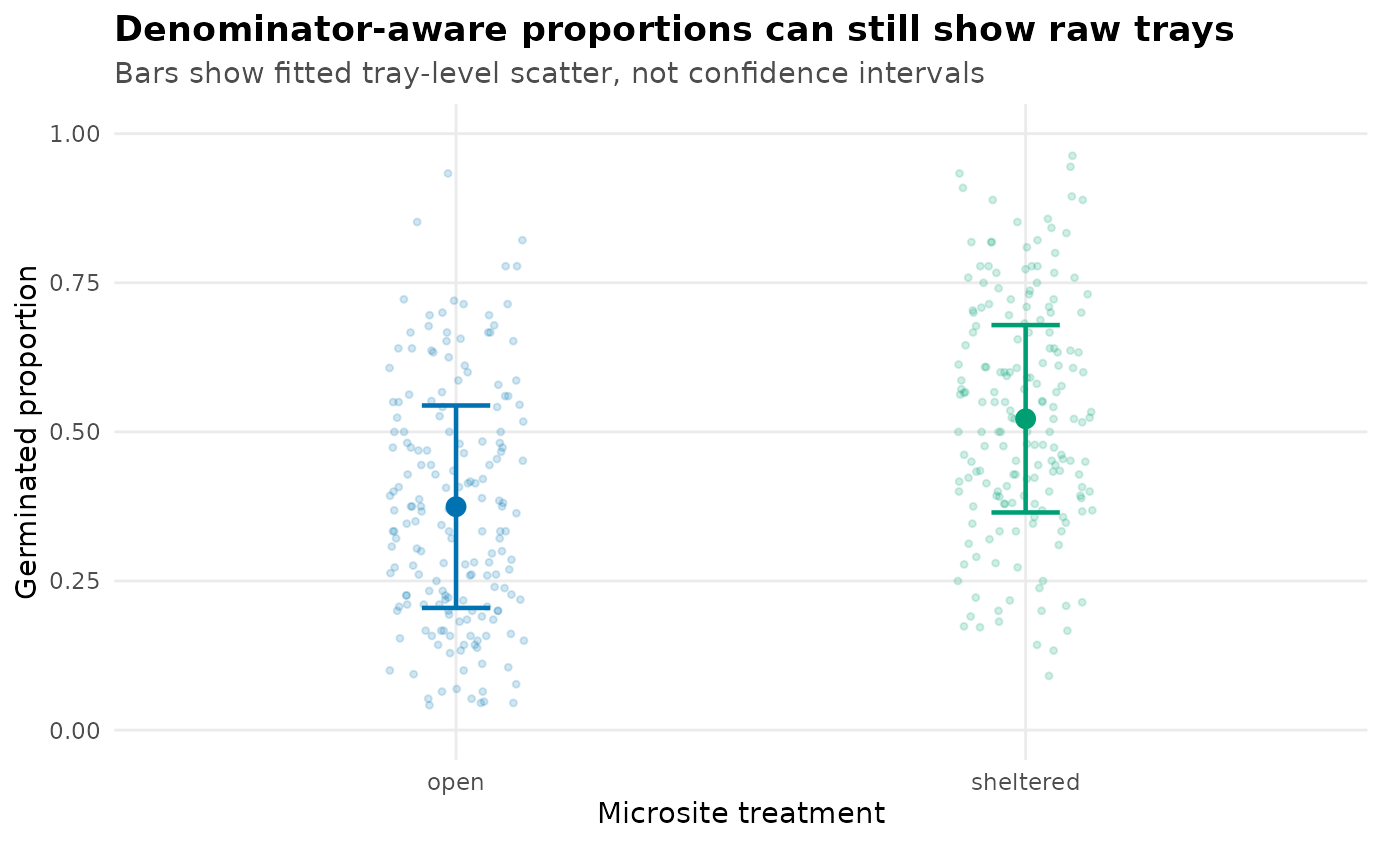
Beta-binomial tray summary for the seed-germination example. Faint points are observed tray proportions; overlaid points are fitted expected germination probabilities; vertical bars show plus or minus one fitted proportion-level standard deviation, not confidence intervals.
Strict Continuous Proportions
Use beta_family() when the response is a continuous
proportion strictly inside the open interval. For example, vegetation
cover measured from image analysis may record 0.03, 0.41, or 0.82 rather
than successes out of a known number of quadrats. The beta model
uses
The fitted syntax is the same one-formula-per-parameter pattern:
drmTMB(
  bf(cover ~ grazing + moisture, sigma ~ grazing),
  family = beta_family(),
  data = cover_data
)
A small transparent example:
set.seed(198)
n_cover <- 300
cover_data <- data.frame(
grazing = factor(
rep(c("ungrazed", "grazed"), each = n_cover / 2),
levels = c("ungrazed", "grazed")
),
moisture = as.numeric(scale(runif(n_cover, 0.05, 0.95)))
)
grazed <- as.numeric(cover_data$grazing == "grazed")
mu_cover <- plogis(0.35 - 0.75 * grazed + 0.35 * cover_data$moisture)
sigma_cover <- exp(-1.10 + 0.45 * grazed)
phi_cover <- 1 / sigma_cover^2
cover_data$cover <- rbeta(
n_cover,
shape1 = mu_cover * phi_cover,
shape2 = (1 - mu_cover) * phi_cover
)
fit_cover <- drmTMB(
bf(cover ~ grazing + moisture, sigma ~ grazing),
family = beta_family(),
data = cover_data
)
check_drm(fit_cover)
#> <drm_check: 17 checks>
#> ok: 17; notes: 0; warnings: 0; errors: 0
#> check status
#> optimizer_convergence ok
#> convergence_status ok
#> optimizer_budget ok
#> finite_objective ok
#> logsigma_clamp_active ok
#> fixed_gradient ok
#> sdreport_status ok
#> hessian_positive_definite ok
#> hessian_conditioning ok
#> standard_errors_finite ok
#> standard_errors_inflated ok
#> mle_existence ok
#> observations_per_parameter ok
#> fixed_effect_collinearity ok
#> dropped_rows ok
#> positive_scale ok
#> fixed_effect_design_size ok
#> value
#> 0
#> converged
#> iterations=28; function=38; gradient=29
#> -93.38
#> <NA>
#> max=0.000000002464; component=beta_sigma[1]
#> ok
#> TRUE
#> min_eig=99.86; cond=9.753
#> range=[0.04484,0.09263]
#> n_inflated=0; max_se=0.09263; reference_median=0.05555
#> finite
#> n_obs=300; n_par=5; ratio=60.00
#> max_abs_r=0.008792
#> nobs=300; dropped=0
#> min=0.3531
#> total_mb=0.05065; max_cols=3; largest=mu; largest_class=matrix; largest_density=0.8333
#> message
#> nlminb convergence code is 0.
#> Optimizer convergence and uncertainty diagnostics are consistent with a proper interior optimum.
#> Optimizer evaluation counts recorded; no eval.max or iter.max control was supplied.
#> Objective and log-likelihood are finite.
#> The log(sigma) clamp is not active at the optimum.
#> Maximum absolute fixed gradient is <= 0.001; largest component is beta_sigma[1].
#> TMB::sdreport() completed successfully.
#> sdreport reports a positive-definite Hessian.
#> Minimum eigenvalue and condition number of TMB's sdreport() fixed-effect covariance (sdr$cov.fixed), inverted. These are a genuinely different read of the fit's conditioning than TMB's internal pdHess flag -- comparable across fits, not claimed to be numerically identical to any raw TMB gradient or Hessian quantity. This fit's Hessian conditioning is within the requested threshold.
#> All fixed-effect standard errors are finite.
#> No fixed-effect standard error is inflated relative to the others.
#> The screened fixed-effect geometry is consistent with a finite maximum-likelihood estimate.
#> Observations per estimated parameter are at or above the small-samplenote threshold (10).
#> No fixed-effect design column pair exceeds the collinearity note threshold.
#> No rows were dropped by model-frame or known-covariance filtering.
#> All fitted scale values are finite and positive.
#> Dense fixed-effect design matrices are modest for this fit.Here, grazing changes both expected cover and the variation of cover among sampling units:
coef(fit_cover, "mu")
#>   (Intercept) grazinggrazed      moisture
#>     0.3732654    -0.7837743     0.3590291
coef(fit_cover, "sigma")
#>   (Intercept) grazinggrazed
#>    -1.0410602     0.3442403

new_cover <- data.frame(
  grazing = factor(c("ungrazed", "grazed"), levels = levels(cover_data$grazing)),
  moisture = c(0, 0)
)

mu_cover_hat <- predict(fit_cover, newdata = new_cover, dpar = "mu")
sigma_cover_hat <- predict(fit_cover, newdata = new_cover, dpar = "sigma")

data.frame(
  grazing = new_cover$grazing,
  expected_cover = mu_cover_hat,
  sigma = sigma_cover_hat,
  phi = 1 / sigma_cover_hat^2,
  cover_sd = sqrt(
    mu_cover_hat * (1 - mu_cover_hat) *
      sigma_cover_hat^2 / (1 + sigma_cover_hat^2)
  )
)
#>    grazing expected_cover     sigma      phi  cover_sd
#> 1 ungrazed      0.5922478 0.3530802 8.021459 0.1636106
#> 2   grazed      0.3987901 0.4981670 4.029490 0.2183350
Do not use this strict beta route if the observed response includes
exact 0 or 1 values. A sprayed plot with 0% damage or a quadrat with
100% cover is a boundary-generating process, not an interior beta
observation. Use zero_one_beta() when those endpoints are
structural outcomes.
Continuous Proportions With Exact Boundaries
Use zero_one_beta() when the response is a continuous
proportion on [0, 1] and exact 0 or 1 values are generated
by a separate boundary process. The interior observations still use the
beta mean-scale model. The two extra probability formulas describe the
boundary process:
drmTMB(
  bf(cover ~ grazing, sigma ~ grazing, zoi ~ drought, coi ~ canopy),
  family = zero_one_beta(),
  data = cover_data
)
predict(fit, dpar = "mu") describes the mean among
interior observations. predict(fit, dpar = "zoi") is the
probability of an exact boundary outcome, and
predict(fit, dpar = "coi") is the probability that a
boundary outcome is exactly 1. fitted(fit) returns the
unconditional mean (1 - zoi) * mu + zoi * coi, which is
usually the response-scale summary an applied reader expects.
zero_one_beta() needs both kinds of boundary value to
estimate coi. If the response has exact zeroes but no exact
ones (or the reverse), coi runs to its boundary,
check_drm() reports the fit as degenerate, and
is_converged() returns FALSE; an omitted
coi formula still means coi ~ 1, so it cannot
be dropped. For such data fit two parts instead:
beta_family() for the values strictly inside
(0, 1) and stats::binomial(link = "logit") for
the indicator of an exact boundary value. Because the zero-one beta
likelihood factorises, the two parts give the same mu,
sigma, and zoi estimates without the
unidentified coi. drmTMB has no ordered-beta family.
Current Boundary
The implemented bounded-response path is univariate. Use
stats::binomial(link = "logit") for ordinary fixed-effect
event probability models, beta_binomial() for overdispersed
counted successes and failures, beta_family() for a single
continuous proportion strictly between 0 and 1, and
zero_one_beta() for a single continuous proportion with
structural exact 0 or 1 values. beta_family() and
beta_binomial() support ordinary unlabelled mu
random intercepts and independent numeric slopes as first mixed-model
slices:
drmTMB(
  bf(cbind(successes, failures) ~ treatment + dose +
       (1 | id) + (0 + dose | id),
     sigma ~ treatment),
  family = beta_binomial(),
  data = dat
)
drmTMB(
  bf(proportion ~ treatment + dose + (1 | id) + (0 + dose | id),
     sigma ~ treatment),
  family = beta_family(),
  data = dat
)
Do not teach the following as fitted proportion examples yet:
- correlated random slopes, labelled covariance blocks, or random
effects in
sigma,zoi, orcoi; -
sd(group) ~ ...random-effect scale models; -
meta_V(V = V), or deprecatedmeta_known_V(V = V)for compatibility, with beta or beta-binomial responses; -
phylo(),spatial(),animal(), orrelmat()bounded-response models, with one exception:beta_family()already accepts a single unlabelledanimal()term – an intercept or one-slope onmu, or an intercept onsigma, one endpoint at a time – but that route is point estimate only (trust the point estimate, not the interval), so it is held back here on tier grounds, not for want of likelihood code; - bivariate or mixed-response bounded models such as
family = c(beta_family(), gaussian()); - ordered beta or beta-binomial zero-inflation;
- denominator shorthand such as
successes / trials,weights = trials, orcbind(successes, trials)as a replacement forcbind(successes, failures).
Most of those are useful future routes that still need likelihood code, simulation recovery, diagnostics, and source-map evidence before they become tutorial syntax.
Working in Julia? The DRModels.jl
companion page mirrors this article with Julia syntax and states
which parts DRModels.jl supports today. DRModels.jl is a separate
package with its own fitting and inference routes; Julia is optional for
drmTMB users.