
When variance carries signal, Part 1: location-scale models
Source:vignettes/location-scale.Rmd
location-scale.RmdThis tutorial starts with a biological question: do two habitats
differ only in mean growth, or does one habitat also make growth less
predictable? In a Gaussian location-scale model, the location part
models the expected response mu, while the scale part
models the residual standard deviation sigma. That residual
scale is not just a nuisance parameter; it can be the scientific answer
when the question is about individual variability, predictability, or
remaining heterogeneity after the mean model is accounted for.
This is Part 1 of a two-article sequence. It models the response mean
mu and the residual standard deviation sigma.
Continue to Part 2:
location-scale-scale models when a predictor should model the
standard deviation of a latent group or phylogenetic random effect
through sd().
Read this after you have fit a first model in Distributional regression with drmTMB and
confirmed Gaussian is the right family in Choosing response families; this
tutorial goes deeper into interpreting mu and
sigma once that choice is made.
If you are fitting your first model, start with the worked growth example, then return to the syntax overview below when you want to adapt the formula.
The core Gaussian location-scale route supports fixed effects,
optional random effects in the location formula, and residual-scale
random intercepts and independent random slopes in the
sigma formula. The same pattern is used throughout the
documentation: write the model symbolically first, show the matching R
syntax, fit the model, and interpret the fitted output.
Model equations and matching R syntax
For Gaussian location-scale regression, each estimated parameter has its own linear predictor:
The matching syntax is:
The location formula defines the design matrix for beta;
the scale formula defines the design matrix for gamma. The
log link keeps the fitted residual SD positive.
| Quantity | R source | Interpretation |
|---|---|---|
mu_i |
y ~ x |
expected response |
beta |
coef(fit, "mu") |
additive effects on the expected response |
sigma_i |
sigma ~ z |
residual SD around the fitted mean |
gamma |
coef(fit, "sigma") |
effects on log residual SD |
Grouped effects do not change the meaning of sigma
A random intercept in the location model adds among-group variation in expected responses:
Here sd_mu_group is the SD of group-level mean
deviations. It is not the residual SD sigma. A random
effect inside the sigma formula asks a third question: do
groups differ in their residual variability?
A random effect on log(sigma) has no closed-form
marginal likelihood, so drmTMB integrates it with TMB’s Laplace
approximation. The sigma coefficients are then conditional
effects on log(sigma) for a typical group (group deviation
zero); they are not effects on the log of the group-averaged residual
SD. For the Gaussian family, DRModels.jl integrates this term by default
with 32-node Gauss-Hermite quadrature per group, with per-group Laplace
as an option (see the implementation map in the DRModels.jl
documentation). The two engines target the same estimand, but their
approximations can differ when groups have few observations or the scale
random-effect SD is large; on one unbalanced simulated design the two
scale random-effect SD estimates differed by about 2% (0.135 and
0.132).
More elaborate ordinary intercept-slope blocks and their covariance output are documented in Which scale are you modelling? and Structural dependence. To model predictors of the group-level SD itself, continue to Part 2: location-scale-scale models.
Interpret sigma on the SD or variance scale
Because log(sigma_i) = z_i^T gamma, exponentiating a
scale coefficient gives an SD ratio. If
gamma_temperature = 0.3, then a one-unit temperature
increase multiplies residual SD by exp(0.3) = 1.35.
Squaring the ratio gives the residual-variance ratio,
exp(2 * 0.3) = 1.82.
Working directly in Julia? The DRModels.jl
companion tutorial uses the same explicit SD- and variance-ratio
reporting scales with Julia syntax. DRModels.jl has its own fitting and
inference routes; Julia remains optional for drmTMB
users.
| Formula component | Report | Biological reading |
|---|---|---|
growth ~ temperature |
beta_temperature |
additive change in expected growth |
sigma ~ temperature |
exp(gamma_temperature) |
residual-SD ratio per temperature unit |
(0 + temperature | population) in mu
|
random-slope SD | variation among population-specific mean slopes |
sigma ~ (0 + temperature | population) |
residual-scale random-slope SD | variation among population-specific log-SD slopes |
Name the measured response and model component before stating a
biological conclusion. “Temperature-dependent variability” is ambiguous
until the reader knows whether the model changed residual
sigma, a mean random-slope SD, or a random effect inside
sigma.
Worked example: growth mean and predictability
Suppose an ecologist measures juvenile growth in two habitats and records the temperature at each observation. The location question is whether mean growth differs between habitats and changes with temperature. The scale question is whether residual growth variability differs between habitats after accounting for those mean effects.
For this example, the fitted model is:
The matching drmTMB syntax is:
drmTMB(
  drm_formula(growth ~ habitat + temperature, sigma ~ habitat),
  family = gaussian(),
  data = dat
)
The code below simulates one dataset with the same structure. Simulated data keep the vignette small and reproducible; a real analysis would replace this block with field or laboratory measurements.
set.seed(42)
n <- 240
dat <- data.frame(
  habitat = factor(rep(c("forest", "grassland"), each = n / 2)),
  temperature = rnorm(n)
)

mu <- 8 + 1.2 * (dat$habitat == "grassland") + 0.6 * dat$temperature
sigma_true <- exp(log(0.6) + 0.55 * (dat$habitat == "grassland"))
dat$growth <- rnorm(n, mean = mu, sd = sigma_true)
Fit the location-scale model:
fit_growth <- drmTMB(
  drm_formula(growth ~ habitat + temperature, sigma ~ habitat),
  family = gaussian(),
  data = dat
)
Before interpreting coefficients, check the fitted object:
check_drm(fit_growth)
#> <drm_check: 17 checks>
#> ok: 17; notes: 0; warnings: 0; errors: 0
#> check status
#> optimizer_convergence ok
#> convergence_status ok
#> optimizer_budget ok
#> finite_objective ok
#> logsigma_clamp_active ok
#> fixed_gradient ok
#> sdreport_status ok
#> hessian_positive_definite ok
#> hessian_conditioning ok
#> standard_errors_finite ok
#> standard_errors_inflated ok
#> mle_existence ok
#> observations_per_parameter ok
#> fixed_effect_collinearity ok
#> dropped_rows ok
#> positive_scale ok
#> fixed_effect_design_size ok
#> value
#> 0
#> converged
#> iterations=19; function=33; gradient=19
#> 279.3
#> <NA>
#> max=0.0000000000002069; component=beta_mu[1]
#> ok
#> TRUE
#> min_eig=77.84; cond=8.082
#> range=[0.04551,0.1102]
#> n_inflated=0; max_se=0.1102; reference_median=0.06466
#> finite
#> n_obs=240; n_par=5; ratio=48.00
#> max_abs_r=0.07076
#> nobs=240; dropped=0
#> min=0.5633
#> total_mb=0.04107; max_cols=3; largest=mu; largest_class=matrix; largest_density=0.8333
#> message
#> nlminb convergence code is 0.
#> Optimizer convergence and uncertainty diagnostics are consistent with a proper interior optimum.
#> Optimizer evaluation counts recorded; no eval.max or iter.max control was supplied.
#> Objective and log-likelihood are finite.
#> The log(sigma) clamp is not active at the optimum.
#> Maximum absolute fixed gradient is <= 0.001; largest component is beta_mu[1].
#> TMB::sdreport() completed successfully.
#> sdreport reports a positive-definite Hessian.
#> Minimum eigenvalue and condition number of TMB's sdreport() fixed-effect covariance (sdr$cov.fixed), inverted. These are a genuinely different read of the fit's conditioning than TMB's internal pdHess flag -- comparable across fits, not claimed to be numerically identical to any raw TMB gradient or Hessian quantity. This fit's Hessian conditioning is within the requested threshold.
#> All fixed-effect standard errors are finite.
#> No fixed-effect standard error is inflated relative to the others.
#> The screened fixed-effect geometry is consistent with a finite maximum-likelihood estimate.
#> Observations per estimated parameter are at or above the small-samplenote threshold (10).
#> No fixed-effect design column pair exceeds the collinearity note threshold.
#> No rows were dropped by model-frame or known-covariance filtering.
#> All fitted scale values are finite and positive.
#> Dense fixed-effect design matrices are modest for this fit.Before choosing an interval, check which parameters can be profiled. For this fixed-effect example, every coefficient is a direct profile target:
profile_targets(fit_growth)[
  ,
  c("parm", "estimate", "profile_ready", "profile_note")
]
#>                           parm   estimate profile_ready profile_note
#> 1         fixef:mu:(Intercept)  7.9948257          TRUE        ready
#> 2    fixef:mu:habitatgrassland  1.2068572          TRUE        ready
#> 3         fixef:mu:temperature  0.5745454          TRUE        ready
#> 4      fixef:sigma:(Intercept) -0.5740190          TRUE        ready
#> 5 fixef:sigma:habitatgrassland  0.6376432          TRUE        ready
Now print the coefficient table:
summary(fit_growth)
#> <summary.drmTMB>
#> estimator: ML
#>                          estimate  std_error
#> mu:(Intercept)          7.9948257 0.05143581
#> mu:habitatgrassland     1.2068572 0.11021157
#> mu:temperature          0.5745454 0.04550928
#> sigma:(Intercept)      -0.5740190 0.06466072
#> sigma:habitatgrassland  0.6376432 0.09160079
#> Distributional, random-effect, scale, and correlation parameters:
#>                         component  dpar         term  estimate   minimum
#> fitted:sigma distributional-scale sigma fitted range 0.8144745 0.5632571
#>               maximum    scale
#> fitted:sigma 1.065692 response
#> Derived summaries: This fit has a sigma predictor, a non-log link, or a
#> known-dispersion override, so a single scalar residual variance is not defined.
#> Random-effect SD estimates remain available in $sdpars.
#> logLik: -279.3
#> convergence_status: converged
#> convergence: 0
How to read this output:
- Rows beginning with
mu:are mean-growth effects on the response scale. For example,mu:temperatureis the expected change in mean growth for a one-unit increase in temperature. - Rows beginning with
sigma:are log-residual-standard-deviation effects. For example,sigma:habitatgrasslandis not an additive change in growth; it is a log-scale change in residual variability. - Exponentiating a
sigmacoefficient gives the multiplicative change in residual standard deviation.
sigma_habitat <- coef(fit_growth, "sigma")["habitatgrassland"]
data.frame(
  coefficient = sigma_habitat,
  residual_sd_ratio = exp(sigma_habitat),
  residual_variance_ratio = exp(2 * sigma_habitat)
)
#>                  coefficient residual_sd_ratio residual_variance_ratio
#> habitatgrassland   0.6376432          1.892017                3.579727
In this fitted example, exp(sigma:habitatgrassland) is
the estimated ratio of grassland residual SD to forest residual SD. The
estimate here is 1.89: after accounting for mean habitat and temperature
effects, grassland growth has about 1.9 times the residual SD of forest
growth. Because residual variance is SD squared, the same coefficient
implies a residual-variance ratio of 3.6. The simulation used a
coefficient of 0.55, a true SD ratio of 1.73 and a true variance ratio
of 3.0; this data set gives a somewhat larger estimate, which is
ordinary sampling variation at this sample size. Report an interval with
the ratio rather than the point estimate alone. Exponentiating the ends
of the Wald interval for the log-SD coefficient gives an interval for
the SD ratio, and doubling them first gives one for the variance
ratio:
ci_sigma <- confint(
  fit_growth,
  parm = "fixef:sigma:habitatgrassland",
  method = "wald"
)
data.frame(
  ratio = c("residual SD", "residual variance"),
  estimate = c(exp(sigma_habitat), exp(2 * sigma_habitat)),
  lower = c(exp(ci_sigma$lower), exp(2 * ci_sigma$lower)),
  upper = c(exp(ci_sigma$upper), exp(2 * ci_sigma$upper)),
  row.names = NULL
)
#>               ratio estimate    lower   upper
#> 1       residual SD 1.892017 1.581081 2.26410
#> 2 residual variance 3.579727 2.499818 5.12615
Both intervals contain the simulated values.
It is often clearer to report the fitted residual SDs and variances directly:
newdat <- data.frame(
  habitat = factor(c("forest", "grassland"), levels = levels(dat$habitat)),
  temperature = 0
)

growth_report <- data.frame(
  habitat = newdat$habitat,
  fitted_mean_growth = predict(fit_growth, newdata = newdat, dpar = "mu"),
  fitted_residual_sd = predict(fit_growth, newdata = newdat, dpar = "sigma")
)
growth_report$fitted_residual_variance <- growth_report$fitted_residual_sd^2
growth_report
#>     habitat fitted_mean_growth fitted_residual_sd fitted_residual_variance
#> 1    forest           7.994826          0.5632571                0.3172586
#> 2 grassland           9.201683          1.0656918                1.1356991
This table maps the model back to the scientific question. The mean column summarises the location model. The residual SD column summarises the scale model in the units of growth. The residual variance column is the variance-facing version of the same fitted Gaussian scale model.
The fitted mean can be checked against the raw response pattern. Here
the points are observed growth values; the fitted lines and ribbons come
from predict_parameters() on an explicit
temperature-by-habitat grid:
growth_mu_grid <- prediction_grid(
  fit_growth,
  focal = c("temperature", "habitat"),
  at = list(
    temperature = seq(
      min(dat$temperature),
      max(dat$temperature),
      length.out = 80
    )
  )
)

growth_mu_surface <- predict_parameters(
  fit_growth,
  newdata = growth_mu_grid,
  dpar = "mu",
  conf.int = TRUE
)

unique(growth_mu_surface[, c(
  "dpar",
  "conf.status",
  "interval_source",
  "conf.level"
)])
#>   dpar conf.status interval_source conf.level
#> 1   mu        wald            wald       0.95

if (requireNamespace("ggplot2", quietly = TRUE)) {
  ggplot2::ggplot(
    dat,
    ggplot2::aes(x = temperature, y = growth, colour = habitat)
  ) +
    ggplot2::geom_point(alpha = 0.38, size = 1.25) +
    ggplot2::geom_ribbon(
      data = growth_mu_surface,
      ggplot2::aes(
        x = temperature,
        ymin = conf.low,
        ymax = conf.high,
        fill = habitat
      ),
      inherit.aes = FALSE,
      alpha = 0.18,
      colour = NA
    ) +
    ggplot2::geom_line(
      data = growth_mu_surface,
      ggplot2::aes(y = estimate),
      linewidth = 0.85
    ) +
    location_scale_habitat_scales() +
    ggplot2::labs(
      title = "Mean growth and observed scatter",
      subtitle = "Points are raw growth; ribbons are 95% Wald bands for mu",
      x = "Temperature",
      y = "Growth",
      colour = "Habitat",
      fill = "Habitat"
    ) +
    location_scale_theme() +
    ggplot2::guides(fill = "none")
}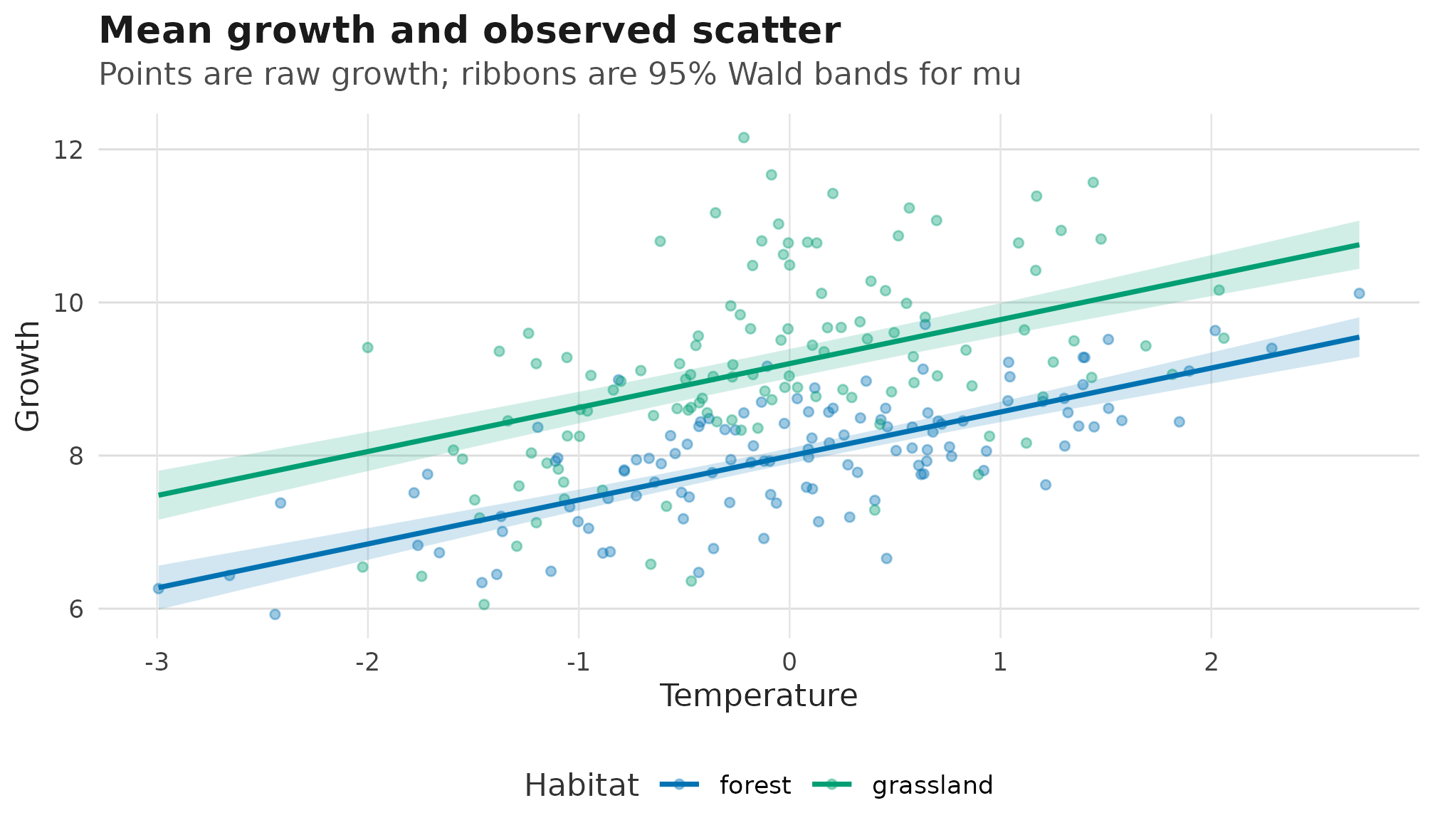
Raw growth observations and fitted response-scale mu
surfaces for the Gaussian location-scale example; ribbons are 95% Wald
confidence bands from predict_parameters().
The scale model is a different display. Do not put raw
growth points on the sigma axis; plot the
fitted residual SD and name the interval source:
growth_sigma_grid <- prediction_grid(
  fit_growth,
  focal = "habitat",
  condition = list(temperature = 0)
)

growth_sigma_surface <- predict_parameters(
  fit_growth,
  newdata = growth_sigma_grid,
  dpar = "sigma",
  conf.int = TRUE
)

unique(growth_sigma_surface[, c(
  "dpar",
  "conf.status",
  "interval_source",
  "conf.level"
)])
#>    dpar conf.status interval_source conf.level
#> 1 sigma        wald            wald       0.95

if (requireNamespace("ggplot2", quietly = TRUE)) {
  ggplot2::ggplot(
    growth_sigma_surface,
    ggplot2::aes(x = estimate, y = habitat, colour = habitat)
  ) +
    ggplot2::geom_segment(
      ggplot2::aes(x = conf.low, xend = conf.high, yend = habitat),
      linewidth = 0.8
    ) +
    ggplot2::geom_point(size = 2.8) +
    location_scale_habitat_scales() +
    ggplot2::labs(
      title = "Residual SD differs by habitat",
      subtitle = "Points are fitted sigma values; bars are 95% Wald intervals",
      x = "Fitted residual SD (sigma)",
      y = NULL,
      colour = "Habitat"
    ) +
    location_scale_theme() +
    ggplot2::guides(colour = "none")
}
#> Warning: No shared levels found between `names(values)` of the manual scale and the
#> data's fill values.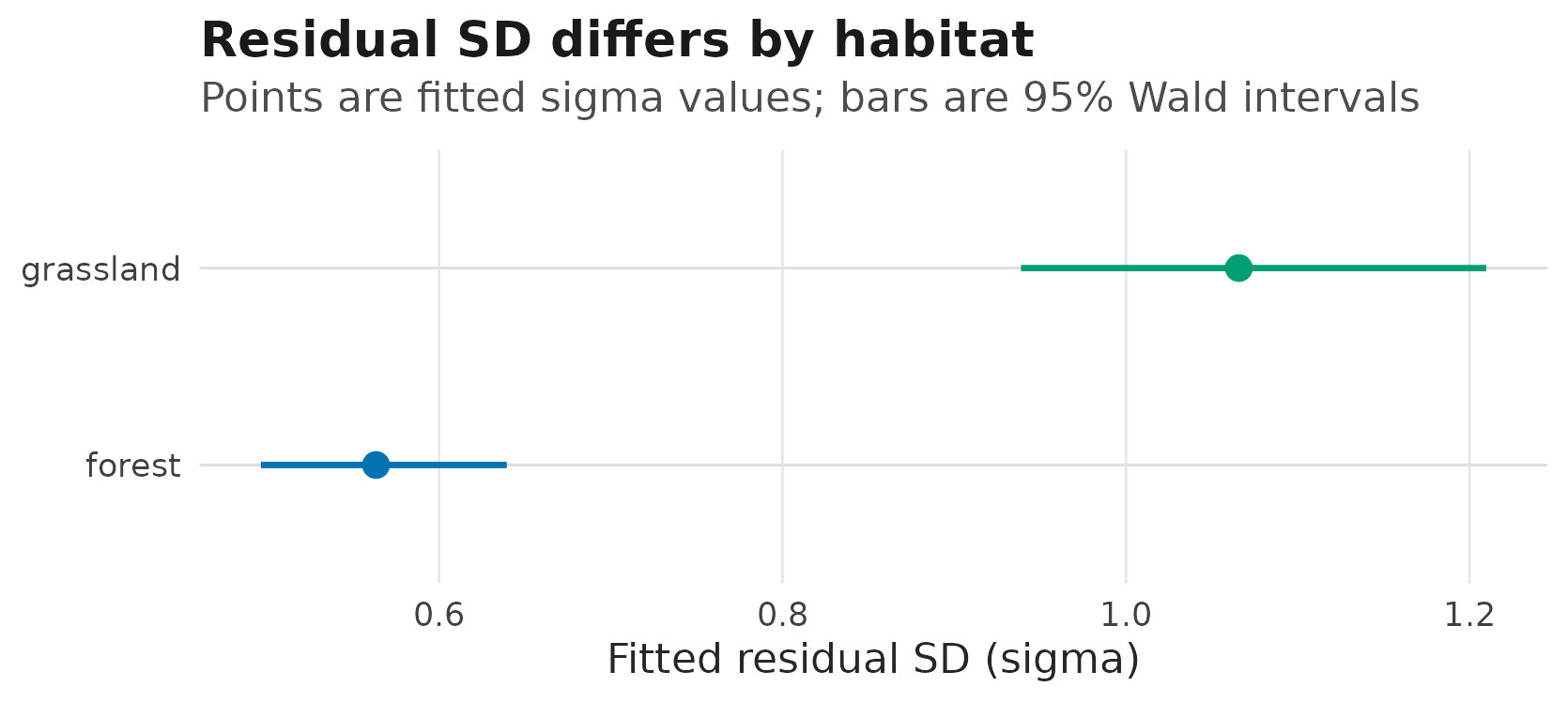
Fitted residual standard deviations by habitat at average temperature;
horizontal intervals are 95% Wald confidence intervals requested from
predict_parameters().
The compact translation table below is the reporting layer a reader should be able to use without returning to the equations:
growth_translation <- data.frame(
  model_piece = c(
    "fixed mean slope",
    "fixed residual-SD contrast",
    "fixed residual-variance contrast"
  ),
  fitted_term = c(
    "mu:temperature",
    "exp(sigma:habitatgrassland)",
    "exp(2 * sigma:habitatgrassland)"
  ),
  response_scale_value = c(
    unname(coef(fit_growth, "mu")["temperature"]),
    unname(exp(sigma_habitat)),
    unname(exp(2 * sigma_habitat))
  ),
  interpretation = c(
    "mean growth change per one-unit temperature increase",
    "grassland residual SD divided by forest residual SD",
    "grassland residual variance divided by forest residual variance"
  )
)
growth_translation$response_scale_value <-
  round(growth_translation$response_scale_value, 3)
growth_translation
#>                        model_piece                     fitted_term
#> 1                 fixed mean slope                  mu:temperature
#> 2       fixed residual-SD contrast     exp(sigma:habitatgrassland)
#> 3 fixed residual-variance contrast exp(2 * sigma:habitatgrassland)
#>   response_scale_value
#> 1                0.575
#> 2                1.892
#> 3                3.580
#>                                                    interpretation
#> 1            mean growth change per one-unit temperature increase
#> 2             grassland residual SD divided by forest residual SD
#> 3 grassland residual variance divided by forest residual variance
A report can now say three concrete things. Mean growth increases by
the fitted mu:temperature slope for each one-unit
temperature increase. Grassland has the fitted residual-SD ratio in the
second row after accounting for mean habitat and temperature effects.
Because Gaussian variance is sigma^2, the residual variance
contrast is the third row. If that third row is larger than one,
individual growth is less predictable in grassland.
The same reporting discipline carries over to hierarchical versions of the question:
| If the biological question is… | Fit this kind of term | Report this quantity | Check before reporting |
|---|---|---|---|
| Do populations differ in thermal plasticity? |
(0 + temperature | population) or
(1 + temperature | population) in the mu
formula |
the random-slope SD, in growth-per-temperature units |
check_drm(fit) and the matching
sd:mu:...temperature... row in
profile_targets(fit)
|
| Do high-baseline populations also have steeper thermal reaction norms? |
(1 + temperature | population) in the mu
formula |
the random-slope SD, and when the correlated block is fitted, the
group-level intercept-slope correlation from
corpairs(fit, class = "mean-slope")
|
check_drm(fit), the matching
sd:mu:...temperature... row, and the fitted correlation row
in profile_targets(fit)
|
| Does predictability change with temperature? | sigma ~ temperature |
exp(gamma_temperature) as the residual-SD ratio, and
exp(2 * gamma_temperature) when the paper talks about
variance |
check_drm(fit) and the
fixef:sigma:temperature row in
profile_targets(fit)
|
| Do habitats differ in among-population variation? |
(1 | population) plus
sd(population) ~ habitat
|
exp(alpha_habitat) as the ratio of among-population
SDs |
check_drm(fit) and the
fixef:sd(population):... row in
profile_targets(fit)
|
These three rows answer different biological questions.
sigma ~ temperature models residual variation among
observations. (0 + temperature | population) models
population-to-population differences in the mean slope.
sd(population) ~ habitat models the size of
among-population mean differences.
Curved responses and interactions
Quadratic terms and interactions can appear in either formula:
fit_curve <- drmTMB(
  bf(
    growth ~ habitat * temperature + I(temperature^2),
    sigma ~ I(temperature^2)
  ),
  family = gaussian(),
  data = dat
)
A linear coefficient is only a local slope when its model also contains a quadratic term or interaction. Interpret the fitted curve at biologically meaningful predictor values rather than reading that coefficient alone:
curve_grid <- expand.grid(
  habitat = c("forest", "grassland"),
  temperature = c(-1.5, 0, 1.5)
)

data.frame(
  curve_grid,
  mu = predict(fit_curve, newdata = curve_grid, dpar = "mu"),
  sigma = predict(fit_curve, newdata = curve_grid, dpar = "sigma")
)
If the sigma formula is omitted, drmTMB
fits one intercept-only residual SD. Use that simpler model only when a
common residual SD is scientifically and diagnostically adequate.
Continue to Part 2
Part 1 has separated expected response mu from residual
SD sigma. Continue to Part 2: location-scale-scale models
when the scientific question also asks whether a predictor changes the
SD of a grouped or phylogenetic location effect through
sd().
- Use Mean effects and residual
heterogeneity for Gaussian meta-analysis with known sampling
covariance through
meta_V(V = V). - Use Changing residual coupling with rho12 for two responses and predictor-dependent residual correlation.
- Use Structural dependence
for
phylo(),animal(),spatial(), andrelmat().
Current implementation boundaries
- This article documents the univariate Gaussian
muandsigmaroute. - Random intercepts, independent slopes, and ordinary correlated
intercept-slope blocks are available in
mu;sigmasupports its documented random-intercept and random-slope slices. - Scale coefficients use a log-SD link. Exponentiate once for an SD ratio and twice in the exponent for a variance ratio.
- Missing rows are removed when variables used by either formula are missing.
- A fitted optimizer code is not enough: run
check_drm(), inspect gradient and Hessian diagnostics, and use Can I fit and report this model? before widening the claim. -
sigmais not a group random-effect SD. Use Part 2 for the separatesd(group) ~ predictorsgrammar.