Large data changes the workflow. A model that is statistically reasonable can still fail because R builds large model frames, dense model matrices, fitted objects, predictions, and residual vectors before the scientific question is answered. This article is for users fitting ecological, evolutionary, or environmental-science models with many observation rows, many species, or both, once the standard post-fit workflow in Checking and using fitted models starts choking on size.
The short version is: fit the smallest model that answers the question, keep only the fitted-object pieces you need, and benchmark on a smaller version of the real data before running the full analysis.
What is implemented now
drmTMB has a first memory-light fitted-object path
through drm_control(). For a large univariate Gaussian
phylogenetic location model, use:
library(drmTMB)

fit <- drmTMB(
  bf(
    y ~ x1 + x2 + phylo(1 | species, tree = tree),
    sigma ~ 1
  ),
  family = gaussian(),
  data = dat,
  control = drm_control(
    optimizer = list(eval.max = 1000, iter.max = 1000),
    se = FALSE,
    keep_data = FALSE,
    keep_model_frame = FALSE,
    keep_tmb_object = FALSE
  )
)
Here keep_data = FALSE removes the stored complete-case
data frame from the fitted object after optimization.
keep_model_frame = FALSE removes stored model frames after
TMB data are built, including nested model-frame caches for direct
random-effect SD models such as
sd(species, level = "phylogenetic") ~ z_species and fitted
q=2 latent-correlation models such as
corpair(...) ~ ecology. se = FALSE skips the
TMB::sdreport() step after optimization. The fitted
coefficients, fitted values, residuals, prediction, simulation,
sigma, rho12, and corpairs()
extraction still use the stored model matrices, terms, offsets, response
vectors, response-name metadata, random-effect metadata, and optimized
parameters. Standard errors, vcov(), and Wald confidence
intervals are unavailable in this mode, and summary() marks
the standard-error state explicitly.
keep_tmb_object = FALSE separately removes the TMB
automatic-differentiation object after optimization.
This control is useful when the fitted model is kept for interpretation, prediction, or plotting, but the original data frame and TMB object do not need to travel with it.
For final interval estimates, keep the pieces required by the
interval method. Wald intervals need se = TRUE, profile
intervals need keep_tmb_object = TRUE, and bootstrap
intervals need keep_data = TRUE because the simulated
responses are refit with the original model data. Exploratory
memory-light fits can therefore use se = FALSE and
keep_tmb_object = FALSE, while a final inference refit
should keep the standard-error covariance, TMB object, or model data
that the chosen interval method needs.
Large tip counts and se_group_sd
For phylogenetic or other high-cardinality direct-SD surfaces such as
sd(species, level = "phylogenetic") ~ ..., keep the default
drm_control(se_group_sd = FALSE).
The fitted per-group standard deviations are always available (they
are recomputed from the parameters). What
se_group_sd = TRUE adds is a delta-method standard-error
surface with one SD per group, so the joint ADREPORT
covariance is n_group × n_group. Under
REML = TRUE the fixed effects enter the Laplace
random block and vcov() reads that joint
covariance, so at about ten thousand tips a bivariate fit can need tens
of gigabytes for the covariance alone.
Default advice for Ayumi-scale tip counts (~10k tips):
- Leave
se_group_sd = FALSEfor exploratory and most final fits. - Set
se_group_sd = TRUEonly when you have measured that you need per-group SD standard errors and the machine can hold then_group × n_groupcovariance. - Pair large-phylo fits with the memory-light controls above
(
se = FALSEfor exploratory fits; restorese = TRUE/keep_tmb_object = TRUEfor the interval method you will report). Prefer Wald for routine fixed-effect rows; profile only the variance-component targets you need.
See ?drm_control for the formal argument and the NEWS
entry that recorded the default.
For factor-heavy fixed-effect Gaussian location models, the first sparse fixed-effect path is also available:
fit_sparse <- drmTMB(
  bf(y ~ habitat + x1, sigma ~ 1),
  family = gaussian(),
  data = dat,
  control = drm_control(sparse_fixed = TRUE)
)
This path stores the mu fixed-effect design as a sparse
Matrix object and uses a sparse TMB matrix multiply. It is
intentionally limited to fixed-effect univariate Gaussian
mu models with intercept-only sigma.
For repeated-row Gaussian fixed-effect models, the first aggregation path is also available:
fit_agg <- drmTMB(
  bf(y ~ habitat + season, sigma ~ effort_class),
  family = gaussian(),
  data = dat,
  control = drm_control(aggregate_gaussian = TRUE)
)
This path collapses rows that have the same processed mu
and sigma design state after model-row filtering. TMB
evaluates the Gaussian likelihood with cell summaries n,
sum(y), and sum(y^2), while the fitted object
still keeps original-row model matrices and response vectors so
predict(fit_agg), fitted(fit_agg), and
residuals(fit_agg) return one value per original model
row.
What this does not solve yet
The current memory-light path does not prevent R from building model frames and model matrices before optimization. It can drop model frames after fitting, but those objects still need to exist during model construction. That means the control helps fitted-object size, but it is not a complete solution for millions of rows.
These pieces remain planned:
- sparse fixed-effect matrices for
sigma, random-effect, phylogenetic, spatial, bivariate, and non-Gaussian models; - Gaussian sufficient-statistic aggregation beyond the first fixed-effect univariate path. Random effects, direct-SD formulas, structured effects, known sampling covariance, bivariate Gaussian models, non-Gaussian families, non-unit likelihood weights, and combined sparse fixed-effect matrices are still rejected;
- sparse or block-sparse storage for full-matrix
meta_V(V = V). The current full known-covariance route keeps the retainedVas a dense R matrix and is for small to moderate correlated sampling-error fits; - memory-light modes that avoid constructing dense model frames or dense model matrices in the first place;
- repeated benchmark runs for million-row, bivariate, factor-heavy, non-Gaussian, and 10,000-species analyses.
If a model has a high-cardinality factor in a fixed-effect formula,
the dense model.matrix() step may dominate memory before
TMB sees the data. Treat that as a sparse-design problem, not as a
phylogenetic precision problem.
If a model has many repeated Gaussian rows with the same
mu and sigma design rows, aggregation is a
separate tool from sparse matrices. In the first implemented path, the
likelihood uses cell summaries such as n,
sum(y), and sum(y^2), but fitted-row summaries
remain original-row summaries.
Choose the interval route deliberately
For large phylogenetic Gaussian fits, start with Wald intervals for
routine reporting. They are fast and now include direct response-scale
targets such as residual sigma and
sd:mu:phylo(1 | species) when TMB::sdreport()
succeeds:
Use profile intervals when you want a likelihood-based check for a
small number of fitted targets. With the default
profile_engine = "auto", direct scalar scale, SD, and
correlation targets use the endpoint solver instead of building a full
adaptive profile curve:
ci_profile <- confint(
  fit_final,
  parm = c("sigma", "sd:mu:phylo(1 | species)"),
  method = "profile"
)
If you need the previous full-profile route for comparison or debugging, ask for it explicitly:
ci_profile_full <- confint(
  fit_final,
  parm = "sd:mu:phylo(1 | species)",
  method = "profile",
  profile_engine = "tmbprofile"
)
On macOS and Linux, parallel = "multicore" can split
independent profile targets across workers. For a single direct endpoint
target, it can split the lower and upper endpoint searches. When
workers = NULL, drmTMB uses about half the
detected physical cores, capped at the number of jobs and at 10 workers.
On Windows, where forking is unavailable, use
parallel = "cluster" for socket workers; see
?drmTMB-parallel:
ci_profile_parallel <- confint(
  fit_final,
  parm = c("sigma", "sd:mu:phylo(1 | species)"),
  method = "profile",
  parallel = "multicore",
  workers = NULL
)
parallel = "multicore" uses process forking, which
Windows does not provide (see ?drmTMB-parallel for the full
parallel-execution guide). On Windows, confint() stops with
an error saying that parallel = "multicore" is not
available; it does not fall back to another backend. Use
parallel = "cluster" for socket workers, or keep
parallel = "none" to run the same targets one after
another:
ci_profile_serial <- confint(
  fit_final,
  parm = c("sigma", "sd:mu:phylo(1 | species)"),
  method = "profile",
  parallel = "none"
)
Parallel work in drmTMB comes from running separate profile searches
or bootstrap refits at the same time, not from threading inside one fit:
the package’s TMB code is built without OpenMP, so raising
TMB_NTHREADS or OMP_NUM_THREADS does not speed
up a single native fit. When parallel = "multicore" workers
run, keep the BLAS library at one thread (for example by starting R with
OPENBLAS_NUM_THREADS=1) so the workers do not compete for
the same cores. The help page ?drmTMB-parallel states the
full thread policy, including Windows; the Julia engine guide covers Julia
threads.
Bootstrap intervals repeatedly simulate and refit the model, so they
take more time and require the fitted model data. Do not combine them
with drm_control(keep_data = FALSE) unless you refit the
final model with keep_data = TRUE first. Start with a small
R to check that the setup works, then increase
R for the final analysis:
ci_boot <- confint(
  fit_final,
  parm = c("sigma", "sd:mu:phylo(1 | species)"),
  method = "bootstrap",
  R = 99,
  seed = 1,
  parallel = "multicore",
  workers = NULL
)
The same Windows restriction applies to bootstrap intervals: do not
pass parallel = "multicore". Use
parallel = "cluster" for socket workers, or drop
parallel and workers (or set
parallel = "none") to run the refits serially.
Treat these routes as different evidence, not as interchangeable
defaults. Wald intervals are the routine first pass, endpoint profiles
are likelihood-based checks for direct scalar targets, full
TMB::tmbprofile() is the debugging and comparison route,
and bootstrap is a slower refit-based option.
The synthetic Gaussian phylogenetic example below gives a rough sense of these choices. Its points are elapsed seconds measured on one machine, not confidence intervals or promises about your computer.
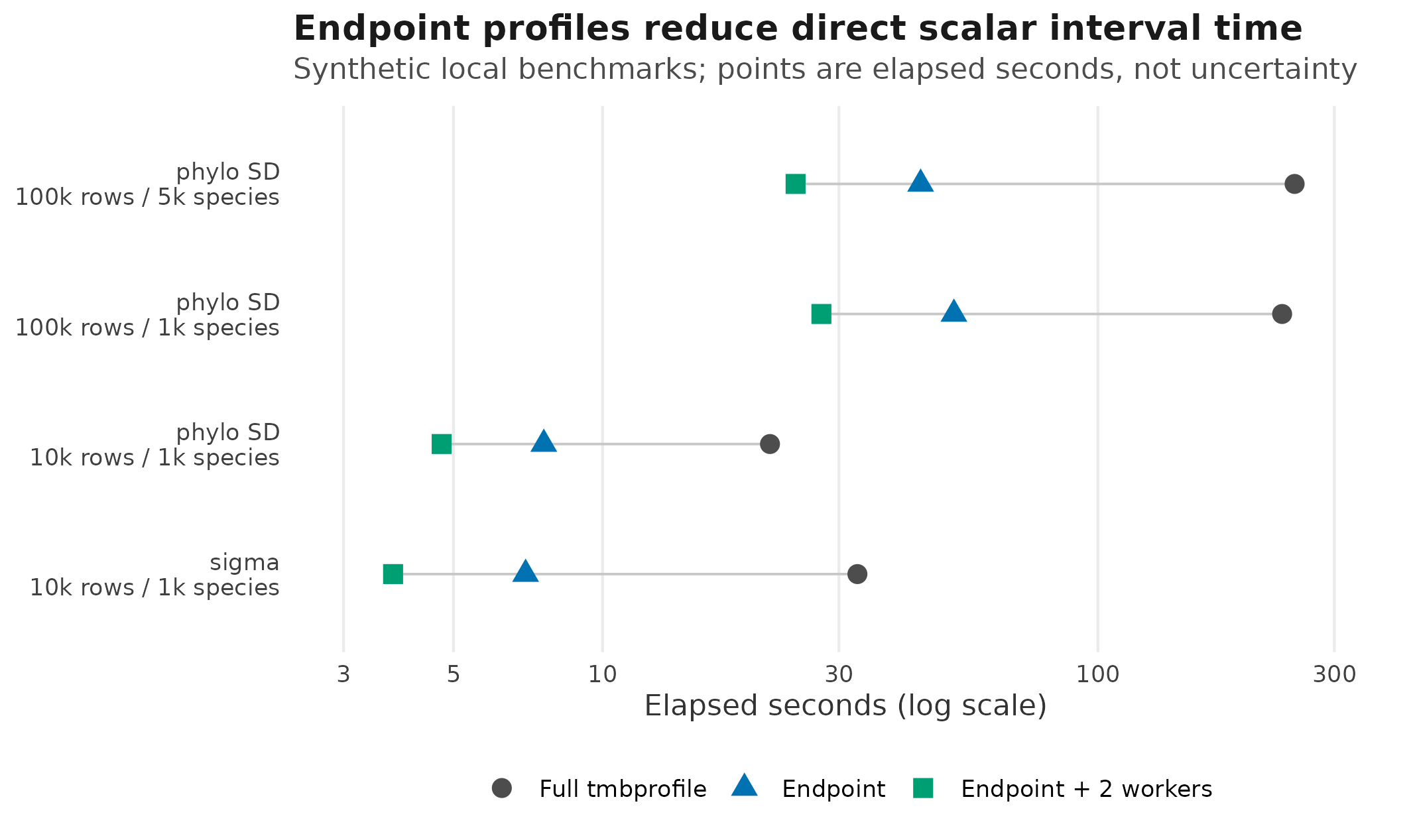
Timing examples for direct scalar profile intervals. Points are elapsed seconds from one local synthetic Gaussian phylogenetic benchmark table; they are performance measurements, not confidence intervals.
Check the fit with the storage choice in mind
Run check_drm() before interpreting a large fit:
check_drm(fit)If keep_tmb_object = FALSE, the fixed-gradient row is a
note rather than an ok result. That note means the gradient
cannot be re-evaluated because fit$obj was intentionally
dropped. Refit with drm_control(keep_tmb_object = TRUE)
when you need the gradient diagnostic for a final report.
If se = FALSE, the sdreport_status,
Hessian, and finite-standard-error rows are notes rather than
ok results. That note means standard errors were
intentionally skipped; refit with drm_control(se = TRUE)
when Wald standard errors, vcov(), or Wald confidence
intervals are part of the final inference.
The optimizer_budget row compares nlminb()
iterations and function evaluations with supplied iter.max
and eval.max. If it is a note or warning, inspect
convergence, gradients, and model structure before increasing the
limits.
Also inspect the fixed_effect_design_size row. It
reports the retained fixed-effect design size, the widest design block,
the matrix class, and the density of the largest retained block. A
dense-fit note with a low density means high-cardinality factors or
sparse interactions may be driving memory use before TMB optimization.
That is a sparse fixed-effect design problem; simplifying the formula or
using drm_control(sparse_fixed = TRUE) when the model is
inside the implemented Gaussian mu scope is more relevant
than changing the phylogenetic tree.
For full-matrix meta_V(V = V) fits, also inspect the
known_sampling_covariance row. It is a note for
dense-matrix storage and reports dimension, density, size, rank, and
conditioning. A low-density dense V often means the
statistical structure is block-sparse, but the current fit has still
paid dense R-matrix storage costs.
For aggregated Gaussian fits, check_drm() also includes
a gaussian_aggregation row. That row reports the number of
original rows, the number of aggregation cells, the compression ratio,
and the largest cell size. If the compression ratio is close to 1,
aggregation was valid but did not buy much row compression for that
model.
Avoid accidental full-row output
Functions such as predict(fit),
fitted(fit), residuals(fit), and
simulate(fit) can create vectors or data frames with one
value per observation. On a five-million-row dataset, that output is
itself large.
For interpretation plots, prefer smaller newdata
grids:
new_dat <- data.frame(
  x1 = seq(-2, 2, length.out = 100),
  x2 = 0,
  species = dat$species[[1]]
)

predict(fit, newdata = new_dat, dpar = "mu")
For residual checks, decide whether you need every row or a targeted
sample. For simulations, start with small nsim and store
only the summaries needed for the biological question.
Benchmark before the full run
The repository includes a non-CRAN benchmark harness:
Rscript bench/large-phylo-location.R --rows 100000 --species 1000 \
  --memory-light true --output bench/results.csv
The script generates a synthetic Gaussian phylogenetic location dataset, fits:
y ~ x1 + x2 + phylo(1 | species, tree = tree)
sigma ~ 1
and records elapsed time, fitted-object size, model-matrix size, TMB-data size, the largest retained fixed-effect design block and density, prediction time, residual time, convergence code, optimizer message, optimizer evaluation counts, and fitted scale summaries. Use it to learn how your machine behaves before running the full analysis.
For factor-heavy designs, add:
Rscript bench/large-phylo-location.R --rows 100000 --species 1000 \
  --factor-heavy true --memory-light true --output bench/results.csv
To benchmark the first sparse fixed-effect path, remove the phylogenetic structured effect explicitly:
Rscript bench/large-phylo-location.R --rows 100000 --species 1000 \
  --structured none --factor-heavy true --sparse-fixed true \
  --memory-light true --output bench/results.csv
That sparse smoke scenario fits a fixed-effect Gaussian location
model, not a phylogenetic model, because
sparse_fixed = TRUE is currently implemented only for
univariate Gaussian mu fixed effects with intercept-only
sigma.
To benchmark the first Gaussian aggregation path, use a non-phylogenetic repeated-cell scenario:
Rscript bench/large-phylo-location.R --rows 100000 --species 1000 \
  --structured none --aggregate-gaussian true --aggregation-cells 100 \
  --memory-light true --output bench/results.csv
That scenario creates repeated fixed-effect cells deliberately, so the benchmark can record the fitted aggregation-cell count and compression ratio.
For a model with a scale predictor, add:
Rscript bench/large-phylo-location.R --rows 100000 --species 1000 \
  --sigma-x true --memory-light true --output bench/results.csv
Run this benchmark only when you need to understand this model shape on your own hardware. It can be slow, and its results reflect your hardware, BLAS, compiler, and operating system as well as package code.
What these benchmark examples show
The table gives selected measurements from one local machine. Use them to plan a first run, not as speed promises for your computer.
| Scenario | Local result | What to learn |
|---|---|---|
| 100k rows, 1k species, ordinary location model | converged; about 25 seconds; about 1.4 GB macOS max RSS | This is the first useful local rung before trying a real large analysis. |
| 100k rows, 5k species | converged; about 32 seconds; about 1.7 GB macOS max RSS | Species-index pressure is separate from row-count pressure. |
| 500k rows, 1k species | converged; about 131 seconds; about 5.1 GB macOS max RSS | Row pressure is feasible on the test machine, but peak memory is already substantial. |
| 100k rows, 1k species, 40-level fixed factor | did not converge under the benchmark optimizer budget | Dense fixed-effect matrices remain a real scaling limitation. |
These results support cautious use of the current sparse phylogenetic location path. They do not prove million-row readiness, 10,000-species readiness, bivariate large-data readiness, or non-Gaussian large-data readiness.
Practical checklist
- Start with a fixed-effect or smaller phylogenetic model that answers a simpler version of the question.
- Fit with
keep_data = FALSE,keep_model_frame = FALSE,se = FALSE, andkeep_tmb_object = FALSEwhen you do not need to carry the original data, model frames, standard-error covariance, or TMB object inside the saved fit. - Refit the final model with
se = TRUEfor Wald intervals,keep_tmb_object = TRUEfor profile intervals, andkeep_data = TRUEfor bootstrap intervals. - Use Wald intervals first for direct
sigma, structured SD, and correlation targets; use endpoint profile intervals as a likelihood-based check on the few targets that matter most. - Keep
keep_tmb_object = TRUEfor final diagnostic refits where the fixed gradient check matters. - Inspect
check_drm(fit)for fixed-effect design-size notes before assuming the phylogenetic part caused memory pressure. - Use
newdatagrids for interpretation instead of creating full-row predictions by default. - Run the benchmark script at 100k rows before trying million-row analyses.
- Treat a non-zero optimizer code as a diagnostic result, not as timing evidence.
- Treat sparse fixed-effect matrices outside fixed-effect Gaussian
mumodels, and data aggregation in all models, as future scaling features rather than current guarantees.
Working in Julia? The DRModels.jl
companion page mirrors this article with Julia syntax and states
which parts DRModels.jl supports today. DRModels.jl is a separate
package with its own fitting and inference routes; Julia is optional for
drmTMB users.