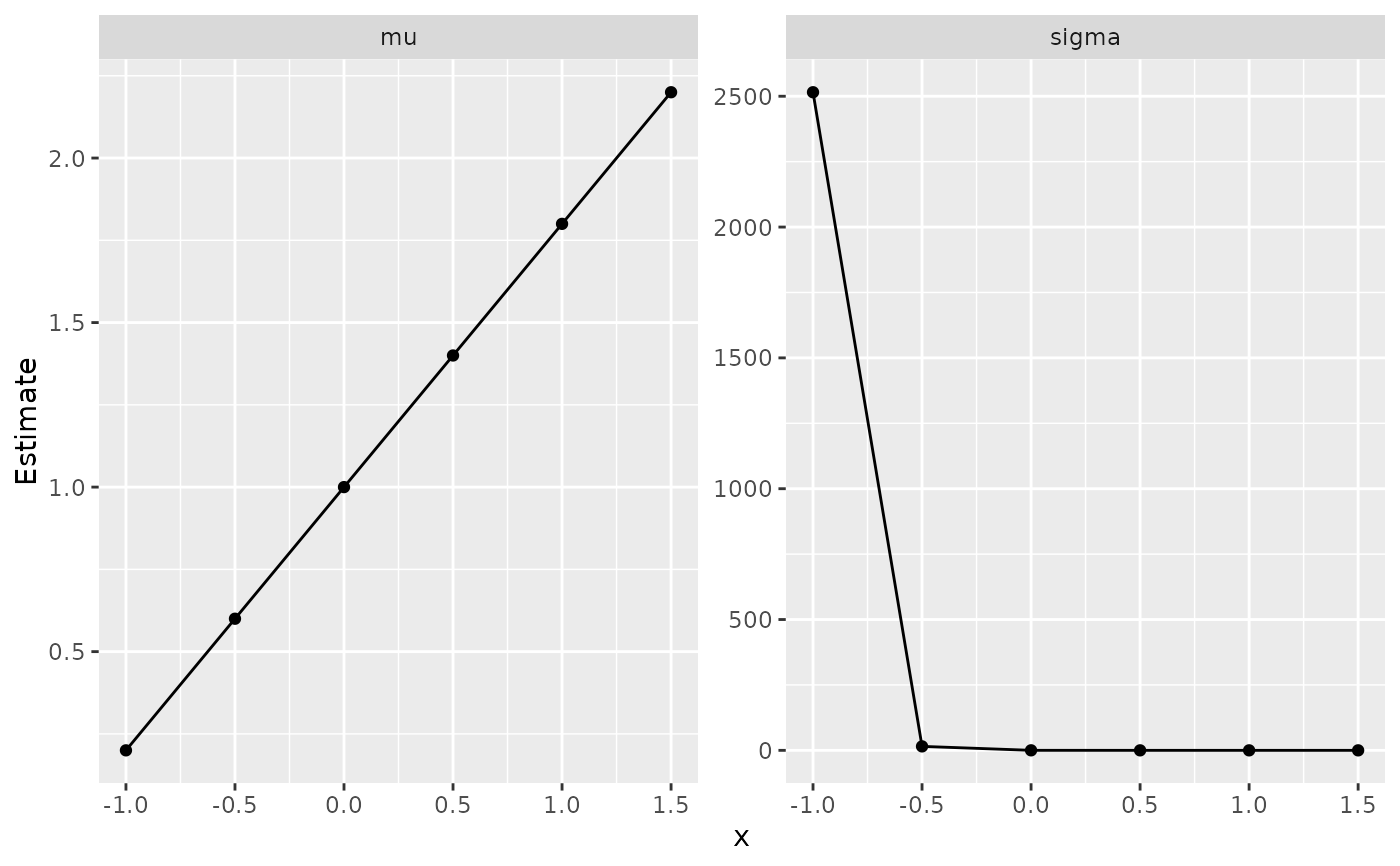
Plot predicted distributional-parameter surfaces
Source:R/plot-parameter-surface.R
plot_parameter_surface.Rdplot_parameter_surface() is a small ggplot2 consumer for long tables
returned by predict_parameters(). It does not fit a model, build a grid,
compute predictions, compute confidence intervals, or choose an estimand.
Build an explicit grid with prediction_grid() or another data-frame
workflow first, then pass the resulting prediction table to this helper.
Usage
plot_parameter_surface(
  data,
  x,
  colour = NULL,
  group = NULL,
  facet = "dpar",
  dpar = NULL,
  type = NULL,
  line = TRUE,
  point = TRUE,
  interval = TRUE,
  ...
)
Arguments
- data
A data frame returned by
predict_parameters(), or a compatible long table with columnsdpar,type,estimate,conf.status, andinterval_source. Ifconf.lowandconf.highare present, both must be numeric.- x
Character scalar naming the column to draw on the x-axis.
- colour
Optional character scalar naming a column to map to colour.
- group
Optional character scalar naming a column to group lines. If
NULL, lines are grouped bydpar,colour, andfacetcolumns when present.- facet
Optional character scalar naming a column to facet by. Use
NULLto suppress faceting. The default facets bydpar.- dpar
Optional character vector of distributional parameters to keep.
- type
Optional character vector of prediction scales to keep, such as
"response"or"link".- line
Logical; draw lines through the estimates.
- point
Logical; draw points at the estimates.
- interval
Logical; draw finite
conf.low/conf.highintervals when those columns are present andconf.statusplusinterval_sourceindicate that an interval was actually computed.- ...
Reserved for future options.
Details
The helper plots estimate against one supplied column. It expects the
interval provenance columns created by predict_parameters(). When finite
conf.low and conf.high columns are present and the provenance columns
describe a real interval, it draws confidence bands for continuous x-values
and interval bars for discrete x-values. Rows without finite supported bounds
remain visible as point or line estimates only. When the filtered table
contains a single
distributional parameter, the y-axis label names that parameter and, when
unique, the prediction scale.
Examples
x <- seq(-1, 1.5, length.out = 8)
pred <- rbind(
  data.frame(
    dpar = "mu",
    type = "response",
    estimate = 1 + 0.5 * x,
    conf.low = 0.85 + 0.5 * x,
    conf.high = 1.15 + 0.5 * x,
    conf.status = "wald",
    interval_source = "wald",
    x = x
  ),
  data.frame(
    dpar = "sigma",
    type = "response",
    estimate = 0.55 + 0.08 * x,
    conf.low = 0.47 + 0.08 * x,
    conf.high = 0.63 + 0.08 * x,
    conf.status = "wald",
    interval_source = "wald",
    x = x
  )
)
if (requireNamespace("ggplot2", quietly = TRUE)) {
  plot_parameter_surface(pred, x = "x", point = FALSE) +
    ggplot2::labs(
      title = "Predicted parameter surfaces",
      subtitle = "Ribbons are Wald intervals from the supplied table"
    ) +
    ggplot2::theme_minimal(base_size = 11)
}