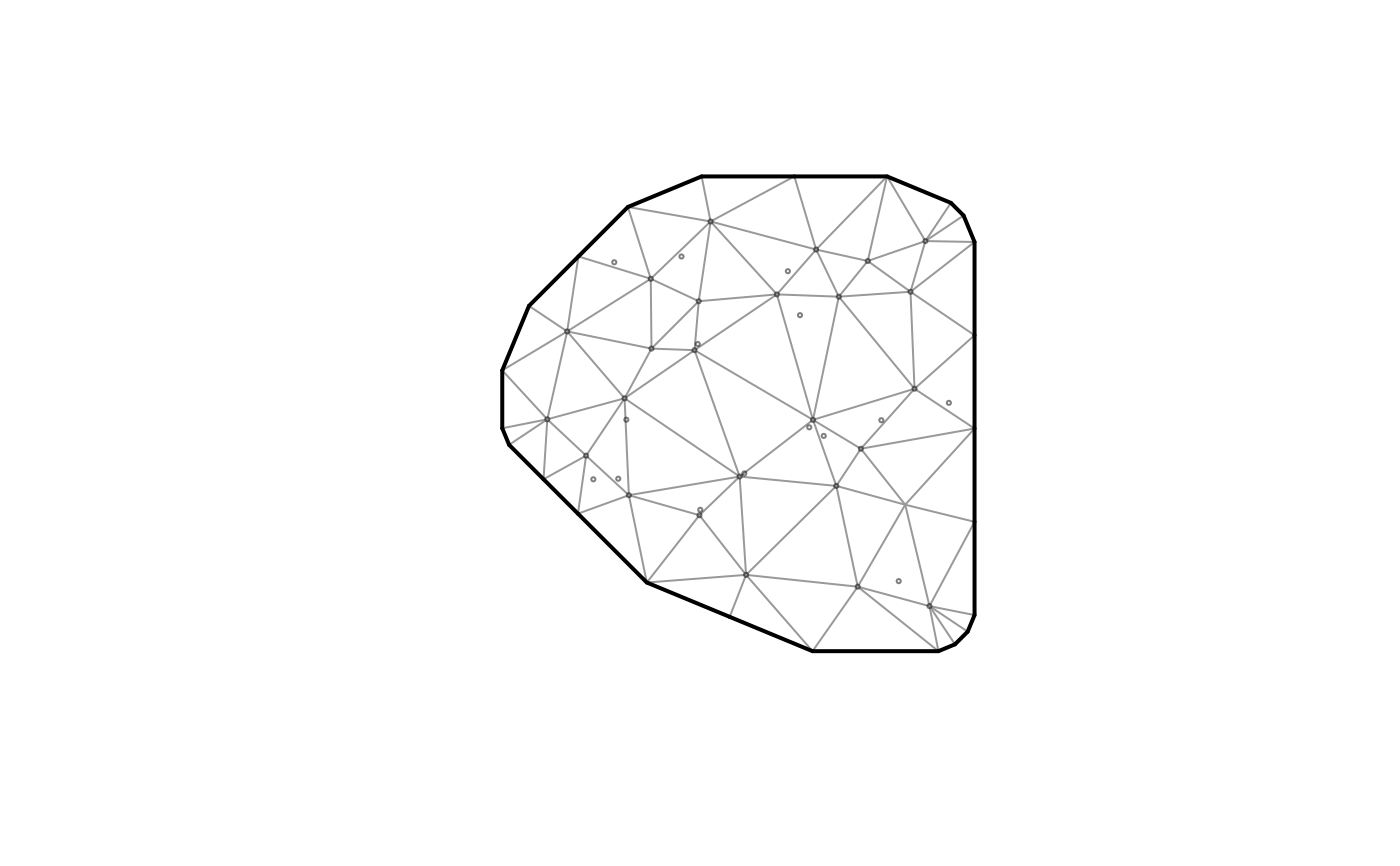
Construct a triangular mesh and the finite-element quantities used by the
spatial_*() keywords. The helper uses the public fmesher API; the
SPDE/GMRF construction follows Lindgren, Rue, and Lindstrom (2011).
Scope: mesh/FEM construction and fit ingestion are covered by focused
tests; evidence across the broader spatial-family surface remains
partial; directional anisotropy, spatiotemporal fields, barriers, and
likelihood changes are rejected from this helper contract.
Usage
make_mesh(
  data,
  xy_cols,
  type = c("cutoff", "kmeans", "cutoff_search"),
  cutoff,
  n_knots,
  seed = 42,
  mesh = NULL,
  fmesher_func = fmesher::fm_rcdt_2d_inla,
  convex = NULL,
  concave = convex,
  ...,
  id_col = NULL
)
Arguments
- data
A data frame containing the coordinate columns.
- xy_cols
Character names of exactly two finite numeric coordinate columns in
data.- type
Mesh construction method:
"cutoff","kmeans", or"cutoff_search".- cutoff
Minimum vertex separation for
type = "cutoff".- n_knots
Number of coordinate centres for
"kmeans", or target number of mesh vertices for"cutoff_search". The latter returns the closest valid mesh when the exact target is unavailable.- seed
Seed used only while selecting k-means centres. The caller's RNG state is restored before this function returns.
- mesh
Optional pre-built
fmeshermesh.- fmesher_func
Mesh constructor from fmesher.
- convex, concave
Optional non-convex-hull controls passed to
fmesher::fm_nonconvex_hull().- ...
Additional arguments passed to
fmesher_func.- id_col
Optional name of a column containing one unique, non-missing label per projection row. The labels are retained for formula terms, such as
spatial_slope(), that align mesh locations to response columns. The defaultNULLpreserves the ordinary observation-aligned mesh contract.
Value
A gllvmTMBmesh object containing loc_xy, xy_cols, mesh, the
finite-element matrices in spde, mesh centres in loc_centers, and the
observation-to-mesh projection matrix A_st. When id_col is supplied,
the object also contains id_col and row_labels.