
This page connects the project history to a practical question: what does a route’s label mean today? Start with Can I fit and report this? for a current decision, then use this page to trace the evidence behind it.
Where we are now
hsquared is the formula-first R interface;
HSquared.jl is the computational engine. A covered R-public
route has the evidence stated in its own row. It is not a production
claim, and Julia engine coverage does not itself change the R-public
count. Report point estimates only within the route scope; interval
coverage is not a general permission.
How a route earns its label
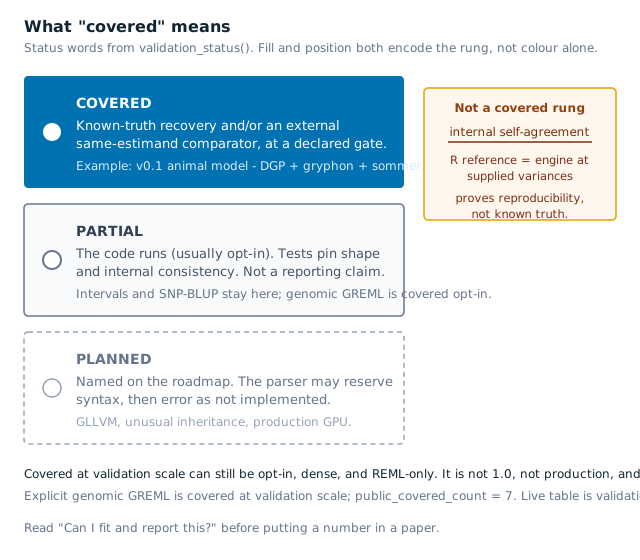
A route moves from planned to partial when it is implemented with a named evidence gap. It earns covered only when its predeclared recovery and external same-estimand comparator requirements are met. The current model-status and validation evidence pages carry the scope and limits that the ladder cannot show by itself.
Historical milestones
These are dated, bounded milestones rather than a release timeline. Counts in this list are historical where stated; the current count is seven.
| Date and phase | What changed | Read the route-specific evidence |
|---|---|---|
| 2026-06-19, 0.1.0 | The univariate Gaussian animal-model contract gained known-truth
recovery, the gryphon published anchor, and sommer
agreement. It was released publicly on GitHub as hsquared
0.1.0; this is not a CRAN or production claim. |
Worked gryphon example and benchmark evidence |
| 2026-06 to 2026-09, 0.2–0.4 capability build | The experimental covered set grew from one to five through the direct–maternal, common-environment/multi-effect, and k=2 random-regression routes; each has its own evidence boundary. | Direct–maternal status, multi-effect comparator, and random-regression comparator |
| 2026-09-02, 0.5.0 | A later experimental public-number policy used 0.5.0 at count five. It did not supersede the earlier 0.1.0 GitHub release or imply CRAN, General registration, production readiness, or a new evidence promotion. | Changelog and current limits |
| 2026-09-02, 0.6.0 | Two-trait unstructured multivariate REML became covered at validation scale; the historical count moved 5 → 6. | Multivariate scope and model status |
| 2026-09-02, 0.7.0 | Narrow genomic GREML became covered at validation scale; the historical count moved 6 → 7. A later temporary default-route decision is superseded in the 0.9 release, which keeps this route explicit. | Genomic prediction and current limits |
| 2026-09-04 to 2026-09-07, 0.8.0 | The experimental number advanced while R FA remained planned and R
single-step remained opt-in partial. Julia FA is engine-covered only for
t = 4, K = 1, interior rotation-invariant
G/R/psi; 8 of 10 broad-protocol scenarios met the criterion, so that
broad protocol did not pass. Julia single-step is engine-covered only
for ordinary-default H-scale sigma-a2/sigma-e2 and the teaching
G = A22 + 0.05I kernel. The 0.8 interval work refined claim
wording; it did not promote a route or announce 0.9. |
Twin boundary and validation evidence |
| 2026-09-11, 0.9.0 release | The ratified three-field Poisson/Binomial contract and retained H0/H1/H3 interval evidence are documented without a covered-count change. H0/H1/H3 language remains route-specific and directional-conservative where stated; it is not a general calibration or promotion claim. CRAN submission, acceptance, and public availability remain separate states. | Twin boundary and validation evidence |
What remains separate
Julia registry status, CRAN acceptance, interval calibration, and future roadmaps are separate decisions. This page does not announce a CRAN release, change a status row, or turn a future roadmap into a reporting permission. For the technical backlog, see the developer pages; for a reporting decision, return to Can I fit and report this?.