
This page answers one question: can I use
hsquared for my analysis, and what am I allowed to write in
the paper?
hsquared is an experimental package. Most of what
follows is not about whether code runs; nearly all of it runs. It is
about which numbers have enough evidence behind them to report.
The three-line version
- Two default-routed covered paths exist: the
univariate Gaussian animal model and t = 2
unstructured multivariate
cbind()(validation-scale). Genomic GREML is also covered at validation scale, but only through its explicitengine = "julia", target = "genomic"route; ordinary-call / default-route genomic activation remains held (design-44 G5;BOUNDARY_HOLDOUT_FAIL). Report point estimates only within each stated scope. - Almost everything else fits through an opt-in engine target (some covered at validation scale, some experimental). k≥3 and diagonal multivariate stay experimental. Treat experimental fits as exploratory, or report them beside a comparator you ran yourself.
-
No standard error or interval in this package is nominally
coverage-calibrated. Named univariate pedigree intervals have a
narrower
directional-conservativeclaim level, not a nominal-calibration claim. Do not report any interval as if nominal coverage had been established. The information matrix also differs by route: see Which information matrix?.
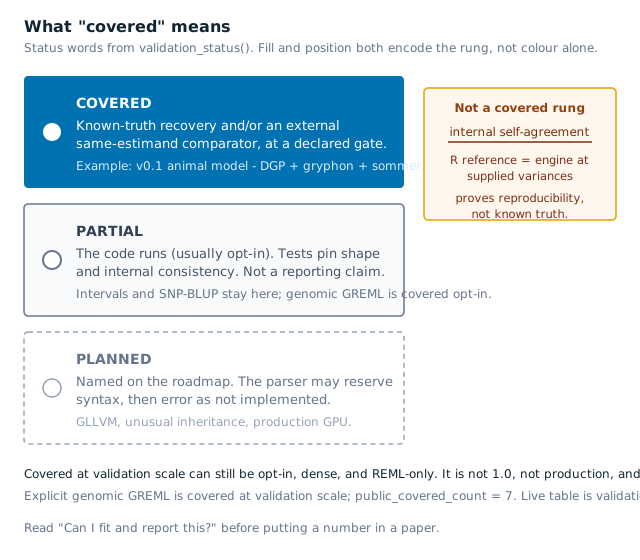
What the status words mean
hsquared uses four words, in descending order of what
you may claim. It deliberately never uses a bare “supported”, because
that word hides the difference between runs and
validated.
| Word | The code | The evidence | What you may report |
|---|---|---|---|
covered |
Runs | Pre-declared recovery gate passed and an external same-estimand comparator agrees | Point estimates, within the stated scope |
partial |
Runs | Bridge-verified and partly evidenced; the chain has a named hole | Exploratory use; report only beside your own comparator |
experimental |
Runs | Labelling, not a status tier; every opt-in route carries it | Nothing on this package’s word alone |
planned |
Aborts as planned, not implemented | None | Nothing |
This page is the user-facing list of what you may report.
validation_status() is a developer evidence table of
validation atoms; it is not a complete list of covered routes.
Developers can inspect it in their own session:
Do I need Julia?
Yes, for fitting. This matters more here than in most R packages, because the default call is the one that needs it.
| What you want | What you need |
|---|---|
| Parse and validate a model, inspect the design matrices and pedigree ordering | R only: hs_control(engine = "validate") and
model_spec()
|
| Actually fit and get heritability, variance components, EBVs | A local Julia, the JuliaCall package, and an
HSquared.jl checkout |
Without the engine, hsquared() still tells you whether
your model is expressible, and errors with install guidance if you ask
it to fit. See the Installation
section of the README.
# no Julia required; same ped/dat as the README
hsquared(
  weight ~ sex + animal(1 | id, pedigree = ped),
  data = dat,
  control = hs_control(engine = "validate")
)

model_spec(
  weight ~ sex + animal(1 | id, pedigree = ped),
  data = dat
)
Route-by-route reporting permissions
The cards below are generated from validation_status(),
a developer evidence table of validation atoms. They are not a complete
list of covered routes — two covered routes have no row there yet and
are listed on this page below the cards.
| Status | Rows | What it means for you |
|---|---|---|
covered |
6 | Pre-declared recovery gate passed and an external same-estimand comparator agrees. Point estimates are reportable within the stated scope. |
partial |
8 | The code runs and is bridge-verified, but the evidence chain is incomplete. Exploratory use only. |
planned |
7 | Not implemented. No reporting permission. |
Those counts are rows in the evidence ledger, not user-facing models. Some rows are validation atoms (a pedigree-inverse check, a textbook fixture) or evidence for another row rather than a model you would fit. The cards below are the model routes.
Reader routes
Every route below runs. The question these cards answer is narrower and more useful: what may I put in a paper?
Univariate Gaussian animal model (the default path)
Can I fit it? Yes - implemented and covered on the default call.
Can I report the point estimate? Yes, within the stated scope - a pre-declared recovery gate passed and an external same-estimand comparator agrees.
Can I report an interval? Measured, but not nominally calibrated. Named univariate pedigree h2 delta/profile/bootstrap and sigma-a2 profile/bootstrap intervals have a directional-conservative claim level. Sigma-a2 delta/Wald is experimental-only. Do not report any of them as nominal 95% coverage.
Exact scope and caveat. One additive genetic effect,
Gaussian response, REML only, fitted by average-information REML on the
sparse mixed-model equations. Known-truth recovery is near-unbiased
across an h2 grid of 0.2/0.4/0.6; the near-boundary cell h2 = 0.1 shows
mild upward bias and 5% boundary pinning. ML is not implemented.
REML = FALSE is rejected; use REML = TRUE (the
default). That is the same rule for the default fit and for
engine = "validate". The covered claim is this REML
estimator, not ML. Named h2 delta/profile/bootstrap and sigma-a2
profile/bootstrap intervals are directional-conservative here; sigma-a2
delta/Wald remains experimental-only. None is nominally calibrated. This
route has no dense-cell cap, but that is not a size-free claim: when
additive variance is near 0 and the pedigree has more than 512 animals,
the default fit can stop with converged = FALSE, optimizer_status
boundary_score_unresolved, and an inflated residual. Check
fit_diagnostics() after every large-pedigree fit.
Concrete fallback. This is the recommended route. If V_A is near 0 and the pedigree has more than 512 animals, retry with engine = “julia” and target = “sparse_reml” (see the sparse REML card). That fallback is experimental and opt-in; it does not change this route’s covered point-estimate claim. For a model with a second random effect, see the two-effect card below.
Animal model plus independent extra effects (common environment, arbitrary N)
hsquared(y ~ animal(1 | id, pedigree = ped) + common_env(1 | group),
         data = dat, control = hs_control(engine = "julia",
           engine_control = list(target = "two_effect")))
# more independent intercepts (hsquared#285):
hsquared(y ~ animal(1 | id, pedigree = ped) + (1 | nest) + (1 | year),
         data = dat, control = hs_control(engine = "julia",
           engine_control = list(target = "multi_effect")))
Can I fit it? Yes - implemented and covered at validation scale, behind an opt-in engine target.
Can I report the point estimate? Yes, within the stated scope - a pre-declared recovery gate passed and an external same-estimand comparator agrees.
Can I report an interval? No. Standard errors and intervals are asymptotic/delta-method, labelled experimental, and NOT coverage-calibrated. No route in this package currently carries an interval-reporting permission.
Exact scope and caveat. The common-environment leg
(additive animal A plus i.i.d. environment, A2 = I) and the arbitrary-N
generalization to independent i.i.d. effects are covered at validation
scale on a pre-declared 48-seed recovery gate with an external
same-estimand REML comparator. The default grammar accepts one named
extra effect beside animal(); more independent intercepts use bare
(1 | group) with target = "multi_effect". A
maternal-genetic plus permanent-environment combination is not
available. The animal-block ratio is narrow-sense h2; other blocks are
variance-explained proportions, NOT heritabilities. Independent effects
only - correlated, random-regression, and non-Gaussian structures are
not this route.
Concrete fallback. The maternal-genetic leg
(maternal_genetic(), A2 = pedigree A) runs on the same
estimator but is still experimental: its own recovery gate and
comparator are owed. Use the covered common-environment route, or treat
a maternal fit as exploratory.
Sparse REML variance components (opt-in engine target)
hsquared(y ~ animal(1 | id, pedigree = ped), data = dat,
         control = hs_control(engine = "julia",
           engine_control = list(target = "sparse_reml")))
Can I fit it? Yes, but opt-in and experimental - the code runs; the evidence is incomplete.
Can I report the point estimate? Not on this package’s evidence alone. Report only beside a comparator you ran yourself, and say the route is experimental.
Can I report an interval? No. Standard errors and intervals are asymptotic/delta-method, labelled experimental, and NOT coverage-calibrated. No route in this package currently carries an interval-reporting permission.
Exact scope and caveat. Reaches the same REML
optimum as the default path and is cross-checked against an independent
pure-R REML optimizer and the external pedigreemm package.
It exists as an engine-target check, not as a separate user-facing
model. It is also the existing fallback when the default AI-REML path
stops unconverged on more than 512 animals with V_A near 0 (converged =
FALSE, optimizer_status boundary_score_unresolved). That use is still
experimental and opt-in; it does not newly cover this route.
Concrete fallback. Use the default
hsquared() call, which is the covered route to the same
estimates, except when that path stops on q > 512 animals with V_A
near 0. Then this target is the existing fallback.
Repeatability / permanent environment (repeated records)
hsquared(y ~ animal(1 | id, pedigree = ped) + permanent(1 | id), data = dat,
         control = hs_control(engine = "julia",
           engine_control = list(target = "repeatability")))
Can I fit it? Yes, but opt-in and experimental - the code runs; the evidence is incomplete.
Can I report the point estimate? Not on this package’s evidence alone. Report only beside a comparator you ran yourself, and say the route is experimental.
Can I report an interval? No. Standard errors and intervals are asymptotic/delta-method, labelled experimental, and NOT coverage-calibrated. No route in this package currently carries an interval-reporting permission.
Exact scope and caveat. REML-only repeatability optimizer returning additive, permanent-environment, and residual variances. Va and Vpe are only identifiable with repeated records per individual. No comparator and no known-truth recovery gate yet.
Concrete fallback. Fit the covered univariate animal
model on individual means, or run your own comparator (for example
sommer) alongside before reporting.
Genomic (GREML) and single-step relationship models
hsquared(y ~ genomic(1 | id, markers = M), data = dat,
         control = hs_control(engine = "julia",
           engine_control = list(target = "genomic")))
Can I fit it? Yes - implemented and covered at validation scale, behind an opt-in engine target.
Can I report the point estimate? Yes, within the stated scope - a pre-declared recovery gate passed and an external same-estimand comparator agrees.
Can I report an interval? No. Standard errors and intervals are asymptotic/delta-method, labelled experimental, and NOT coverage-calibrated. No route in this package currently carries an interval-reporting permission.
Exact scope and caveat. 0.7 covered claim is opt-in genomic GREML only (target = “genomic”; genomic_variance_ratio on K_lambda; design-51/53). Accepts supplied Ginv or builds VanRaden1 G from markers. Ordinary-call / default-route activation remains held (design-44 G5; BOUNDARY_HOLDOUT_FAIL). Single-step / metafounder paths in this combined validation_status row remain exploratory (not the 0.7 covered claim). APY / production / intervals out of scope.
Concrete fallback. Report genomic_variance_ratio on the declared kernel with the no-anchor and scale disclosures. Do not treat single-step or default genomic routing as covered.
SNP-BLUP marker effects
hsquared(y ~ genomic(1 | id, markers = M), data = dat,
         control = hs_control(engine = "julia",
           engine_control = list(target = "snp_blup")))
Can I fit it? Yes, but opt-in and experimental - the code runs; the evidence is incomplete.
Can I report the point estimate? Not on this package’s evidence alone. Report only beside a comparator you ran yourself, and say the route is experimental.
Can I report an interval? No. Standard errors and intervals are asymptotic/delta-method, labelled experimental, and NOT coverage-calibrated. No route in this package currently carries an interval-reporting permission.
Exact scope and caveat. VanRaden method-1 marker model returning per-marker effects, genomic breeding values, and fixed effects, with variances either supplied or REML-estimated. Weighted/Bayesian marker priors and JWAS/sommer/BLUPF90 parity are planned.
Concrete fallback. Use the genomic GREML route above for a breeding-value question, and treat marker effects as exploratory.
Multivariate Gaussian animal model (cbind response)
hsquared(cbind(y1, y2) ~ animal(1 | id, pedigree = ped), data = dat)
# routes on the default path; engine = "julia", target = "multivariate" still works
Can I fit it? Yes - implemented and covered on the default call.
Can I report the point estimate? Yes, within the stated scope - a pre-declared recovery gate passed and an external same-estimand comparator agrees.
Can I report an interval? No. Standard errors and intervals are asymptotic/delta-method, labelled experimental, and NOT coverage-calibrated. No route in this package currently carries an interval-reporting permission.
Exact scope and caveat. REML-only,
animal-model-only, dense/validation-scale. Returns G0/R0 covariance and
correlation matrices, per-trait h2, and cross-trait EBVs. Covered claim
is t = 2 unstructured G0/R0 only (2026-09-02 maintainer sign-off);
k>=3 and genetic_structure = “diagonal” stay experimental. The R-lane
evidence includes a 100-replicate t = 2 cold-start recovery study, one
reproduced full-unstructured sommer comparator leg, a
published Mrode-style supplied-variance anchor, and a Bayesian MCMCglmm
agreement probe - which is NOT same-estimand REML parity. The Mrode
anchor is SUPPLIED-covariance (fixed effects and BLUPs given known
G0/R0), so it does NOT anchor the ESTIMATED G0/R0, and no published
textbook anchor for estimated multivariate G0/R0 exists - that evidence
is comparator- and recovery-based, not textbook-anchored.
R<->engine element-wise parity is verified LOCALLY at pre-declared
tolerances, NOT in CI (the CI runner has no Julia, so those checks
skip). The engine row is covered; this R-public surface is now covered
at validation scale; public_covered_count is 7. Since default routing
the cbind route is selected on the default call.
Concrete fallback. For k>=3 or a diagonal genetic structure, treat the fit as experimental. For a single-trait question, use the covered univariate model.
Planned validation lanes and grammar
These rows are planned validation tasks in
validation_status(), not a blanket statement that every
related fit aborts. Check the partial routes on this page for bounded FA
and genetic GLLVM fits. A planned row by itself gives no reporting
permission.
- Mrode fitted animal-model outputs (Phase 1)
- ASReml comparison policy (Phase 1)
- BLUPF90/DMU/WOMBAT comparison policy (Phase 1)
- XSim simulation truth (Phase 5+)
- genomic and QTL/eQTL validation (Phase 5+)
- GLLVM-style multivariate validation (Phase 6)
- CPU/GPU backend comparison (Phase 7+)
Before you report
- Confirm this page still lists your route as reportable. Do not treat
validation_status()as the complete user list. - Report point estimates for covered routes only.
- Do not report a standard error or interval as nominally calibrated. The named univariate-pedigree directional-conservative methods are a narrower claim, not a nominal-coverage permission.
- For a
partialroute, run an external comparator yourself and report both numbers. - Say in the methods that the fit came from an experimental package, and name the version.
Two covered routes without their own status row
validation_status() does not yet carry a separate row
for two routes that docs/design/capability-status.md
records as covered at validation scale:
-
Random regression / reaction norm, k = 2:
animal(rr(age, order = 2) | id, pedigree = ped)viaengine_control = list(target = "random_regression"). A pre-declared 48-seed recovery gate passed and asommerleg()same-estimand comparator agrees on allK_gentries and the residual. k = 2 only. The residual is homogeneous and there is no permanent-environment term, sorr_heritability()can overstate h²(t) for repeated-records designs.K_gvalues are not comparable across basis-normalization conventions. Rescale the response to about unit variance before fitting; otherwise a large-scale trait can reportconverged = TRUEbelow the REML optimum and a wrong covariance function. -
Direct–maternal correlated 2×2 G:
animal(1 | id, pedigree = ped) + maternal_genetic(1 | dam)viaengine_control = list(target = "direct_maternal"). A pre-declared 48-seed gate passed and asommercovm()same-estimand comparator agrees.heritability()returns the labelled Willham triple: direct h²_d, maternal m², total h²_T, and r_am; never a bare scalar. Direct h² is not the total heritability, and a negative r_am is real and expected. Single relationship A only.
Both are opt-in, experimental, and REML-only. The engine-enforced
dense rule on the default animal() route and
target = "repeatability" is
nobs^2 + nanimals^2 <= 1e6 (default
max_dense_cells), counting every animal in the pedigree,
not just records. Unlike those guarded routes, neither random regression
nor direct-maternal currently accepts
engine_control$max_dense_cells, so they have no
engine-enforced cell cap. Read this page before reporting a number;
validation_status() is a developer evidence table. The
cards above are generated from the evidence table and will not mention
them until those rows exist.
New partial FA and genetic GLLVM routes
The four-trait, one-factor Gaussian pedigree FA fit is available through an explicit Julia expert-control target. It returns a fitted genetic covariance, uniqueness estimates, genetic correlations, and diagnostics. The rank does not by itself identify every loading and uniqueness configuration. The tested fixture required a higher iteration limit. In a 200-seed Gaussian pedigree study with four traits and three records per animal, 141 fits converged and 110 met the declared covariance-recovery diagnostics, using two ordinary starts with 5000 iterations each. All 200 attempts were counted. Inspect convergence, start disagreement and floor diagnostics before interpreting a fit. See Multivariate Gaussian animal models for the exact call and the study’s limits.
The three-trait, two-factor Poisson-log pedigree genetic GLLVM fit is also an explicit expert-control route. It returns genetic covariance and correlations plus trait-level conditional genetic modes on the log-rate scale. See Genetic GLLVM opt-in for the exact call and limits.
Both routes are partial. Use their point estimates for exploration; for a paper, run a suitable comparator yourself. No interval, automatic factor rank, missing-response fit, or broader family claim follows from these cells.
Which information matrix?
SE and interval extractors do not all use the same information matrix. Swapping one matrix for the other changes the SE (the two are not the same estimand). The method itself is unchanged; this table only names what each route already computes.
| Route | Information matrix | How it is built | Ratio SE / interval |
|---|---|---|---|
| Univariate animal model (default) | Average information | Analytic AI matrix from the REML fit | Delta method; logit scale for
heritability_interval()
|
| Repeatability / permanent environment | Observed information | Central finite-difference Hessian, fd_step = 1e-4
|
Logit-scale delta method for
repeatability_interval()
|
Two-effect (common_env / maternal) |
Observed information | Central finite-difference Hessian, fd_step = 1e-4
|
Logit-scale delta method for heritability_interval()
and common_env_proportion_interval()
|
Multivariate cbind()
|
Observed information | Central finite-difference Hessian, fd_step = 1e-4
|
Delta method for covariance_standard_errors(); Fisher-z
for genetic-correlation endpoints |
See ?variance_component_standard_errors,
?heritability_interval,
?repeatability_interval,
?common_env_proportion_interval, and
?covariance_standard_errors. None of these intervals is
nominally coverage-calibrated.
Testing V_A = 0 and boundary fits
Additive variance sits on the edge of the parameter space
(V_A >= 0). The Wald SE and the logit-delta CI are not
valid when V_A is near 0. The likelihood-ratio test of
V_A = 0 uses a 50:50 mixture of chi^2_0 and
chi^2_1 (Self and Liang 1987; Stram and Lee 1994), so a
plain chi^2_1 p-value is twice too large. R
anova() does not run that test. logLik() and
AIC() are exposed for converged fits, so a reader can build
a naive chi^2_1 LRT by hand – do not. The Julia engine
already implements the mixture as
HSquared.nested_lrt(loglik_constrained, loglik_full; df = 1, boundary_df = 1).
That names an existing helper; it is not a new R test statistic.
Where to read next
- Fitting models: the smallest honest workflow after you choose a route.
- Visualizing models: diagnose a fitted result before extracting it.
- Model status: the same ledger organised by model family.
- Validation evidence: the evidence chain behind each row, atom by atom.
- Function map and cheat sheet: which function to call at which step.
- Formula grammar roadmap: what the parser reserves for later, and what it refuses today.
- Progression & evidence: dated milestones that do not themselves change a reporting permission.