
Case 3: Snow-gum PSII under Dark and Light recovery
Source:vignettes/case-study-snowgum.Rmd
case-study-snowgum.RmdThis is the frequentist analogue of the Snow-gum PSII case in the bayesTLS
supplement. The response is retained photosystem-II function, not
mortality, so the experimental Beta family is used.
library(freqTLS)
#> freqTLS 0.1.0
#> Please cite: Noble DWA, Arnold PA, Nakagawa S & Pottier P (2026) A flexible
#>   modelling framework for estimating thermal tolerance and sensitivity.
#>   bioRxiv. doi:10.64898/2026.07.16.738378
#> Run  citation("freqTLS")  for all entries.
#>
#> Tutorial & online vignette: https://itchyshin.github.io/freqTLS/
data(snowgum_psii)
Data and boundary handling
fvfm_prop is post-exposure Fv/Fm divided by its
pre-exposure value. The 394-row object is byte-identical to the pinned
bayesTLS object. Exact zeros are clamped inward by
standardize_data() because a Beta density is defined on the
open interval (0, 1); the warning makes this adjustment
visible.
leaf_std <- standardize_data(
  snowgum_psii,
  temp = "Temp", duration = "Time", proportion = "fvfm_prop",
  duration_unit = "minutes"
)
#> Warning: standardize_data() clamped 90 of 394 finite proportion values into
#> [0.001, 0.999] for the Beta likelihood. Check whether boundary values and this
#> epsilon are scientifically appropriate.
table(snowgum_psii$recovery)
#>
#>  Dark Light
#>   196   198
Locked model
Recovery condition has direct effects on CTmax and
z; plant supplies one independent random intercept on
CTmax; low, up, and
k are shared. The reference time is 60 minutes and the
threshold is the relative midpoint.
This shared-shape choice is an intentional freqTLS analogue, not a claim of formula identity: the pinned bayesTLS supplement also teaches recovery-by-temperature shape terms. Those additional Bayesian shape terms are not silently substituted here.
leaf_fit <- fit_4pl(
  leaf_std,
  ctmax = ~ 0 + recovery + (1 | plant),
  z = ~ 0 + recovery,
  low = ~ 1,
  up = ~ 1,
  k = ~ 1,
  family = "beta",
  t_ref = 60,
  method = "wald",
  quiet = TRUE
)
diagnose_tdt_fit(leaf_fit)
#> # A tibble: 1 × 9
#>   converged pd_hessian max_abs_gradient gradient_pass optimizer logLik n_params
#>   <lgl>     <lgl>                 <dbl> <lgl>         <chr>      <dbl>    <int>
#> 1 TRUE      TRUE               0.000290 TRUE          nlminb      657.        9
#> # ℹ 2 more variables: AIC <dbl>, all_pass <lgl>
leaf_tls <- tls(leaf_fit, by = "recovery", lethal = FALSE, method = "wald")
leaf_table <- leaf_tls$summary
names(leaf_table)[names(leaf_table) == "median"] <- "estimate"
leaf_table
#> # A tibble: 4 × 5
#>   recovery quantity estimate lower upper
#>   <chr>    <chr>       <dbl> <dbl> <dbl>
#> 1 Dark     CTmax       45.7  45.2  46.3
#> 2 Light    CTmax       44.1  43.6  44.6
#> 3 Dark     z            4.71  4.29  5.16
#> 4 Light    z            3.64  3.20  4.14
plot_confidence_eye(leaf_fit, parm = c("CTmax", "z"), method = "wald")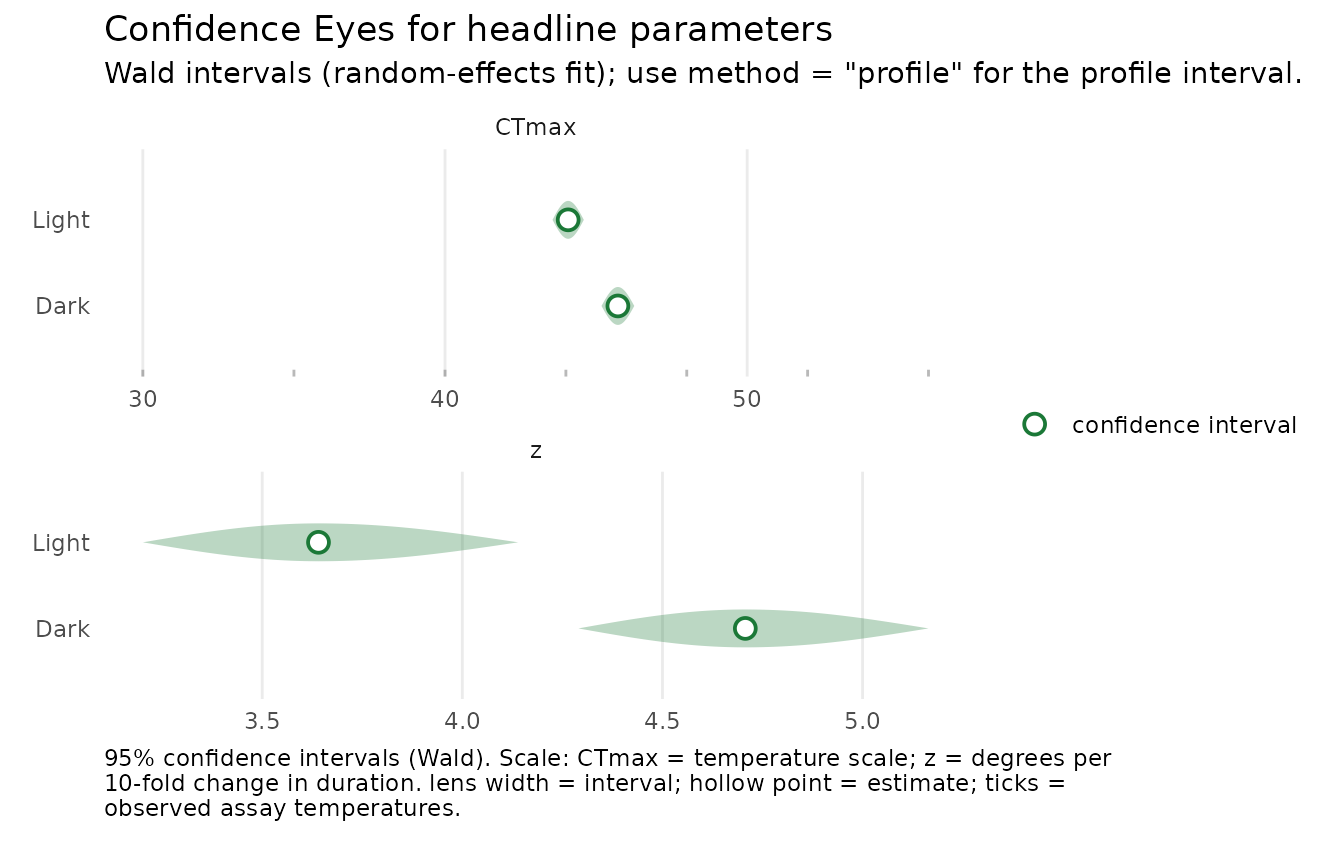
This sublethal endpoint reports only CTmax and
z; Tcrit is not a valid headline quantity
here. Inspect convergence, Hessian/gradient diagnostics, the Beta
boundary warning, and the limited-random-intercept assumptions before
interpretation.
Licence boundary
Arnold et al. (2026; doi:10.64898/2026.04.09.717599) release the current
source under CC BY-NC 4.0. Pieter A. Arnold, the data holder, authorised
its use as this package’s separately licensed teaching dataset. Retain
the source and licence notice when reusing it. See
inst/COPYRIGHTS and the licence ledger.