📖 Documentation & articles: https://itchyshin.github.io/drmSEM/
The drmSEM package is a distributional piecewise SEM framework built on drmTMB, where causal paths can target not only the expected response but also scale, shape, zero-inflation, hurdle probability, random-effect scale, and residual correlation.
Status: early / experimental (version 0.5.0). See Status.
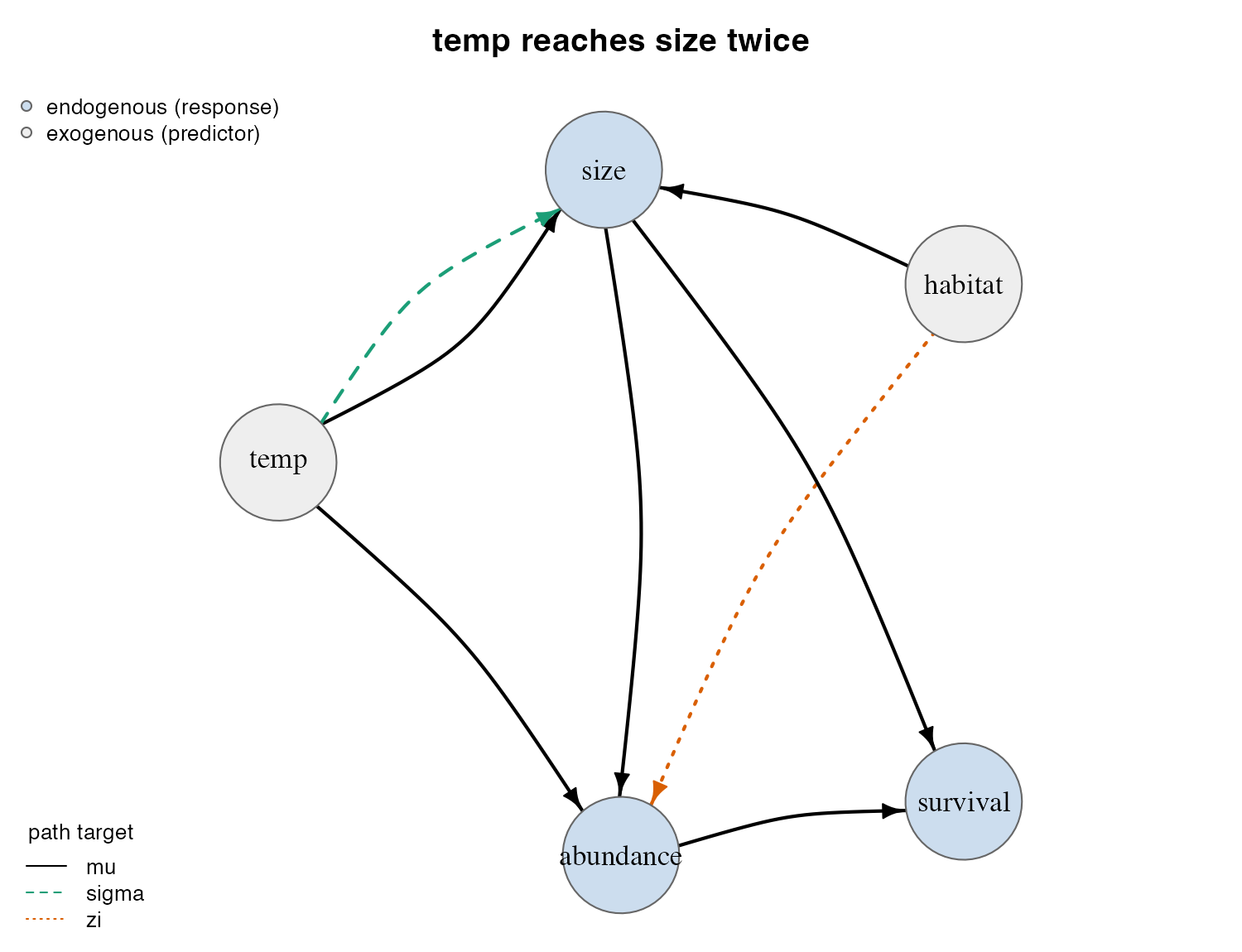
temp reaches size twice — a solid arrow into its mean, and a dashed arrow into its spread. Here is what that second arrow actually does:
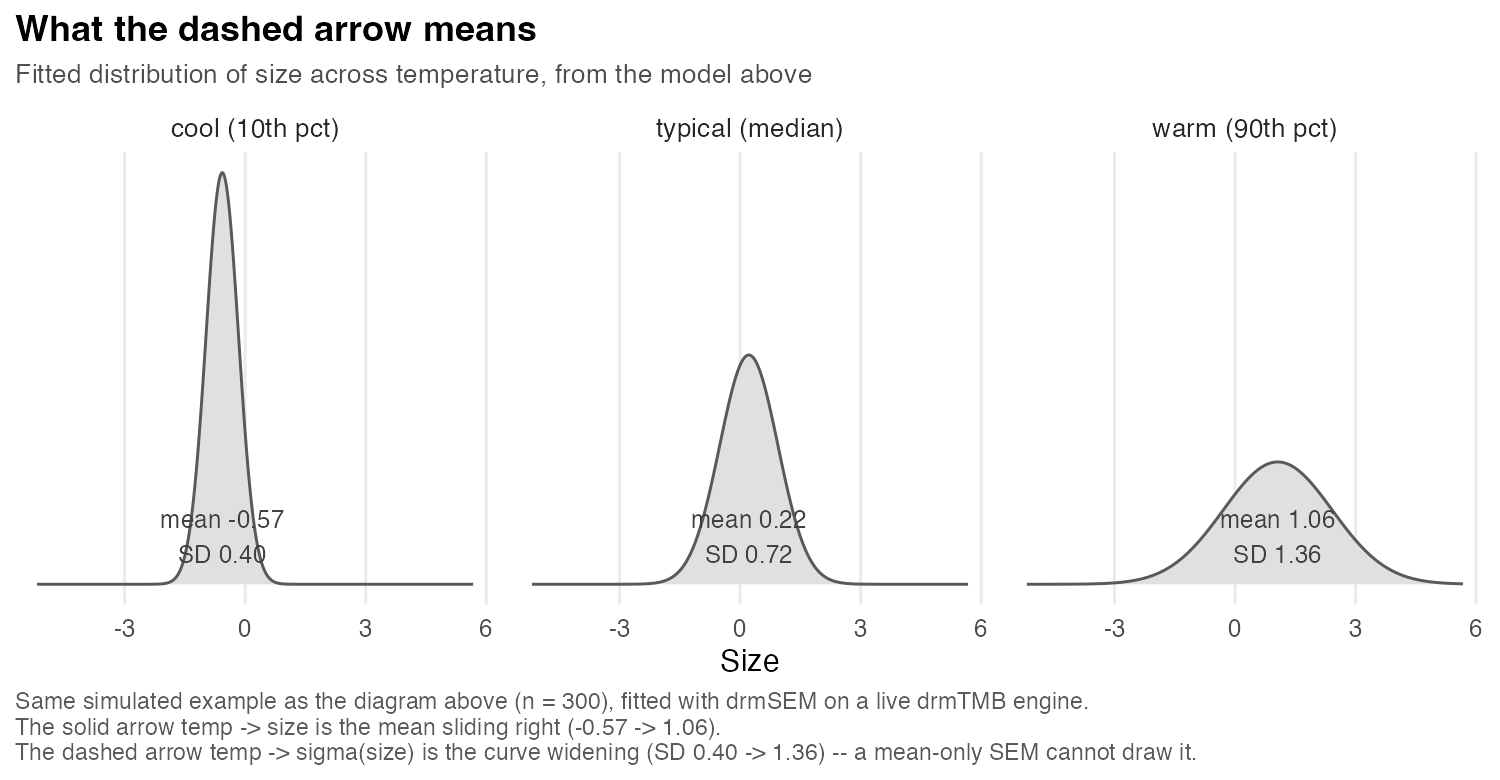
As temperature rises, size does not merely get larger — it gets more variable (SD 0.40 → 1.36). A mean-only SEM draws the first arrow and has no way to express the second. Both figures are the same fitted model.
That is the whole idea. A path may target sigma, nu, zi, hu, a random-effect scale, or a residual correlation, and paths() labels every edge by the component it targets. From there dsep() tests independence on any component, and indirect_effects() separates the part of an effect carried by a mediator’s mean from the part carried by its distribution. Reproduce both with Rscript tools/render-readme-sigma-edge.R.
Installation
drmSEM is built on the drmTMB fitting engine, which compiles TMB (C++) from source, so you need a working C++ toolchain (Rtools on Windows, Xcode command-line tools on macOS, a standard build toolchain on Linux). Install the engine first, then drmSEM:
Or with remotes:
# install.packages("remotes")
remotes::install_github("itchyshin/drmTMB")
remotes::install_github("itchyshin/drmSEM")
Why drmSEM
Engine / layer split. drmTMB is the fitting engine; drmSEM is the SEM layer on top of it. drmSEM never fits its own likelihoods. Each endogenous node is one drmTMB fit, the system is piecewise, and the graph must be a DAG.
Component-labelled paths. A causal path does not have to point at the mean. It can target any modelled distributional component of a node: mu, sigma, nu, zi, hu, sd(group), or rho12 (the residual correlation between the two responses of a bivariate node, i.e. eps_y1 <-> eps_y2 — not a directed y1 -> y2 path). For example, temperature can act on abundance through several distinct channels:
-
temp -> mu(abundance)— temperature shifts the expected abundance. -
temp -> sigma(abundance)— temperature changes the dispersion / scale, not the mean. -
temp -> zi(abundance)— temperature changes the probability of structural zeros, not the conditional mean.
These are different scientific claims, and drmSEM keeps them distinct everywhere: a path to sigma or zi is never reported as a mean effect.
Honest effects. Indirect and total effects are computed by Monte-Carlo g-computation over the fitted DAG (mean-mediated vs distribution-mediated), never by multiplying coefficients — coefficient products are invalid across non-Gaussian links and across distributional components. Effects are reported on the conditional (typical-group, random-effects-at-zero) response scale. The default direct is a controlled direct effect; the mean/distribution split is an interventional decomposition (the distribution-mediated row is a Jensen-gap term — Pearl; Imai et al.; VanderWeele), not a cross-world natural decomposition unless the outcome is linear with no exposure–mediator interaction (use effect = "natural" for that).
Compared to existing tools. lavaan does latent-variable Gaussian SEM; piecewiseSEM does piecewise SEM but works on the mean only; glmmTMB fits rich distributional GLMMs but is not an SEM; dsem does dynamic SEM. drmSEM is the piece that lets a piecewise SEM address scale, shape, zero-inflation, hurdle, random-effect scale, and residual correlation as first-class causal targets. Unmeasured confounding can be projected with latent = (MAG m-separation on the observed graph); that is not FIML and not a joint latent-variable likelihood.
Quick start
The question. Suppose body size, local abundance, and survival form a chain, and you want to know: does temperature reach survival only by shifting the average size and abundance, or also by changing how variable size is and how often abundance collapses to zero? A mean-only SEM cannot even ask the second half of that question. drmSEM can, because a path can target a non-mean component.
The canonical example below encodes that chain: size -> abundance -> survival, with temp acting on the sigma (scale) of size and habitat on the zi (zero-inflation) of abundance. This block is illustrative and not executed here; the drmSEM intro vignette runs the same chain end to end with simulated data.
library(drmSEM)

sem <- drm_sem(
  size      = drm_node(drmTMB::bf(size ~ temp + habitat, sigma ~ temp),
                       family = stats::gaussian()),
  abundance = drm_node(drmTMB::bf(abundance ~ size + temp, zi ~ habitat),
                       family = drmTMB::nbinom2()),
  survival  = drm_node(drmTMB::bf(cbind(alive, dead) ~ abundance + size),
                       family = drmTMB::beta_binomial()),
  data = dat
)

paths(sem)        # component-labelled path table
basis_set(sem)    # independence claims implied by the DAG
dsep(sem)         # any-component LRT for each claim
fisher_c(sem)     # Fisher's C goodness-of-fit for the SEM

# Effects of temperature on survival, propagated through the fitted DAG
direct_effects(sem,   from = "temp", to = "survival")
indirect_effects(sem, from = "temp", to = "survival")
total_effects(sem,    from = "temp", to = "survival", method = "simulate")

plot(sem)         # DAG with component-labelled edges
Reading the output. indirect_effects() returns one row per quantity, each an effect on the response (here, probability) scale:
-
total_path— the full effect oftemponsurvivalthrough the chain; -
direct— the controlled direct effect (mediators held fixed); -
indirect—total_path - direct; -
mean_mediated— the part carried by mediator means; -
distribution_mediated— the extra part that appears only when mediators pass realized draws, i.e. signal flowing through theirsigma,zi, ornu(indirect ≈ mean_mediated + distribution_mediated).
The distribution_mediated row is the answer to the second half of our question: if it is clearly non-zero, temperature reaches survival partly by changing the spread of size and the zeros of abundance, not only their means. A mean-only SEM would report that channel as zero or fold it silently into the mean; drmSEM keeps it visible and correctly labelled. (Effects are computed by Monte-Carlo g-computation, so honest numbers require the fitted engine — see the vignette for a worked run.)
More
-
Outcome functionals & tail analytics. Target causal effects directly on non-mean response functionals: exceedance tail risk (
target = "p_gt"), zero probabilities (target = "p_zero"), variance (target = "var"), or quantiles (target = "quantile",prob = 0.50), with closed-form analytic forms (functional = "analytic") and cross-world natural mediation. -
Cluster bootstrap & population integration. Evaluate non-parametric parameter uncertainty via full cluster/block refit bootstrap (
uncertainty = "bootstrap",R = 500) and integrate out random effects to compute population-averaged marginal effects (population = "marginal") using Gauss-Hermite quadrature. -
Model selection. Define a candidate set with
drm_dag()/drm_model_set(), thencompare()/best()/average()to rank and model-average competing DAGs by CBIC or CICc. Seevignette("comparison"). -
Latent & MIMIC measurement models. Construct formative, reflective, and MIMIC measurement blocks with
drm_latent()anddrm_indicator(). Quantify construct reliability with Cronbach’s (drm_cronbach_alpha()) and Raykov’s composite (drm_raykov_rho()), and separateloadings(sem)from structuralpaths(sem). Seevignette("latent-variables"). -
Covariance cliques & K >= 3 partitioning. Declare residual and random-effect covariance edges with
covary()orcovary_clique(). Bron-Kerbosch maximal clique detection (covariance_cliques()) automatically suppresses spurious within-clique independence claims inbasis_set()/dsep(). Seevignette("covariance-edges-and-composites"). -
Latent confounding (MAG m-separation). Name marginalised latents with
latent =ondrm_sem()/drm_psem().basis_set()/dsep()then test m-separation on the implied MAG (Richardson & Spirtes 2002 Cor. 5.3 anteriors; empty selection set). This is a graph projection onto a piecewise observed SEM, not FIML and not a reflective measurement model. Selection latents are not supported. Seedocs/design/14-m-separation.md. -
Bivariate nodes.
drm_pair()declares a joint two-response node with a residualrho12(and higher-levelcorpair) correlation.drm_sem()fits one bivariatedrmTMBmodel;rho12()then returns the estimated coefficients (intercept and anyrho12 ~ xpredictors) on thetanhlink. An unfitted declaration still reportsNA, never a fabricated number.plot(show = "all")draws residual / higher-level edges as double-headed / dashed arcs. Seevignette("bivariate-nodes"). -
Feedback / cyclic models. Declare a reciprocal motif with
drm_cycle()/feedback =(undeclared cycles stay an error);total_effects()then reports the system’s equilibrium effect by multi-component Banach fixed-point iteration, audited by spectral radius () and Lipschitz contraction diagnostics. Node-wise fitting of a cycle is inconsistent under simultaneity — drmSEM warns and never fakes consistency. Seevignette("feedback-cycles"). -
Missing data & graph-derived imputation. Automatically derive missing mediator models from the causal DAG with
drm_sem(impute = "auto"). Supports continuous (gaussian,Gamma,lognormal,student,beta) and discrete (poisson,nbinom2,ZIP,beta_binomial) families, with multi-parent () support and detailed diagnostics (imputation(),imputed()). Seevignette("missing-data"). -
Symbolic equation rendering. Walk fitted SEMs in topological order and render publication-quality LaTeX equations via
symbolize(sem)andas_latex()(integrating withsymbolizer). Seevignette("equations-via-symbolizer"). -
Interoperability.
as_lavaan()/from_lavaan()exchange the graph with lavaan model syntax (non-mean distributional paths are dropped with notice, never misrepresented), andas_dot()exports a Graphviz diagram. Graph interchange only — drmSEM never fits its own likelihoods. -
Path attribution.
path_effects()splits an indirect effect by mediator (inclusion / exclusion) and by distributional component (mean / sigma / zi), with a cross-world natural variant and recanting-witness flag. -
Phylogenetic SEM. Build an evolutionary relatedness matrix with
drm_phylo_cov()and feed it to a node viarelmat(). Seevignette("phylogenetic-sem").
Status
Early and experimental. The kernel logic — d-separation bookkeeping, the any-component LRT and Fisher’s C, and the simulation-based effect calculus — is validated by recovery tests that run without the engine. MAG m-separation under latent = is partial: Cor. 5.3 anterior projection with empty selection set, no selection latents, residual compositional-graphoid question (OQ-16). The full drmTMB-integration path (fitting nodes end to end) is validated in the cloud / CI environment where drmTMB is compiled and installed. APIs may change before a stable release.
Methodological background
drmSEM builds on a number of distinct literatures and is rigorous about crediting them at the point of use (see the @references blocks on each help page and the bibliography: of each vignette). The canonical entry points are:
- piecewise SEM and local-likelihood d-separation — Shipley (2000, 2009,
- and Lefcheck (2016,
piecewiseSEM);
- and Lefcheck (2016,
- d-separation as a graphical criterion — Pearl (2009);
- ancestral graphs and m-separation — Richardson & Spirtes (2002), Sadeghi & Lauritzen (2014), Lauritzen & Sadeghi (2018);
- counterfactual mediation — Pearl (2001), Robins & Greenland (1992), Imai et al. (2010), VanderWeele (2014, 2015), Vansteelandt & Daniel (2017);
- distributional regression — Rigby & Stasinopoulos (2005, GAMLSS), Brooks et al. (2017,
glmmTMB); - phylogenetic comparative methods — Felsenstein (1985), Martins & Hansen (1997), Pagel (1999), van der Bijl (2018,
phylopath), Thorson & van der Bijl (2023,phylosem); - information criteria on Fisher’s C — Shipley (2013, CICc), Schwarz (1978, BIC), Burnham & Anderson (2002).
Three constructions inside the package are explicitly drmSEM contributions built on this foundation — the any-component d-separation test, the distribution-mediated effect row in indirect_effects(), and the BIC-style CBIC information criterion that is now the default in compare(). Each is flagged as such in its help page and the corresponding vignette, with the underlying components cited.
The bibliography lives in inst/REFERENCES.bib (and the JOSS-facing paper.bib); ?drmSEM lists the principal sources.