
S3 plot method for pigauto_pred objects, using base R
graphics. Three plot types are available: scatter plots of observed
vs predicted values, interval plots per species, and probability
charts for discrete traits.
Usage
# S3 method for class 'pigauto_pred'
plot(x, data = NULL, splits = NULL, type = "scatter", trait = NULL, ...)
Arguments
- x
An object of class
"pigauto_pred".- data
Optional numeric matrix or data.frame of observed values in original scale. Rows must match the predictions in
xone-for-one and in the same order; rows are paired by position, not matched by row names or species identifiers. Trait columns are selected by name. Values are overlaid on scatter and interval plots. For probability plots, class labels are used to group predictions; rows with missing or unrecognized labels are omitted from these groups.- splits
Optional list (output of
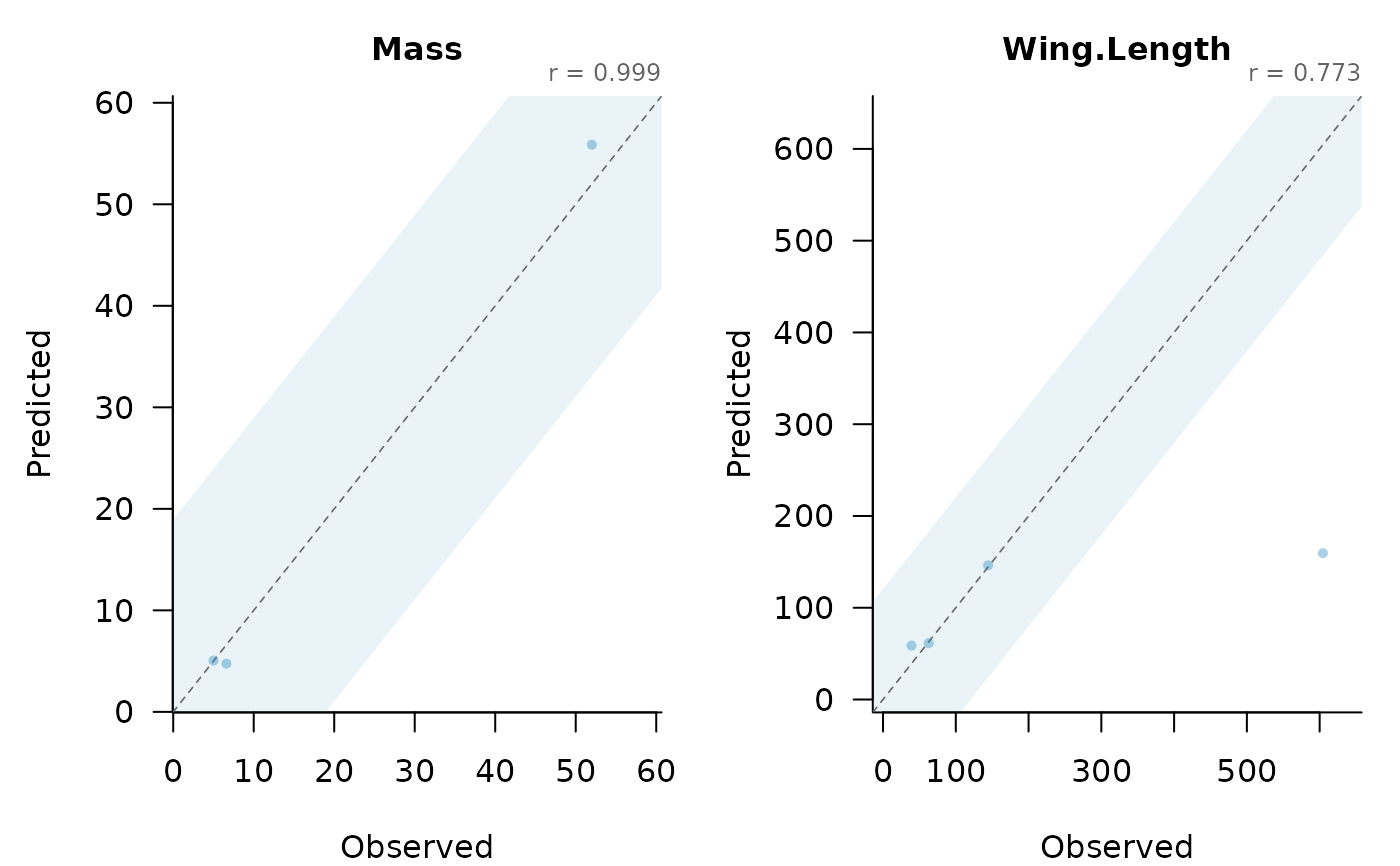
make_missing_splits). Currently unused by this plotting method. All finite pairs indataandx$imputedare plotted, so the scatter is not a held-out performance estimate. To display held-out cells, obtainpredict(fit, evaluation = TRUE), and supply a truth frame with every cell outside the desired validation/test subset set to NA.- type
Character.
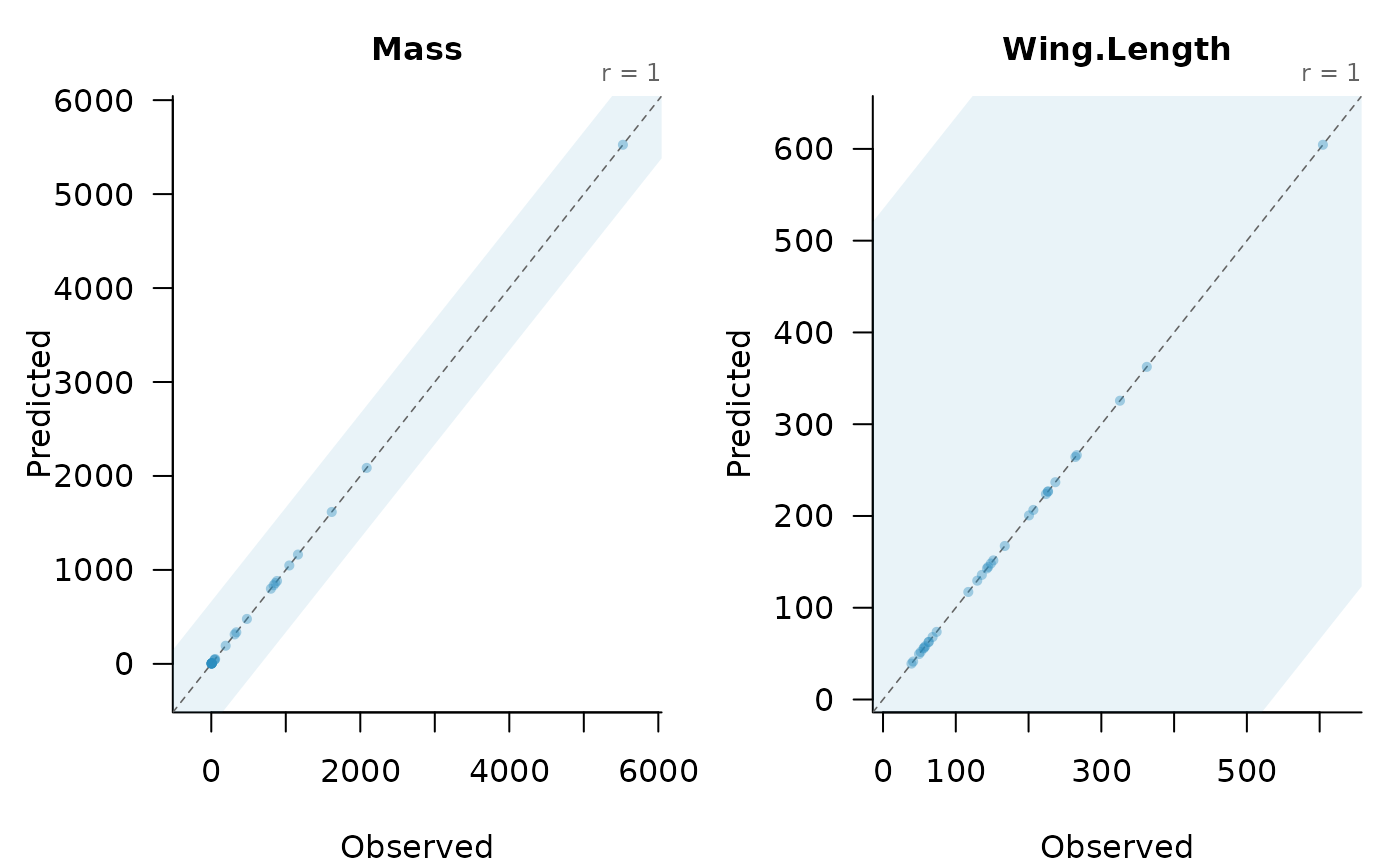
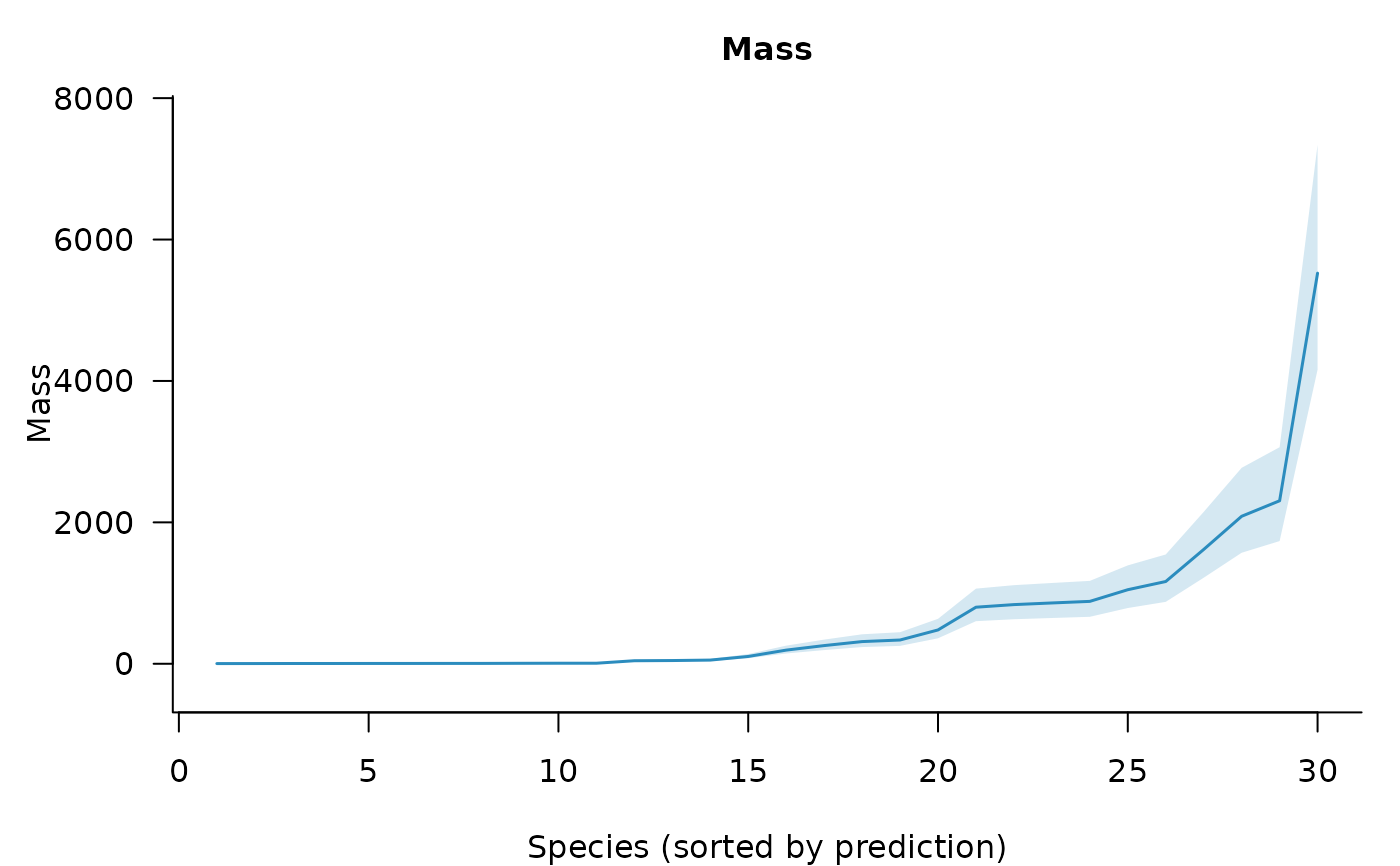
"scatter"(default): grid of observed-vs-predicted scatter plots for continuous, count, and proportion traits, with 1:1 line and conformal interval bands where available."intervals": for each trait, species sorted by predicted value with conformal-interval ribbon; observed values shown in red where available."probabilities": for binary traits, the probability of the second class level is shown in boxplots grouped by observed class when usable labels are present; otherwise a histogram shows the probabilities. For categorical traits, usable labels give stacked bars of mean predicted probabilities by observed class; without usable labels, stacked bars show up to 100 observations, ordered by their most probable class. These plots are descriptive: grouping by observed class does not itself assess calibration. Unless the predictions are for cells held out from fitting anddatasupplies their truth, they are not held-out performance assessments. To inspect held-out predictions, usepredict(fit, evaluation = TRUE)and provide a truth frame with all other cells set toNA. Select only traits with at least one usable held-out class label; otherwise the fallback plot uses predictions without restricting them to held-out cells.- trait
Character vector of trait names to plot. If
NULL(default), all traits appropriate for the chosentypeare plotted.- ...
Additional arguments passed to base plotting functions.
Examples
# \donttest{
data(avonet300, tree300)
tree <- ape::keep.tip(tree300, tree300$tip.label[seq_len(30L)])
traits <- avonet300[match(tree$tip.label, avonet300$Species_Key),
c("Mass", "Wing.Length"), drop = FALSE]
rownames(traits) <- tree$tip.label
traits$Mass[seq_len(3L)] <- NA_real_
result <- impute(traits, tree, epochs = 5L, verbose = FALSE)
#> Warning: Small validation set for 2 trait(s): Mass (n=3), Wing.Length (n=4). Calibrated gate and conformal scores will be noisy for these trait(s). 95% split-conformal coverage is NOT achievable for 2 trait(s) with fewer than 19 validation cells (Mass (n=3), Wing.Length (n=4)): the achievable ceiling is n_val / (n_val + 1), which only reaches 0.95 at n_val >= 19. See `?fit_pigauto` under 'Calibration at small n' for smoothing options.
pred <- result$prediction
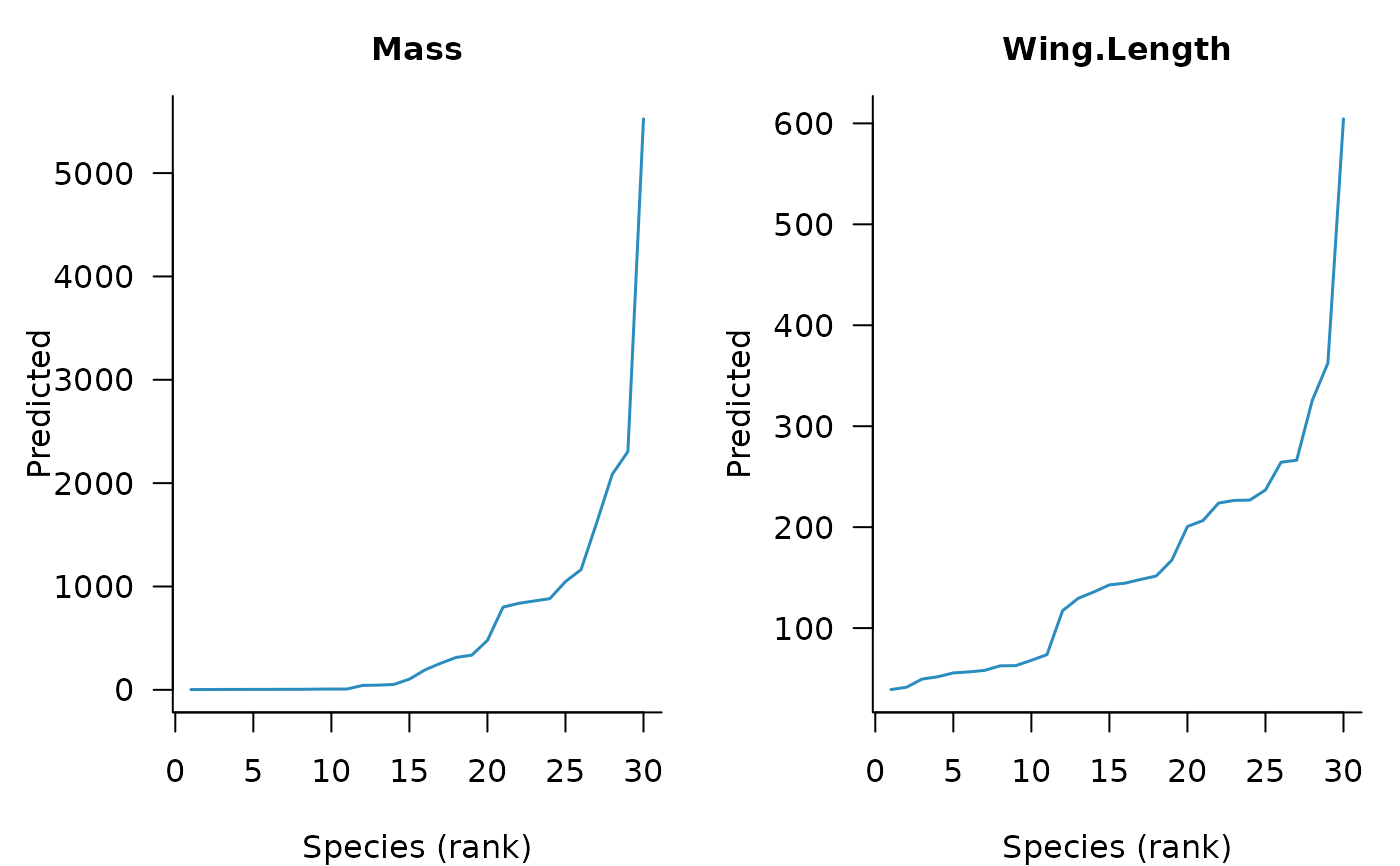
plot(pred)
 plot(pred, type = "scatter", data = traits) # descriptive all-finite pairs
 plot(pred, type = "intervals", trait = "Mass")
 # These two continuous traits each occupy one latent column.
evaluation_pred <- predict(result$fit, evaluation = TRUE)
heldout_truth <- as.matrix(traits)
heldout_truth[] <- NA_real_
idx <- result$fit$splits$test_idx
heldout_truth[idx] <- as.matrix(traits)[idx]
plot(evaluation_pred, type = "scatter", data = heldout_truth)
 # }