
Progression and evidence
This is an evidence history, not a release timeline. HSquared.jl currently has an experimental 0.9.0 release; the R-public public_covered_count is 7. Neither fact means production readiness, Julia General registration, or calibrated intervals. For applied work, begin in hsquared.
Where we are now
Read the live validation table for route-specific scope. A Julia engine row can be covered while its R formula, payload mapping, or public workflow remains planned or partial. The twin boundary explains that distinction before an applied claim is made.
Point estimates may be reported only inside the stated route scope. Intervals and standard errors do not have a shared coverage guarantee: inspect each route's claim boundary rather than borrowing evidence from a neighbour.
How a route earns its label
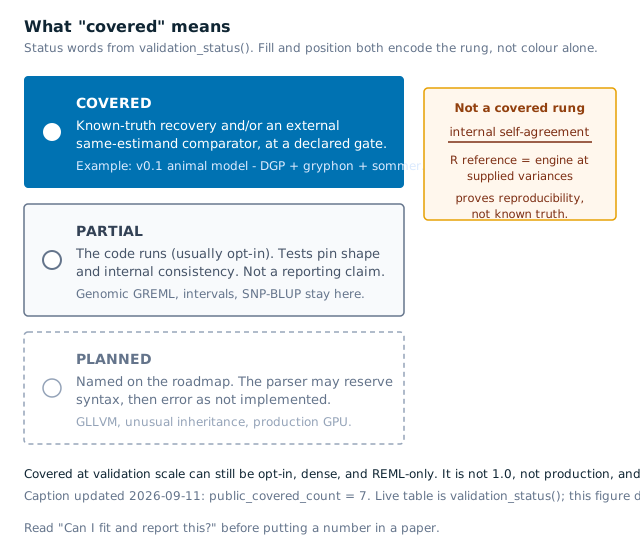
A route moves from planned to partial when a bounded implementation and its limits are recorded. Covered is a stronger, scoped evidence label: it does not widen the route, make it default, or settle interval calibration. The validation table gives the current evidence and the audience/comparator page explains why comparison must match the estimand.
Historical milestones, each with a boundary
0.1 contract — June 2026 foundation. Pedigree normalization and sparse
Ainvwere established as engine utilities, while the narrow R formula contract still stopped honestly at the bridge boundary. This is the starting contract, not a production fitting claim; see the 0.1 contract and its pedigree/Ainv record.Early 0.2–0.4 development — June–July 2026. Two-effect, arbitrary-N independent-effect, k=2 random-regression, and direct–maternal work each earned separate, bounded evidence. These are development milestones rather than asserted release tags; none transfers its evidence to another model or to production scale. See the two-effect record, arbitrary-N R-surface record, k=2 random-regression evidence, and direct–maternal record.
0.5.0 — later experimental numbering marker. The project moved its experimental numbering from
0.0.1to0.5.0without claiming a production engine or Julia General registration. This does not rewrite the separate R-package release history, including its verified v0.1.0 GitHub release. See the 0.5.0 changelog.0.6.0 — R-public multivariate milestone. The R-public count changed from 5 to 6, while the engine multivariate row was already covered. This is a public-surface milestone, not a new engine promotion or universal multivariate reporting permission. See the 0.6.0 record.
0.7.0 — genomic GREML milestone. The R-public count changed from 6 to 7. It does not turn every genomic route, interval, or sparse path into a covered default. See the 0.7.0 changelog and the live genomic rows.
0.8.0 — engine FA and single-step pillars. The named engine cells are deliberately narrow: FA is S4
t=4,K=1, positive Ledermann slack, interior uniqueness, and rotation-invariantG/R/ψ; single-step is H-scaleσ²a/σ²eunder ordinary defaults andG=A₂₂+0.05I. R factor-analytic grammar remains planned and R single-step remains opt-in partial. See the 0.8.0 changelog and current status.
What remains separate
Julia registry status, any future Julia-package release decision, interval calibration, production readiness, and future roadmaps are separate decisions. This page does not announce a release or change a status row. For technical plans, use the roadmap and developer pages; for an applied reporting decision, return to the twin boundary.